


AUD/USD jumps as hot CPI fuels RBA tightening bets



- AUD/USD surges after CPI beats estimates, lifting tightening expectations at the Reserve Bank of Australia.
- RBA Governor Michelle Bullock stresses patience as inflation pressures remain persistent.
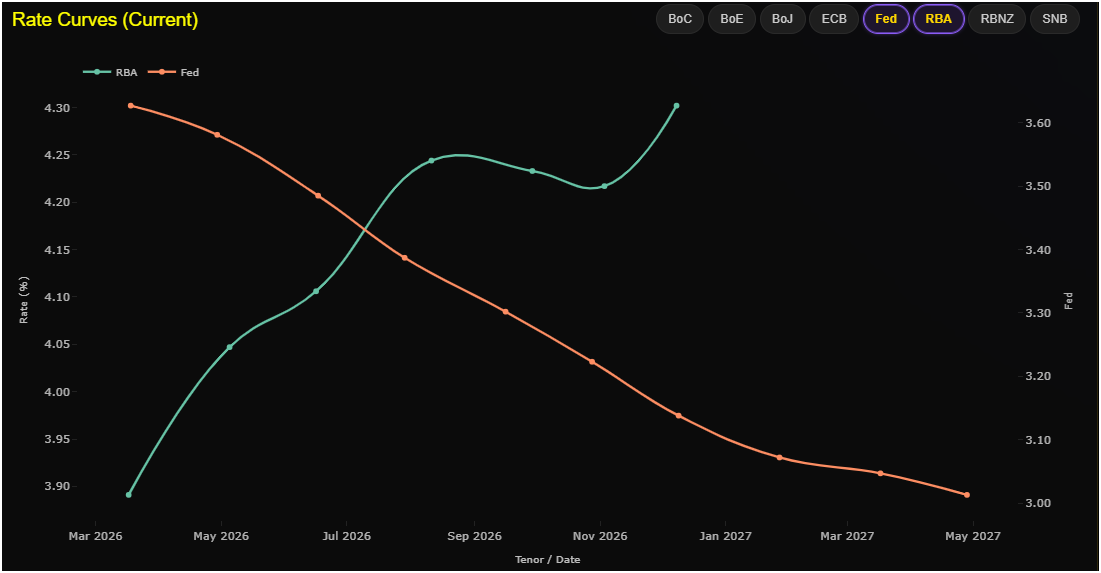
- Policy divergence widens as markets price Fed easing while anticipating further RBA hikes.
The Australian Dollar rallies over 0.80% against the US Dollar on Wednesday, courtesy of a red-hot inflation report, which increased speculation of further tightening by the Reserve Bank of Australia (RBA). At the time of writing, the AUD/USD trades at 0.7118 after bouncing off daily lows of 0.7057.
AUD/USD shrugs-off Fed comments as Aussie’s inflation rise
Market mood remains upbeat, a tailwind for the Aussie Dollar high-beta currency status, as it continues to outperform most G10 FX currencies. Traders waiting for NVIDIA earnings keep the market trading sideways, amid the lack of catalysts and US economic data releases.
Recently, Federal Reserve Regional Presidents Jeffrey Schmid and Thomas Barkin crossed the wires. Barkin said that “rate policy can’t address disruption from AI.” Schmid was hawkish as he said that monetary policy is in a good place for the job market, though acknowledged that “we have work to do on the inflation side” of the Fed mandate.
Earlier during the Asian session, the Consumer Price Index (CPI) in Australia exceeded estimates in January, with core inflation reaching its highest level in over a year. Australia’s CPI rose 0.4% MoM, from the previous month above forecasts of 0.3%. On a yearly basis, headline prices rose by 3.8%, while the trimmed mean measure, sought as the favorite inflation gauge for the RBA, jumped from 3.3% to 3.4% YoY.
RBA Governor Michelle Bullock commented that the state of the economy has changed rapidly since mid-2025, when the disinflation process evolved and the economy was slowing.
Since then, a strong jobs report prompted the RBA to hike rates 25 basis points, earlier this month, to 3.85%.
Governor Michelle Bullock emphasized the need for patience in addressing persistent inflationary pressures, highlighted that navigating the current economic landscape requires a careful and measured approach, as the RBA must maintain a delicate balance between achieving price stability and supporting the labor market.
Markets priced in a hawkish RBA and a dovish Fed
Divergence between the Fed and the RBA should keep the AUD/USD leaning on the bullish side. The Fed is expected to reduce rates by 51 bps towards the year end, according to the swaps market, while the RBA is projected to raise rates by 45 bps. Hence, the Aussie Dollar is expected to extend its gains aside from a deterioration in market sentiment.
Ahead this week, the Aussie’s docket will feature Capital Expenditure, which is expected to come at 0%. The US calendar will include additional speeches from Federal Reserve officials, along with the release of Initial Jobless Claims data on Thursday.
AUD/USD Price Forecast: Technical outlook
In the daily chart, AUD/USD trades at 0.7120. The near-term bias is bullish as price holds above clustered simple moving averages around 0.6860 and continues to respect the steeper rising trend line that has guided the advance from the 0.6897 region. RSI at 65 keeps momentum in positive territory without signaling exhaustion, reinforcing buyer control after the pair bounced repeatedly from the ascending support structure connecting recent higher lows.
Immediate support emerges near 0.7050, where the shorter-term rising trend line and recent reaction lows converge, followed by stronger backing at 0.7000 and then the broader trend support zone starting around 0.6900. On the topside, initial resistance is now at 0.7150, ahead of 0.7200, where a break would extend the bullish sequence and open the way toward 0.7300 as the next upside objective.
(The technical analysis of this story was written with the help of an AI tool.)
Economic Indicator
Trimmed Mean CPI (YoY)
The Trimmed Mean Consumer Price Index (CPI), released by the Australian Bureau of Statistics on a monthly basis, is a measure of underlying inflation. The Trimmed mean is calculated using a weighted average of percentage change from the middle 70% of the distribution of all CPI components in order to smooth the data from the more-volatile items. The YoY reading compares prices in the reference month to the same month a year earlier. Generally, a high reading is seen as bullish for the Australian Dollar (AUD), while a low reading is seen as bearish.
Last release: Wed Feb 25, 2026 00:30
Frequency: Monthly
Actual: 3.4%
Consensus: 3.3%
Previous: 3.3%
Source: Australian Bureau of Statistics
Recommended Articles









Comments (0)
Click the $ button, enter the symbol, and select to link a stock, ETF, or other ticker.