


EUR/USD eases from 1.1850 as ECB’s Lagarde hints at an early departure



- EUR/USD remains close to weekly lows at 1.1805 with upside attempts capped around 1.1850.
- News reports suggest that ECB's Lagarde will step down before the end of her term.
- Market volatility remains subdued with all eyes on the Fed's minutes.
The Euro (EUR) remains on its back foot against the US Dollar (USD) this week. The pair’s recovery attempts from the 1.1805 lows were capped below 1.1850, and the common currency eased to the 1.1835 area, amid rumours that European Central Bank (ECB) President Christine Lagarde plans to leave the bank before the end of her term in October 2027.
A Financial Times report released on Wednesday states that Lagarde is considering stepping down as president of the ECB ahead of the French elections, due in May 2027, to give French President Emmanuel Macron and German Chancellor Merz the chance to select her successor.
This news has stirred an otherwise dozy market, with investors on a wait-and-see stance ahead of the release of the minutes of the Federal Reserve’s January meeting, due later on Wednesday. This report, together with the US Q4 Gross Domestic Product (GDP) and January's Personal Consumption Expenditures (PCE) Price Index, due on Friday, is likely to set the pair's near-term direction.
Technical Analysis: EUR/USD remains vulnerable below the reverse trendline
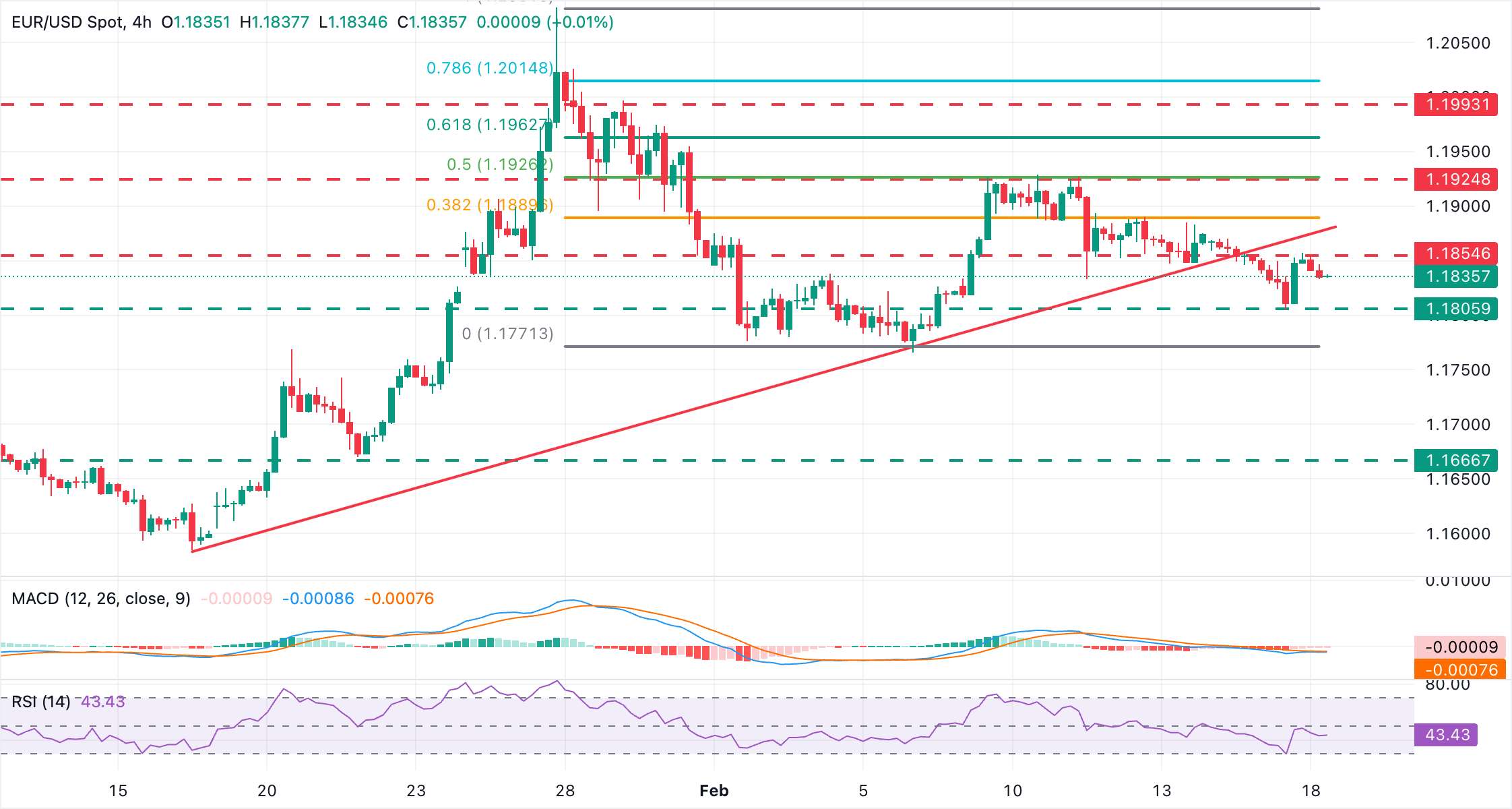
EUR/USD has found support in the 1.1800 area, but the immediate trend remains bearish, while below the broken trendline, now in the vicinity of 1.1880. Indicators in the 4-hour chart remain moderately negative. The Moving Average Convergence Divergence (MACD) line remains below zero, and the Relative Strength Index (RSI) sits at 43, beneath the midline, consistent with a soft tone.
Resistance aligns at 1.1855, is holding bulls for now ahead of the 1.1880-1.1890 area where the mentioned trendline and the February 12 nd 13 highs meet the 38.2 Fibonacci retracement of the late January selloff.
On the downside, immediate support is at Tuesday's low of 1.1805, which closes the path to the February 6 low, at 1.1765.
(The technical analysis of this story was written with the help of an AI tool.)
ECB FAQs
The European Central Bank (ECB) in Frankfurt, Germany, is the reserve bank for the Eurozone. The ECB sets interest rates and manages monetary policy for the region. The ECB primary mandate is to maintain price stability, which means keeping inflation at around 2%. Its primary tool for achieving this is by raising or lowering interest rates. Relatively high interest rates will usually result in a stronger Euro and vice versa. The ECB Governing Council makes monetary policy decisions at meetings held eight times a year. Decisions are made by heads of the Eurozone national banks and six permanent members, including the President of the ECB, Christine Lagarde.
In extreme situations, the European Central Bank can enact a policy tool called Quantitative Easing. QE is the process by which the ECB prints Euros and uses them to buy assets – usually government or corporate bonds – from banks and other financial institutions. QE usually results in a weaker Euro. QE is a last resort when simply lowering interest rates is unlikely to achieve the objective of price stability. The ECB used it during the Great Financial Crisis in 2009-11, in 2015 when inflation remained stubbornly low, as well as during the covid pandemic.
Quantitative tightening (QT) is the reverse of QE. It is undertaken after QE when an economic recovery is underway and inflation starts rising. Whilst in QE the European Central Bank (ECB) purchases government and corporate bonds from financial institutions to provide them with liquidity, in QT the ECB stops buying more bonds, and stops reinvesting the principal maturing on the bonds it already holds. It is usually positive (or bullish) for the Euro.
Recommended Articles









Comments (0)
Click the $ button, enter the symbol, and select to link a stock, ETF, or other ticker.