


USD/CHF declines as soft US data and bearish technicals weigh on pair



- USD/CHF drifts lower as soft US claims data caps Dollar recovery after strong NFPs.
- Technical bias remains bearish, with RSI aligned to signal sustained downside momentum.
- Break below 0.7600 exposes 0.7550 and 0.7500, while rebounds face resistance near 0.7780.
The Swiss Franc continued to appreciate versus the Greenback on Thursday, following a slightly soft US jobs report overshadowed by Wednesday’s Nonfarm Payrolls print. Despite this, the Greenback, has failed to rally and USD/CHF trades at 0.7700 down 0.22%.
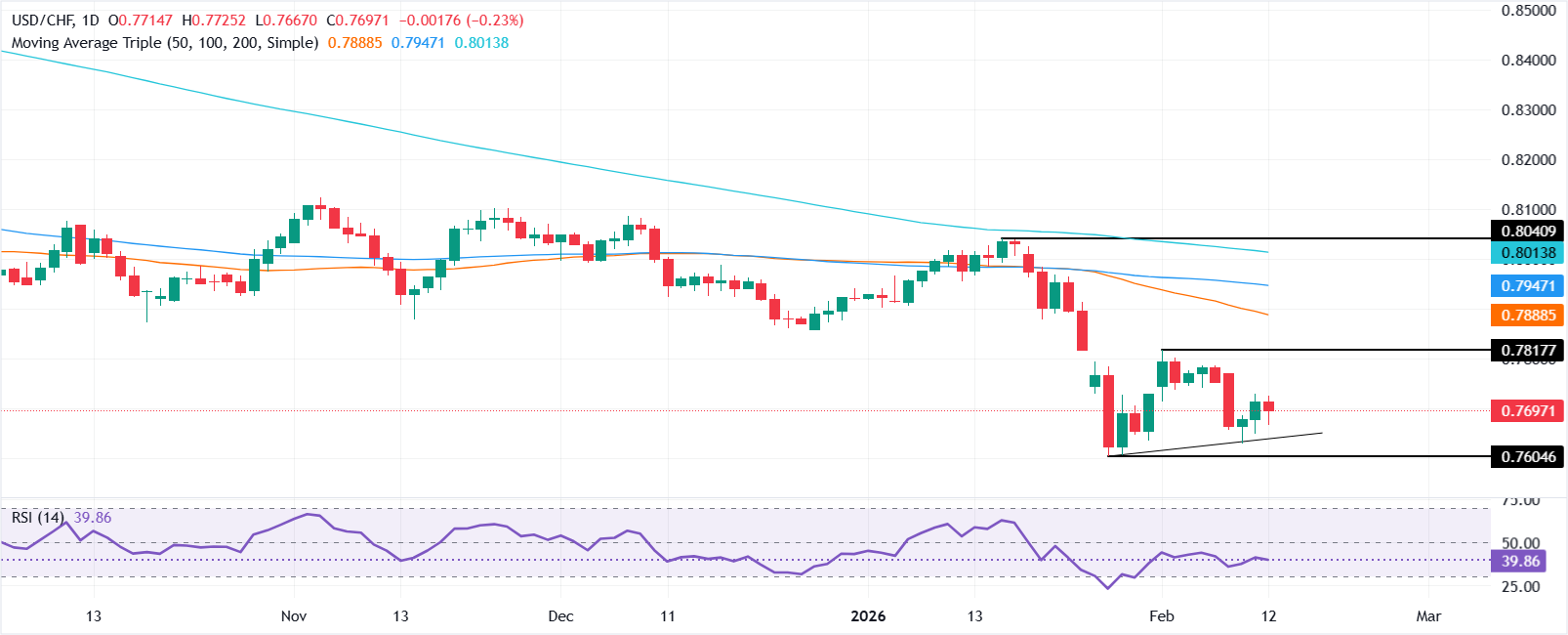
USD/CHF Price Forecast: Technical outlook
The technical picture shows the USD/CHF is downward biased, with momentum in sync as depicted by the Relative Strength Index (RSI).
Although the USD/CHF bottomed out at around 0.7600 and recovered towards 0.7800, the pair has already registered a lower high, paving the way for further downside. Since peaking, the pair edged towards0.7627 before resuming upwards, and for the last three trading days, it has consolidated within 0.7600-0.7700.
For a bearish continuation, sellers must clear 0.7600 which could open the door for further downside. The first key support level would be 0.7550, followed by 0.7500.
Conversely, if USD/CHF surpasses 0.770, the first resistance would be the 20-day Simple Moving Average (SMA) at 0.7780. A breach of the latter will expose 0.7800, followed by the December 24 daily low turned resistance at 0.7861. Up next, lies 0.7900.
USD/CHF Daily Chart
US Dollar Price Today
The table below shows the percentage change of US Dollar (USD) against listed major currencies today. US Dollar was the strongest against the Australian Dollar.
| USD | EUR | GBP | JPY | CAD | AUD | NZD | CHF | |
|---|---|---|---|---|---|---|---|---|
| USD | 0.02% | -0.01% | -0.21% | 0.27% | 0.40% | 0.19% | -0.23% | |
| EUR | -0.02% | -0.03% | -0.22% | 0.25% | 0.37% | 0.17% | -0.25% | |
| GBP | 0.01% | 0.03% | -0.19% | 0.29% | 0.41% | 0.20% | -0.22% | |
| JPY | 0.21% | 0.22% | 0.19% | 0.47% | 0.60% | 0.36% | -0.02% | |
| CAD | -0.27% | -0.25% | -0.29% | -0.47% | 0.13% | -0.09% | -0.50% | |
| AUD | -0.40% | -0.37% | -0.41% | -0.60% | -0.13% | -0.20% | -0.62% | |
| NZD | -0.19% | -0.17% | -0.20% | -0.36% | 0.09% | 0.20% | -0.42% | |
| CHF | 0.23% | 0.25% | 0.22% | 0.02% | 0.50% | 0.62% | 0.42% |
The heat map shows percentage changes of major currencies against each other. The base currency is picked from the left column, while the quote currency is picked from the top row. For example, if you pick the US Dollar from the left column and move along the horizontal line to the Japanese Yen, the percentage change displayed in the box will represent USD (base)/JPY (quote).
Recommended Articles








Comments (0)
Click the $ button, enter the symbol, and select to link a stock, ETF, or other ticker.