


Bank of Japan set to keep interest rates on hold for the fifth consecutive meeting in September



- The Bank of Japan is widely expected to keep interest rates unchanged at 0.5% for the fifth consecutive meeting on Friday.
- The central bank is likely to wait for Japan’s political uncertainty to fade before hiking interest rates further.
- Markets will be attentive to the BoJ statement, looking for signals of further monetary tightening in October or December.
The Bank of Japan (BoJ) is widely expected to leave its benchmark interest rate unchanged at 0.5% after concluding its two-day September monetary policy meeting on Friday.
BoJ policymakers have reiterated their commitment to hike interest rates further amid the growing inflationary pressure. Still, the bank might wait for the Japanese political uncertainty to fade before resuming its monetary policy normalisation cycle.
Investors will be attentive to BoJ Governor Kazuo Ueda’s press conference to confirm the bank’s commitment to monetary tightening, with Ueda’s comments likely to set the Japanese Yen’s (JPY) near-term direction.
What to expect from the BoJ interest rate decision?
The BoJ is widely expected to maintain its monetary policy unchanged for the fifth consecutive meeting in September.
A trade deal with the United States (US) has eased trade uncertainty and improved the outlook of a strongly trade-oriented economy. Nevertheless, some BoJ officials have warned that it is still too early to assess the impact of US tariffs on Japan’s economy, asking for more time before hiking rates further.
In the meantime, Prime Minister Shigeru Ishiba rattled markets, announcing his departure on September 7, following the defeat in July’s election. Ishiba’s resignation has led the country into a period of political uncertainty that is expected to be resolved at the ruling Liberal Democratic Party (LDP) internal elections on October 4.
Five LDP figures have emerged as potential replacements for Ishiba, with the former economic minister, Sanae Sakaichi, standing out as an active supporter of loose monetary policies, who might pressure the central bank to remain cautious with monetary tightening.
Back to the macroeconomic front, recent data support the BoJ’s hiking plans. Gross Domestic Product (GDP) data revealed that economic growth accelerated in the second quarter, driven by strong exporting activity, while the Unemployment Rate fell to a nearly five-year low of 2.3% in July, with nominal wages growing and pushing inflation higher.
The advanced Tokyo Consumer Price Index (CPI) showed mixed data, with the yearly inflation cooling to 2.6% in August from the previous 2.9% reading, but with the core CPI, which excludes fresh food and energy prices, remaining sticky at 3%.
The stronger-than-expected Japanese trade balance figures reported earlier this week have highlighted the resilience of the exporting sector. The decline in shipments to the US has been offset by increases in trade with Asian and European countries, allowing for a moderately optimistic view about the economic outlook.
How could the Bank of Japan's monetary policy decision affect USD/JPY
Against this backdrop, investors are likely to accept a wait-and-see stance on Friday, with the BoJ keeping interest rates unchanged. Notwithstanding, they will be looking for signals that the option of a rate in late October or December, as the latest, remains on the table. The Japanese Yen might suffer otherwise.
The JPY has strengthened against a softer US Dollar (USD) since late July, when the USD/JPY pair peaked above the 150.00 mark, favoured by narrowing US-Japan yield spreads and investors positioning for a Fed rate cut in September.
In Japan, Governor Ueda reaffirmed the central bank’s plan to gradually tighten its monetary policy in a regular meeting with Prime Minister Ishiba earlier this month. Ueda assured that there is “no change in the stance of rising rates if economy, prices move in line with forecasts.”
Apart from that, the Federal Reserve’s (Fed) dovish turn, confirmed on Wednesday after the US central bank cut rates by 25 basis points as widely anticipated, has highlighted a JPY-supportive monetary policy divergence that will be checked on Friday. The Yen has rallied nearly 3% against the US Dollar from late July lows, although the USD is firming up as we head into the BoJ’s decision.
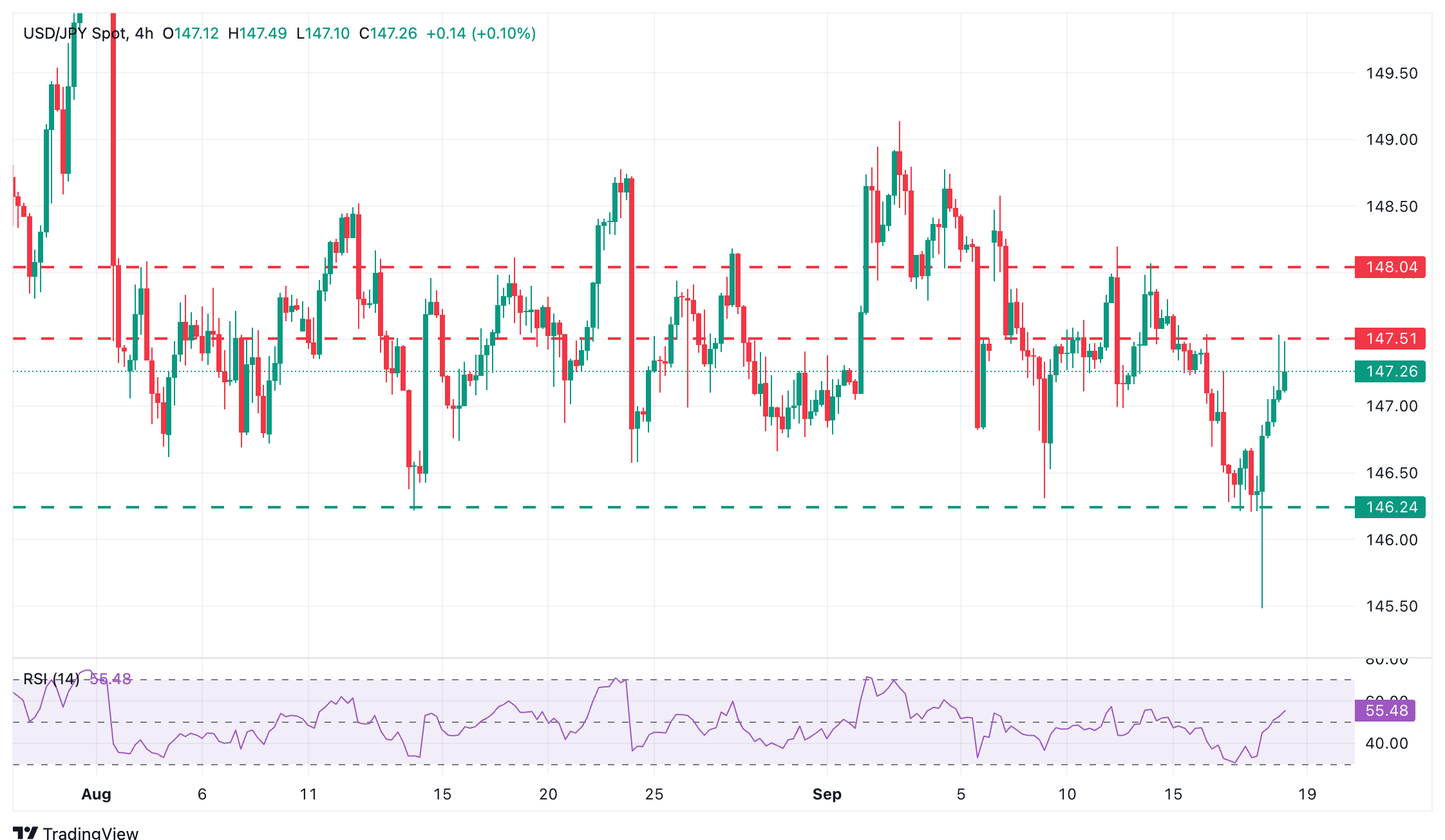
From a technical standpoint, Haresh Menghani, analyst at FXstreet, points to the resistance area ahead of 147.50 as the level to bet for bulls: "The USD/JPY pair is likely to confront stiff resistance near the 147.40-147.50 region. That said, a sustained strength beyond the said barrier has the potential to lift spot prices to the 148.00 mark en route to the 200-day Simple Moving Average (SMA), currently pegged near the 148.75 zone, the 149.00 mark, and the monthly high, around the 149.15 region.”
To the downside, Menghani sees 146.20 and 146.00 as the key support area: “On the flip side, any meaningful slide might continue to find some support near the 146.20 region ahead of the 146.00 mark. A convincing break below the latter would expose the overnight swing low, around the 145.50-145.45 region, below which the USD/JPY pair could accelerate the fall towards challenging the 145.00 psychological mark.”
USD/JPY 4-hour Chart
Japanese Yen Price This week
The table below shows the percentage change of Japanese Yen (JPY) against listed major currencies this week. Japanese Yen was the strongest against the New Zealand Dollar.
| USD | EUR | GBP | JPY | CAD | AUD | NZD | CHF | |
|---|---|---|---|---|---|---|---|---|
| USD | -0.90% | -0.69% | -0.25% | -0.47% | -0.12% | 0.73% | -1.12% | |
| EUR | 0.90% | 0.24% | 0.63% | 0.44% | 0.83% | 1.61% | -0.22% | |
| GBP | 0.69% | -0.24% | 0.42% | 0.20% | 0.59% | 1.36% | -0.57% | |
| JPY | 0.25% | -0.63% | -0.42% | -0.26% | 0.16% | 0.96% | -0.87% | |
| CAD | 0.47% | -0.44% | -0.20% | 0.26% | 0.46% | 1.17% | -0.78% | |
| AUD | 0.12% | -0.83% | -0.59% | -0.16% | -0.46% | 0.77% | -1.08% | |
| NZD | -0.73% | -1.61% | -1.36% | -0.96% | -1.17% | -0.77% | -1.91% | |
| CHF | 1.12% | 0.22% | 0.57% | 0.87% | 0.78% | 1.08% | 1.91% |
The heat map shows percentage changes of major currencies against each other. The base currency is picked from the left column, while the quote currency is picked from the top row. For example, if you pick the Japanese Yen from the left column and move along the horizontal line to the US Dollar, the percentage change displayed in the box will represent JPY (base)/USD (quote).
Economic Indicator
BoJ Press Conference
The Bank of Japan (BoJ) holds a press conference at the end of each one of its eight scheduled policy meetings. At the press conference the Governor of the BoJ communicates with media representatives and investors regarding monetary policy. The Governor talks about the factors that affect the most recent interest rate decision, the overall economic outlook, inflation, and clues regarding future monetary policy. Hawkish comments tend to boost the Japanese Yen (JPY), while a dovish message tends to weaken it.
Next release: Fri Sep 19, 2025 06:30
Frequency: Irregular
Consensus: -
Previous: -
Source: Bank of Japan
Recommended Articles










Comments (0)
Click the $ button, enter the symbol, and select to link a stock, ETF, or other ticker.