


Gold price surges after weak US payrolls shake US Dollar



- Gold climbs over 1% after US Nonfarm Payrolls show 92K job losses.
- Unemployment rises to 4.4%, pushing Fed easing bets to 43 bps.
- XAU/USD still set for weekly loss as strong US Dollar and yields weigh.
Gold price (XAU/USD) rallies on Friday during the North American session, boosted by a weaker-than-expected US jobs report and a risk-off market mood amid the Middle East conflict. At the time of writing, XAU/USD trades near $5,140, up more than 1%.
Bullion rebounds as risk aversion rises and traders boost Fed rate cut bets
Despite posting gains on Friday, Gold is poised to end the week on a lower note. Factors such as broad US Dollar strength and rising US Treasury yields weighed on the yellow metal, set to end the week with nearly 2.50% losses.
In the meantime, US Nonfarm Payroll figures for February were dismal, with the economy shedding over 92K jobs, beneath forecasts of a creation of 59K jobs. The Unemployment Rate ticked higher at 4.4%, but it remained beneath the Federal Reserve’s 4.5% projected for 2026.
US Retail Sales for January contracted 0.2% MoM due to a drop in car sales, related to winter weather disruptions. Economists estimated a drop of 0.3%, so the report was better than expected, but revealed a deterioration in households’ consumption, falling for the second straight month.
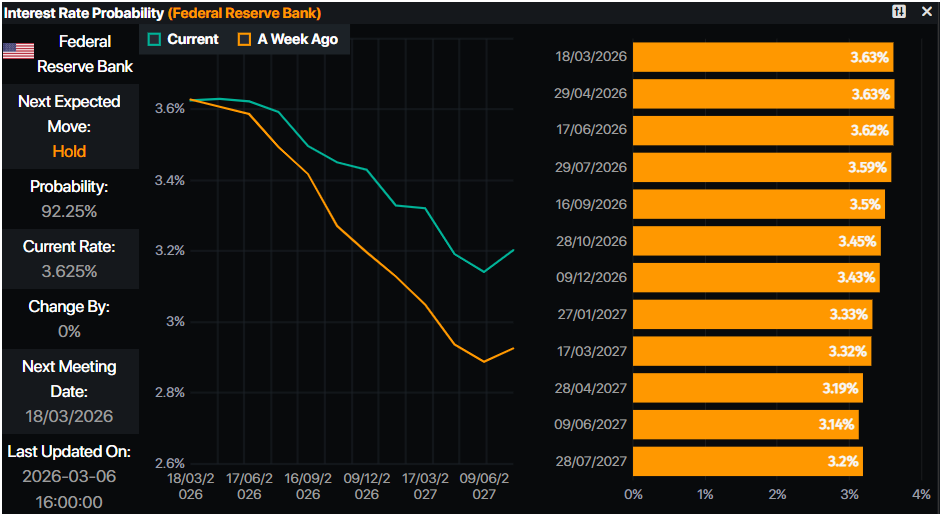
After the data, traders priced in 43 basis points of Fed rate cuts towards the end of the year, up from 35 basis points a day ago, as revealed by Prime Market Terminal data.
Several Fed officials crossed the wires. Kansas City Fed President Jeffrey Schmid commented that businesses are not hiring people, while Governor Stephen Miran said that he’s hesitant to read too much into one month of jobs data, adding that policy is miscalibrated, too restrictive.
San Francisco Fed Mary Daly said that February’s employment data was disappointing and undermined the notion that the labor market was stabilizing. However, she added that holding rates steady, “while we collect more information.”
Given the backdrop, traders could expect the Fed to keep rates unchanged at the March 17-18 meeting, yet eyes would be on updates to the so-called dot-plot in the Summary of Economic Projections (SEP).
Next week, the US economic docket is packed
Next week, the US economic schedule will feature the inflation data on the consumer side, housing data, Gross Domestic Product (GDP) figures, Durable Goods Orders, Initial Jobless Claims and the Fed’s preferred inflation gauge, the Core Personal Consumption Expenditure (PCE) Price Index.
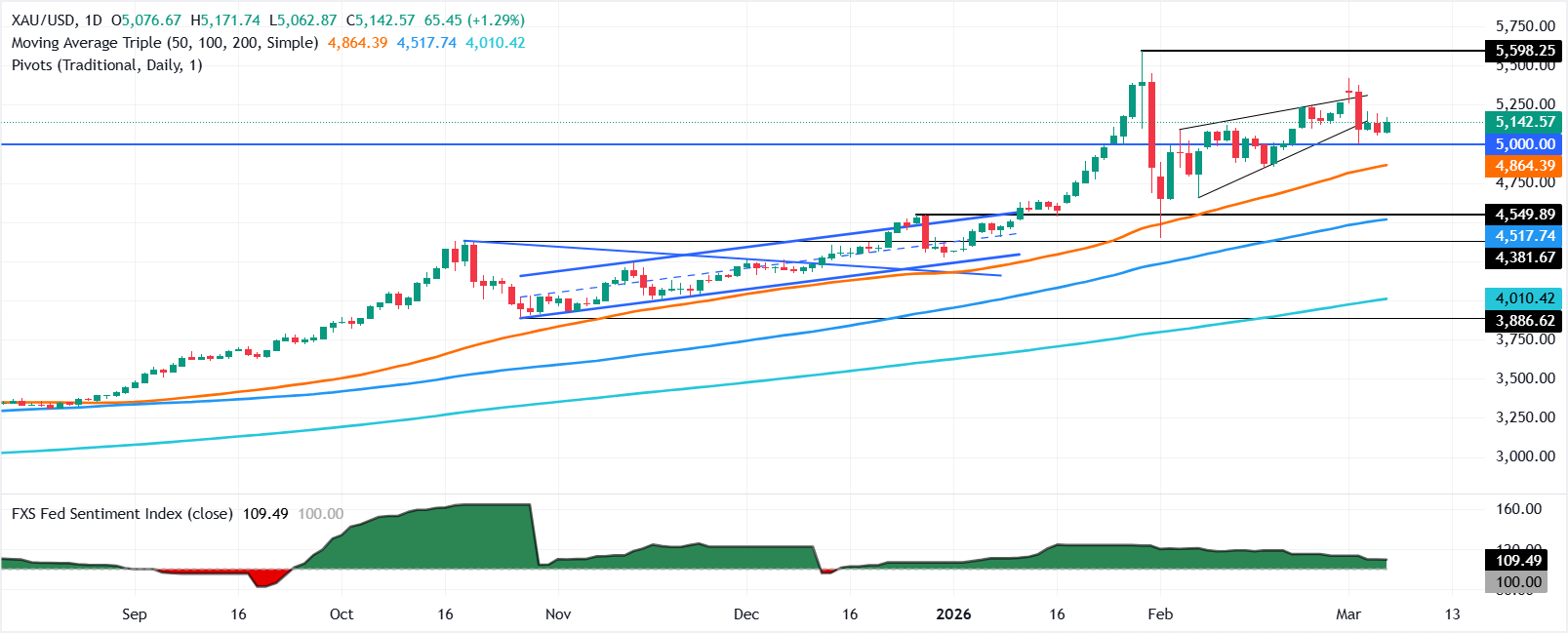
XAU/USD technical outlook: Gold trades range-bound within $5,100-$5,150
Gold price is upward-biased, though as of writing, buyers had failed to clear Thursday’s high of $5,195, which could open the door to challenge $5,200. Bullish momentum seems weak as depicted by the Relative Strength Index (RSI), above its 50-neutral level, but it remains far from its latest peak.
If XAU/USD surpasses $5,150, the next resistance would be the March 5 high at $5,194. On further strength, the March 4 daily high at $5,206 is up next, followed by the February 24 high at $5,249 and then $5,300.
Conversely, if Gold prices retreat below $5,100, it opens the door to test the 20-day Simple Moving Average (SMA) at $5,091. The next area of demand will be the $5,000 figure, ahead of the 50-day SMA near $4,855, ahead of the February 17 cycle low at $4,841.
Gold FAQs
Gold has played a key role in human’s history as it has been widely used as a store of value and medium of exchange. Currently, apart from its shine and usage for jewelry, the precious metal is widely seen as a safe-haven asset, meaning that it is considered a good investment during turbulent times. Gold is also widely seen as a hedge against inflation and against depreciating currencies as it doesn’t rely on any specific issuer or government.
Central banks are the biggest Gold holders. In their aim to support their currencies in turbulent times, central banks tend to diversify their reserves and buy Gold to improve the perceived strength of the economy and the currency. High Gold reserves can be a source of trust for a country’s solvency. Central banks added 1,136 tonnes of Gold worth around $70 billion to their reserves in 2022, according to data from the World Gold Council. This is the highest yearly purchase since records began. Central banks from emerging economies such as China, India and Turkey are quickly increasing their Gold reserves.
Gold has an inverse correlation with the US Dollar and US Treasuries, which are both major reserve and safe-haven assets. When the Dollar depreciates, Gold tends to rise, enabling investors and central banks to diversify their assets in turbulent times. Gold is also inversely correlated with risk assets. A rally in the stock market tends to weaken Gold price, while sell-offs in riskier markets tend to favor the precious metal.
The price can move due to a wide range of factors. Geopolitical instability or fears of a deep recession can quickly make Gold price escalate due to its safe-haven status. As a yield-less asset, Gold tends to rise with lower interest rates, while higher cost of money usually weighs down on the yellow metal. Still, most moves depend on how the US Dollar (USD) behaves as the asset is priced in dollars (XAU/USD). A strong Dollar tends to keep the price of Gold controlled, whereas a weaker Dollar is likely to push Gold prices up.
Recommended Articles







Comments (0)
Click the $ button, enter the symbol, and select to link a stock, ETF, or other ticker.