


Gold Price Forecast: XAU/USD sticks close to $5,000 watermark ahead of Fed policy clues


- Federal Open Market Committee (FOMC) minutes from the January meeting are due Wednesday and could reshape rate cut expectations, with markets pricing roughly 92% odds of rates holding at 3.50% to 3.75% in March.
- Easing US-Iran tensions and thin liquidity from the Chinese Lunar New Year holiday are adding two-way volatility to safe-haven flows, while the People's Bank of China (PBoC) extended gold purchases for a fifteenth straight month in January.
Gold bounced sharply on Wednesday after falling more than 2% in the previous session, as traders positioned ahead of the FOMC minutes later today. The Federal Reserve (Fed) held rates unchanged at 3.50% to 3.75% in January, and the minutes are expected to offer detail on how divided policymakers are over the pace of future easing. Recent US data has been mixed; January Consumer Price Index (CPI) cooled to a four-year low of 2.4%, supporting the case for cuts, while labour market strength (312K jobs added in January) gives the Fed room to hold. Friday's Personal Consumption Expenditures Price Index (PCE) reading and Q4 Gross Domestic Product (GDP) will round out a data-heavy week. On the geopolitical front, progress in US-Iran nuclear talks has unwound some of the risk premium that helped drive gold to its all-time high above $5,595 in late January, while a stronger US Dollar and higher COMEX margin requirements have added headwinds.
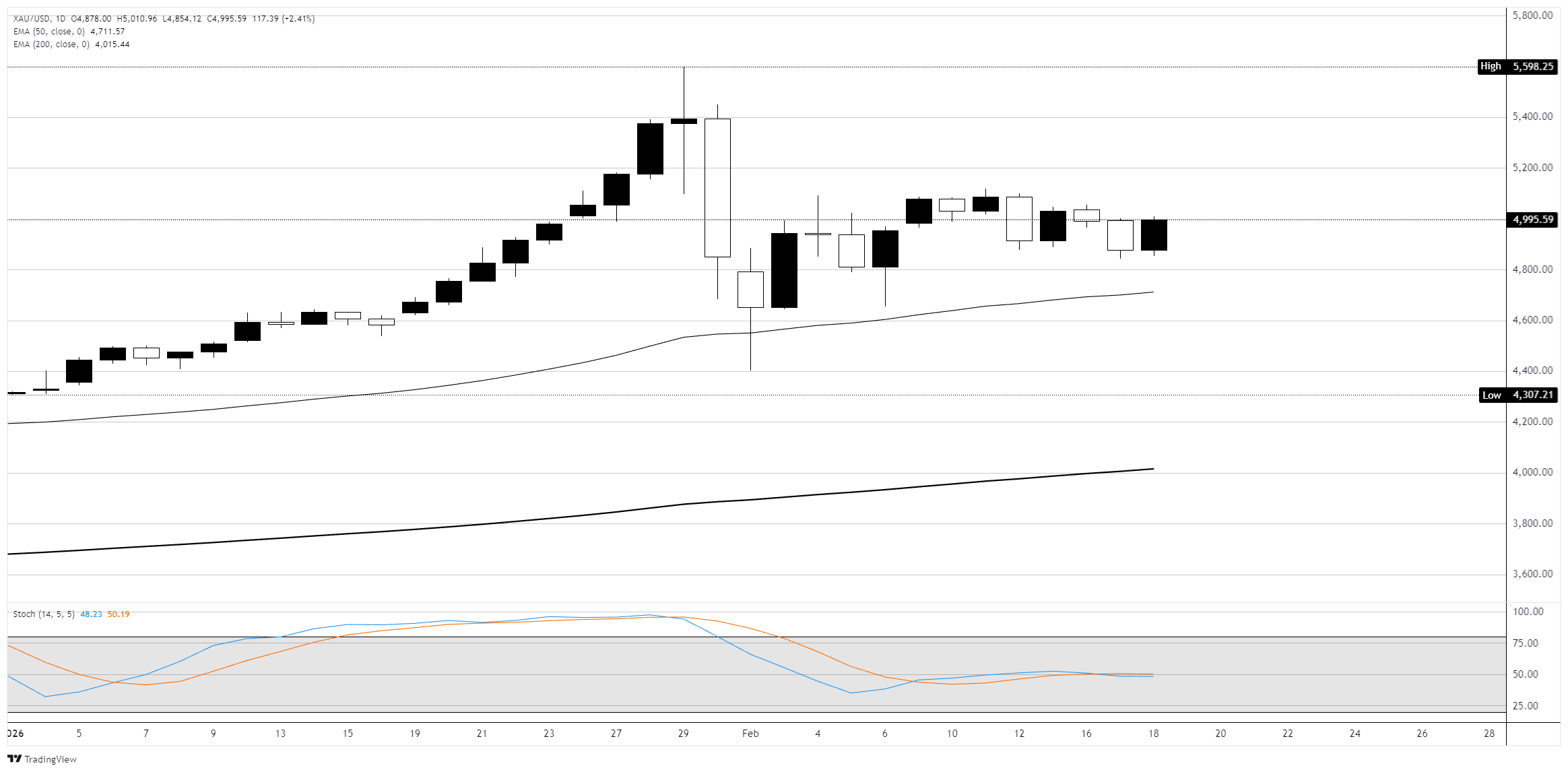
Bullish daily candle retests $5,000 as Stochastic holds neutral midrange
On the daily chart, XAU/USD opened Wednesday near $4,880, reaching a high of $5,011 as Spot Gold markets keep prices firmly planted around the $5,000 handle, which has become the key battleground since the violent reversal from the all-time high in late January. Price is trading well above the rising 50-day Exponential Moving Average (EMA) at $4,712 and the 200-day EMA at $4,015, confirming the broader uptrend remains firmly in place despite the correction. The Stochastic Oscillator is sitting in neutral territory near the midline, suggesting momentum is balanced and has room to develop in either direction. Repeated tests of $5,000 from below point to a market searching for conviction; a sustained close above $5,100 would suggest the corrective phase is ending and open the path toward $5,300 and the January high. A failure to hold $5,000 would shift focus back to the $4,850 support area and the $4,400 swing low from early February.
XAU/USD daily chart
Gold FAQs
Gold has played a key role in human’s history as it has been widely used as a store of value and medium of exchange. Currently, apart from its shine and usage for jewelry, the precious metal is widely seen as a safe-haven asset, meaning that it is considered a good investment during turbulent times. Gold is also widely seen as a hedge against inflation and against depreciating currencies as it doesn’t rely on any specific issuer or government.
Central banks are the biggest Gold holders. In their aim to support their currencies in turbulent times, central banks tend to diversify their reserves and buy Gold to improve the perceived strength of the economy and the currency. High Gold reserves can be a source of trust for a country’s solvency. Central banks added 1,136 tonnes of Gold worth around $70 billion to their reserves in 2022, according to data from the World Gold Council. This is the highest yearly purchase since records began. Central banks from emerging economies such as China, India and Turkey are quickly increasing their Gold reserves.
Gold has an inverse correlation with the US Dollar and US Treasuries, which are both major reserve and safe-haven assets. When the Dollar depreciates, Gold tends to rise, enabling investors and central banks to diversify their assets in turbulent times. Gold is also inversely correlated with risk assets. A rally in the stock market tends to weaken Gold price, while sell-offs in riskier markets tend to favor the precious metal.
The price can move due to a wide range of factors. Geopolitical instability or fears of a deep recession can quickly make Gold price escalate due to its safe-haven status. As a yield-less asset, Gold tends to rise with lower interest rates, while higher cost of money usually weighs down on the yellow metal. Still, most moves depend on how the US Dollar (USD) behaves as the asset is priced in dollars (XAU/USD). A strong Dollar tends to keep the price of Gold controlled, whereas a weaker Dollar is likely to push Gold prices up.
Recommended Articles






Comments (0)
Click the $ button, enter the symbol, and select to link a stock, ETF, or other ticker.