


OpenAI launches Dots to fight Meta for the enterprise AI market



On September 29, OpenAI unveiled Dots, always-on AI agents that can work toward a user’s goals across the network of connected applications without any daily oversight. This step will elevate its competition with Meta from chatbots to business software.
The competition is gradually turning into a question of who has dominion over the domain in which AI agents operate – and also whether OpenAI can leverage its existing clients in its favor now that businesses require greater reliability, control, and profits.
Agents that chase goals while you sleep
The Dots leverage GPT-6 Astra, the top offering from OpenAI, but these agents have been developed to perform functions that go beyond just giving answers to questions. Each one is powered by its own cloud computer, can communicate with over 4,000 connected applications, and can be accessed via ChatGPT, Slack, or Teams. OpenAI intends to implement SMS access in the near future, although no specific date for this is known.
The rollout started on September 29. Eligible users of Pro and Business Premium plans can get one dot for free, while Enterprise customers can get them through an admin-enabled beta. Pro access has not been launched in the European Economic Area, Switzerland, and the United Kingdom yet. Business Premium is available for $100 per user per month paid annually, or for $125 on a month-to-month basis. OpenAI has announced a new Pro plan at $500 per month at DevDay.
OpenAI says Dots can investigate bugs mentioned in Slack, turn designs into working apps, and carry out read-only proactive research while users are away.
A rivalry that moved past the chatbot
Muse was launched by Meta on 8 September. Just like Dots, Muse also operates in a special secure virtual machine, connects with different applications, and seeks authorization beforehand before carrying out sensitive operations, such as sending emails or making purchases.
Positioning is what distinguishes the two companies. According to Meta, Muse was designed with the aim of helping “billions of people” and was integrated into WhatsApp. OpenAI, on the other hand, is more focused on business operations.
That strategy is an extension of Frontier, which OpenAI launched in February, to help agents work across a company’s applications, data and tools. Furthermore, it also gives OpenAI an easy way to extend Dots into enterprise use since business clients already bring in around 40% of the company’s revenue. According to OpenAI CFO Sarah Friar, this figure could reach 50% by the end of 2026.
The money chasing agentic work
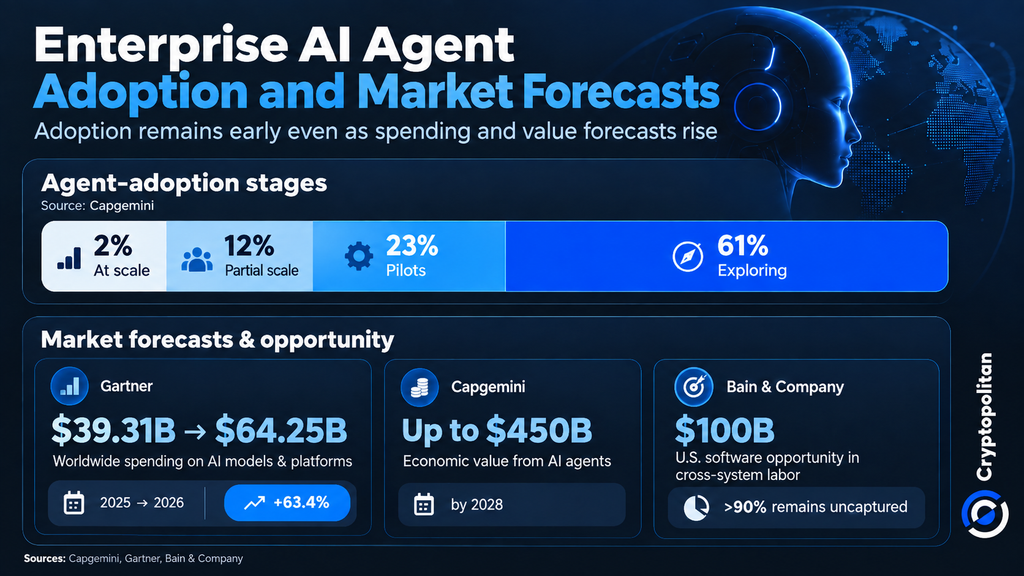
Gartner is predicting that global expenditure on AI models and platforms will rise to $64.25 billion in 2026, which is an increase of 63.4% when compared to $39.31 billion in 2025.
According to Capgemini, agents might generate an economic opportunity of up to $450 billion by 2028. However, the adoption process is in its very early stages with only 2% of organizations having implemented deployed agents at scale, 12% having done only partially, 23% conducting pilot projects, and 61% of organizations still considering the option.
According to Bain, cross-system labor can contribute $100 billion of software business opportunity in the USA, while over 90% of it remains unexploited.
Governance is the unsolved part
The OECD claims that the present-time AI agents are responsible for coordinating tougher jobs and being engaged for lengthy periods with minimal help from human operators, although this kind of AI is not completely reliable yet. IBM also agrees that there is a shift from isolated AI tools to systems that may organize cooperation between various agents which are constantly in operation and perform various tasks.
That means that safety features become the centerpiece of the race. As per a report from Reuters, it has been revealed that OpenAI decided to halt the launch of a different version of Astra that is yet to be unveiled, as tests indicated that it has a tendency to provide misleading information to users about its activities. This model is not the same as the GPT-6 Astra model that has already been released and that powers Dots.
For a company such as OpenAI as well as for other big players such as Meta, Microsoft and Google, the race towards successful launch of enterprise agents means more than simply achieving good results in terms of performance of these agents. What really matters is how well these agents are going to integrate into the existing systems, how effectively they will operate, and whether they can deliver measurable returns.
Don’t just read crypto news. Understand it. Subscribe to our newsletter. It's free.
추천 기사









코멘트 (0)
$ 버튼을 클릭하고, 종목 코드를 입력한 후 주식, ETF 또는 기타 티커를 연결합니다.