


Apple Leads Mag 7 With Over 26% Gain This Year; Stock May Test $400 After Breaking $355 Resistance



AI Podcast


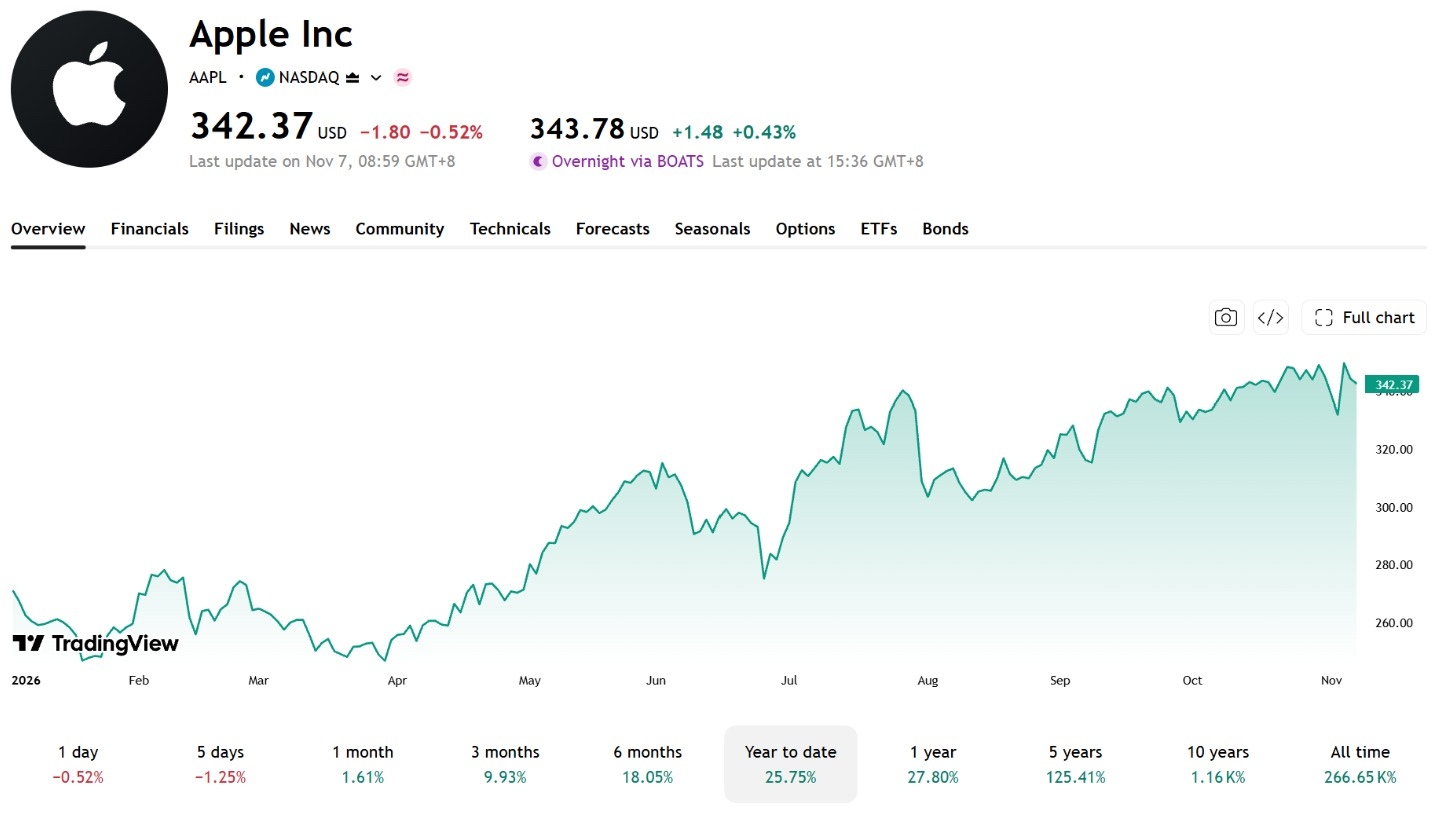
As of the close on November 6 Eastern Time, Apple led the Mag7 with a 26.3% year-to-date gain, driven by record Q4 fiscal 2026 revenue of $114.477 billion and all-time high services revenue. However, rising memory costs and cloud expenditures for Siri AI are expected to pressure December quarter gross margins to 45%–46%. Technically, Apple faces short-term resistance at $355–$356, with support near the 50-day moving average at $336–$338. A confirmed breakout above $355 on heavy volume could target the $400 psychological mark, though sustained momentum depends on managing rising costs and successfully monetizing upcoming AI features.
TradingKey - As of the close on November 6 Eastern Time, Apple (AAPL) stood at $342.37, up about 26.3% year-to-date and leading the Mag7. On November 5, Apple shares touched $355.38 intraday before pulling back, with $355–$356 becoming a short-term resistance zone.
Over the same period, Amazon (AMZN) was up about 12% year-to-date, Microsoft (MSFT) rose about 10%, and Nvidia (NVDA) was virtually flat; Meta (META) and Alphabet (GOOGL) fell about 7% and 9%, respectively, while Tesla (TSLA) dropped about 20%. Apple significantly outperformed the other six mega-cap tech companies, making it the best-performing Mag7 constituent year-to-date.
[Source: TradingView]
In terms of fundamentals, Apple's fourth-quarter fiscal 2026 revenue reached $114.477 billion, up 12% year-over-year; diluted earnings per share were $2.10, up 14% year-over-year.
Among segments, iPhone revenue reached $57.583 billion, setting a new record for the comparable period, while services revenue hit an all-time high of $31.573 billion, providing solid support for the company's performance growth.
However, rising costs may put pressure on margins in the coming quarter. Apple expects its gross margin for the December quarter to be 45%–46%, lower than the 47.9% recorded in the fourth fiscal quarter.
Management stated that rising memory prices were the primary reason for the gross margin decline, while cloud service costs related to Siri AI and revenue deferrals will also have an impact. Additionally, the fourth-quarter gross margin benefited from a tariff refund of approximately 1 percentage point.
Holiday-season sales performance, memory procurement costs, and Siri AI-related expenditures will be key factors influencing Apple's profitability and market expectations for the next quarter.
Siri Reportedly Accelerates Upgrade as AI Features Expand Services Growth Potential
According to a November 8 report by Bloomberg reporter Mark Gurman, Apple CEO John Ternus is pushing software chief Craig Federighi to accelerate AI product development.
Gurman believes that Siri could gain stronger agent capabilities as early as 2027, shifting from responding to single commands to continuously executing tasks, though the exact launch timeline has not been officially confirmed.
If the upgrade increases usage frequency and drives the adoption of paid features, it could expand Apple's services revenue. However, added cloud computing costs could also pressure profit margins, and whether the stock price receives sustained support will still depend on feature implementation, paid conversion, and cost control.
AAPL Technical Analysis: Poised to Test $400 After Breaking Previous High of $355
[Source: TradingView]
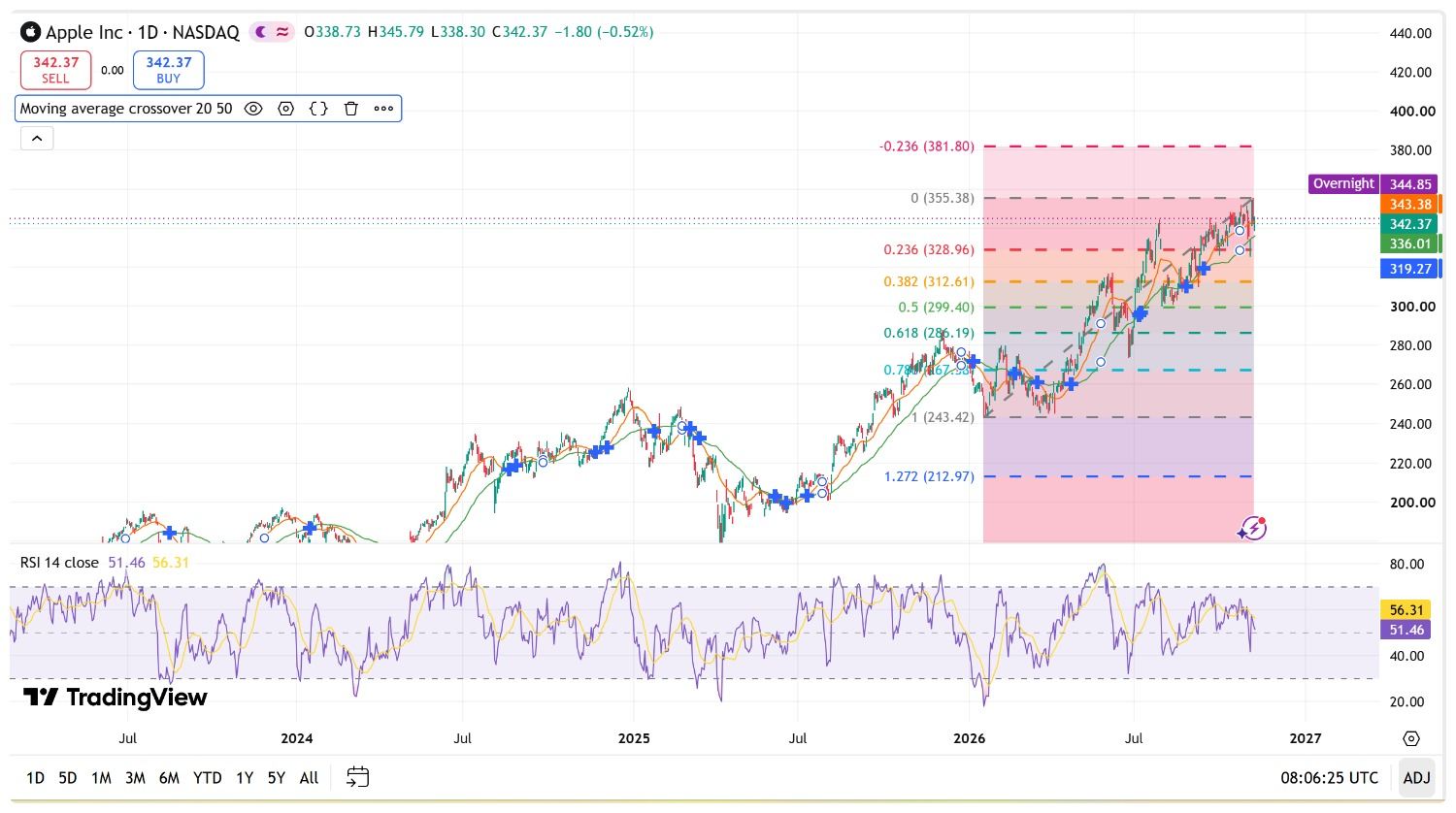
As of November 6, Apple was below its 20-day moving average of approximately $343.38, but remained above its 50-day moving average of $336.01. The 14-day RSI stood at around 51.46 in neutral territory, indicating that short-term upward momentum has yet to show a clear recovery.
Trading volume indicates persistent divergence near previous highs. On November 4, the stock rose 5.31% with volume of approximately 89.64 million shares; the next day, it touched $355.38 before closing down 1.53% on volume of about 75.68 million shares. The pullback from intraday highs suggests that a confirmed breakout near $355 has yet to materialize.
Based on the move from the January 20 low of $243.42 to the November 5 high of $355.38, the 0.236, 0.382, and 0.500 Fibonacci retracement levels stand at approximately $328.96, $312.61, and $299.40, respectively.
On the upside, the stock needs to first reclaim $343–$345 before testing $355–$356. If it closes above the previous high on heavy volume and holds the breakout zone in subsequent trading sessions, the 1.272 extension level at $385.83 could come into view; following a breakout, attention would shift to the $400 psychological mark.
On the downside, $336–$338 serves as an immediate support zone, encompassing the 50-day moving average and recent lows. If breached, the next support lies at $328–$330; a further breakdown would direct focus to $312–$313. If the stock repeatedly faces resistance at $355 while breaking below support near $329, corrective pressure could intensify.
Apple's push toward $400 is predicated on a confirmed breakout above previous highs. Over the medium term, investors will need to monitor whether sales growth can offset rising costs to prevent gross margin pressure from further weighing on earnings expectations.
This content was translated using AI and reviewed for clarity. It is for informational purposes only.
Recommended Articles









Comments (0)
Click the $ button, enter the symbol, and select to link a stock, ETF, or other ticker.