


Micron Stock Price Forecast: Data Center Construction Curbs Weigh on Valuation, but Long-Term Agreements and HBM Price Hikes to Support Earnings Delivery



AI Podcast


Despite potential AI infrastructure delays from new data center construction limits, robust server memory demand continues to outpace supply expansion. Citi and JPMorgan project healthy industry fundamentals, supported by strong enterprise demand and Micron’s expanding long-term supply agreements alongside finalized 2027 HBM pricing, which mitigate earnings volatility. Nevertheless, Micron’s stock remains in a bearish technical alignment with downward-sloping moving averages, indicating that fundamental strength may not immediately spark a price rebound. Key resistance lies at the $737.88–$753.30 range, with downside support monitored near the $650 level.

TradingKey - Following Democratic victories in the U.S. midterm elections, several newly elected governors have advocated limits on data center construction, prompting the market to reassess the pace of AI infrastructure expansion. If approvals tighten and projects face delays, server and storage equipment procurement could also be pushed back, bringing the timing of future revenue realization for Micron (MU) into focus.
However, recent research from Citi and JPMorgan shows that demand growth for server memory and storage continues to outpace supply expansion. Meanwhile, Micron's expanding long-term supply agreements and already finalized 2027 HBM pricing provide more concrete earnings protection against demand volatility.
Citi and JPMorgan Bullish on Memory Supply-Demand as AI Demand Still Outpaces New Supply
After raising supply forecasts for major memory makers, Citi narrowed its projected 2027 DRAM supply-demand deficit from 8.7% to 3.8% and the NAND deficit from 6.1% to 3.3%. While increased supply is easing shortages, it remains insufficient to meet overall demand.
The support is primarily coming from servers. Citi forecasts that in 2027, demand for server DRAM and enterprise SSDs will grow by 53% and 52%, respectively, while mobile DRAM demand will fall by 11%. Based on this projection, AI-related demand will still be capable of absorbing new capacity, providing support for memory prices, according to a Citi research report.
JPMorgan similarly believes that industry fundamentals are poised to remain robust through 2028, with a low likelihood of downward revisions to earnings forecasts over the next six months. The bank noted that while the pace of NAND price hikes has slowed, there are no clear signs of a downward price trend in the near term, according to a JPMorgan research report.
This implies that delays in certain data center projects may not immediately push the memory market into oversupply. The existing supply-demand gap provides a buffer; however, weak consumer demand also leaves Micron's growth more dependent on whether AI customer procurement can be sustained.
Micron Long-Term Agreements Rise to 26 as Price Floors and HBM Price Hikes Support Profit
According to Micron's financial reports, the company has increased its strategic customer agreements from 16 to 26, with some extending through 2031. The company expects these agreements to cover more than 35% of its revenue through 2030, enhancing the certainty of future orders and revenue.
The company's annual report shows that the agreements include binding multi-year volume commitments under 'take-or-pay' arrangements, where customers must assume payment obligations corresponding to the agreed purchase volumes under contract. Most agreements feature price caps and floors, with customers also providing cash deposits or letters of credit as performance guarantees.
Micron expects that even at the price floor, gross margins under these agreements will remain significantly above the quarterly peaks of previous cycles. Therefore, provided that deliveries are made as contracted and costs remain controlled, long-term agreements will both secure sales volumes and mitigate the impact of falling market prices on profits.
Meanwhile, HBM contracts provide support for profit growth in 2027. Micron stated that the vast majority of its 2027 HBM bit supply has already been contracted at prices significantly higher than in 2026, helping narrow the gross margin gap between HBM and conventional DRAM.
Bloomberg forecasts cited in a JPMorgan report showed that Micron was trading at a forward P/E of around 4.8 times for 2027 at the time, reflecting persistent market concerns over how long high profitability can be sustained. If construction restrictions mainly result in project delays rather than reductions in long-term procurement commitments, long-term agreements and HBM price hikes will help underpin earnings delivery. However, the bank noted that due to a lack of clear near-term catalysts, fundamental support may not necessarily translate immediately into a stock price rebound.
Micron Technical Analysis
From a technical perspective, the stock has entered an extended downward phase after breaking below its late-July low ($737.88), with the current rebound primarily repairing the previous sharp drop candlestick. The rebound remains below the breakdown level, leaving the original downward structure unchanged.
From a trend and structural perspective, the October rebound failed to break above the June high, after which the price center shifted downward again. Recently, it not only fell below the prior consolidation range, but also breached the late-July low, reinforcing the downward structure of lower highs and lower lows. The current daily candlestick peaked at $724.80 and has yet to return to the prior low, indicating that this is still merely a localized rebound following the sharp decline.
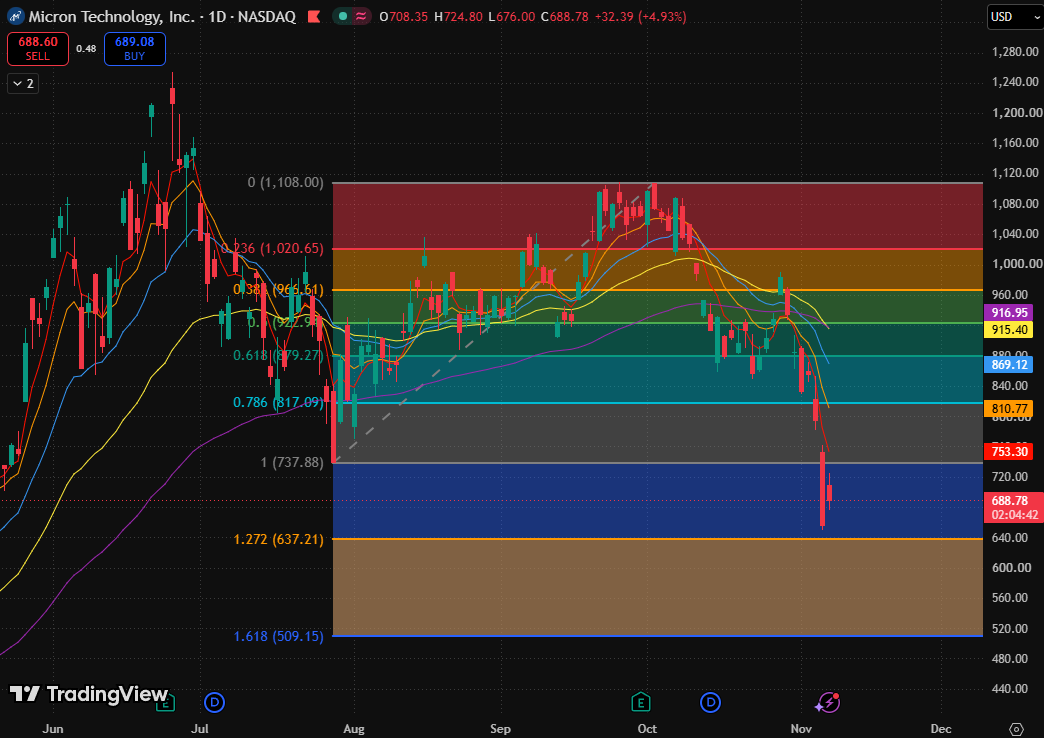
Micron Technology stock chart, Source: TradingView
In terms of moving averages, the 5-day exponential moving average ($753.30), 10-day exponential moving average ($810.77), and 20-day exponential moving average ($869.12) continue to exert downward pressure, with short-term moving averages diverging downward. The 80-day exponential moving average ($915.40) has dropped slightly below the 160-day exponential moving average ($916.95), turning the medium-term moving averages into a bearish alignment as well. The five moving averages have formed a full bearish alignment, although the two medium-term averages remain close together and have not yet widened significantly.
On the upside, if the stock price reclaims and stabilizes above the $737.88–$753.30 range formed by the late-July low and the 5-day exponential moving average, it could embark on a sustained short-term recovery.
In terms of downside support, the recent low ($650) serves as a key observation level for short-term buying interest; a breakdown below this level could see the price seek support at the 1.272 Fibonacci extension ($637.21).
This content was translated using AI and reviewed for clarity. It is for informational purposes only.
Recommended Articles












Comments (0)
Click the $ button, enter the symbol, and select to link a stock, ETF, or other ticker.