


Nvidia Stock Jumps Over 2% Amid Flurry of AI Boosts at GTC Berlin: Will It Return to All-Time High of $243?



AI Podcast


On October 21 Eastern Time, Nvidia surged 2.26% in pre-market trading to $221.34 following bullish AI announcements at GTC Berlin, including the Jetson Thor module, advanced networking tech, European enterprise collaborations, and Sovereign AI agreements. This momentum positions the stock to potentially challenge its $243 historical high, provided it breaks the $232–$235 resistance zone. However, macroeconomic risks, specifically potential spikes in U.S. Treasury yields, could trigger a pullback to the key technical support level of $210, where strong institutional buy-the-dip orders are concentrated.
TradingKey - Nvidia heavily rolled out bullish AI news at GTC Berlin, driving its stock price to rebound from declines and potentially laying the groundwork to challenge historical highs.
On October 21 Eastern Time, Nvidia (NVDA) stock showed a clear rebound from its decline, surging 2.26% in pre-market trading today to temporarily stand at $221.34, not only ending its recent narrow consolidation range but also filling the gap left on October 15. The primary driver behind this price rally was Nvidia's dense release of major bullish AI developments at the GTC Berlin conference.
During the conference, Nvidia showcased its Jetson Thor module, specifically designed for humanoid robots and autonomous systems, accelerating the commercialization of edge physical AI. It also unveiled the next-generation NVLink 6 interconnect technology and Quantum-X800 InfiniBand/Spectrum-X Ethernet switches, significantly reducing network latency and power consumption for training LLMs with hundreds of billions of parameters, further solidifying its exclusive moat in cloud service providers' data center infrastructure.
Nvidia CEO Jensen Huang announced expanded collaborations with European industrial giants such as Siemens, SAP, and Daimler, deeply embedding Omniverse into physical AI and robotics simulation for European automakers and automated factories, opening up a new growth driver for Enterprise AI software subscription revenue. In addition, several European governments and research institutions officially signed Sovereign AI computing buildout agreements to comprehensively procure Nvidia GB200 / NVL72 architecture servers, validating that "sovereign AI infrastructure" is taking over as the second-largest source of computing power buyers outside of tech giants.
Supported by these tailwinds, Nvidia's stock price saw a significant rise, currently leaving less than a 10% gain to reach its historical high of $243. If the stock price consolidates around $224 and successfully breaks through the first resistance zone of $232–$235 on heavy volume, it could trigger momentum buying from quantitative funds and trend-followers, potentially testing or even breaking through the all-time high ceiling of $243 ahead of its November earnings report.
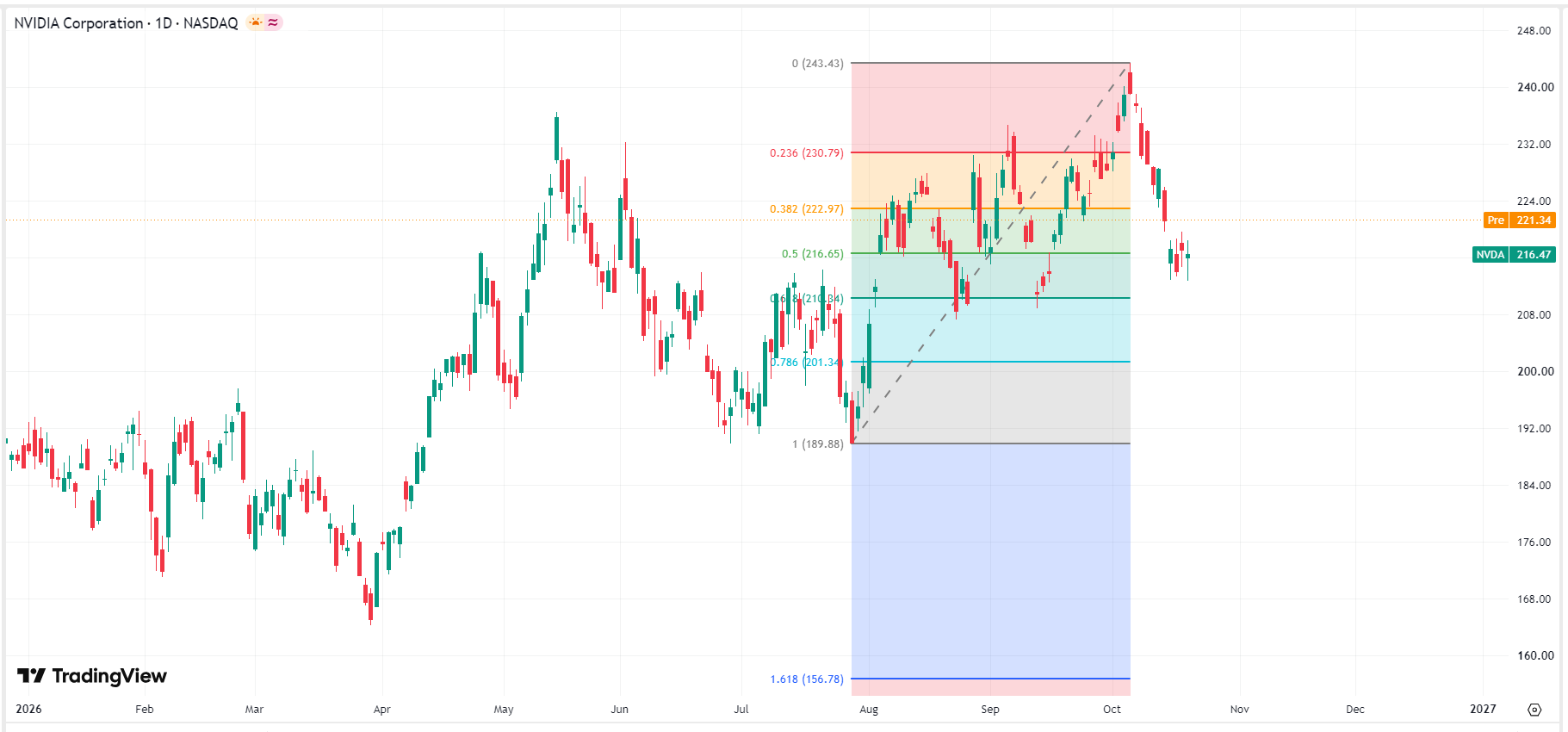 Nvidia stock price chart, Source: TradingView
Currently, the biggest potential downside risk for Nvidia's stock price stems from macroeconomic factors. If a pullback is triggered by a spike in U.S. Treasury yields, Nvidia's rally could not only be capped but might also retest its recent support level of $210. This price point has accumulated a massive amount of institutional buy-the-dip orders, serving as a strong layer of technical protection.
This content was translated using AI and reviewed for clarity. It is for informational purposes only.
Recommended Articles









Comments (0)
Click the $ button, enter the symbol, and select to link a stock, ETF, or other ticker.