


Why Did Netflix Stock Still Fall Nearly 6% After Q3 Earnings Beat Expectations?



AI Podcast


Netflix reported strong third-quarter earnings, with EPS of $0.87 beating estimates and net income rising 44% year-over-year to $3.664 billion. However, weaker advertising growth, a lowered 2026 ad revenue forecast of $2.7 billion, and soft fourth-quarter guidance caused shares to drop nearly 6% in after-hours trading. Slower viewing time growth and intensifying competition from digital platforms weigh on engagement. To improve efficiency, Netflix announced workforce reductions of approximately 1,000 employees and leadership changes. Despite robust profitability, slowing top-line expansion and decelerating ad monetization highlight mounting challenges to the company's growth model.
TradingKey - Netflix (NFLX) delivered better-than-expected third-quarter earnings, but slowing revenue growth, weaker-than-expected advertising growth, and soft fourth-quarter guidance kept investors cautious about its future growth prospects.
Following the earnings report, Netflix shares fell nearly 6% in after-hours trading, bringing their year-to-date decline to nearly 27%.
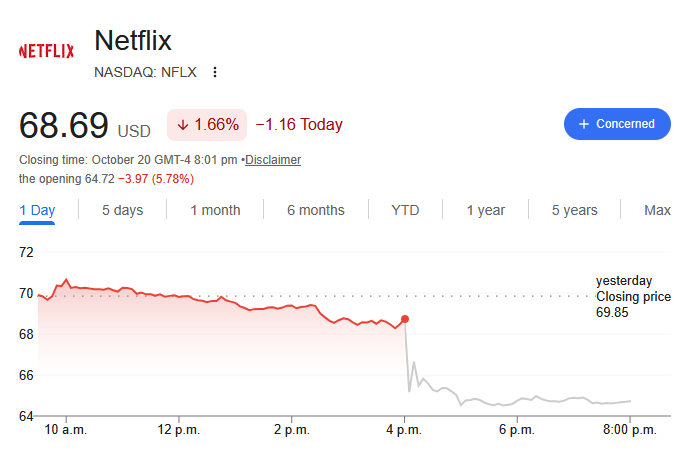
Source: Google Finance
As of the end of September, Netflix's third-quarter revenue reached $12.874 billion, up 11.8% year-over-year and largely in line with market expectations; net income reached $3.664 billion, up roughly 44% year-over-year, with diluted earnings per share at $0.87, above analysts' expectations of $0.82. Operating profit stood at $4.459 billion, with an operating margin of 34.6%.
For the fourth quarter, Netflix expects revenue of $13.44 billion, up about 11% year-over-year, which falls short of the market consensus of $13.52 billion compiled by FactSet; earnings per share are expected to be $0.67, also missing analysts' forecasts of $0.73. The company projects an operating margin of approximately 26% for the quarter, with restructuring costs from recent layoffs expected to weigh on short-term profitability.
The advertising business was a particular disappointment for the market. Netflix lowered its 2026 ad revenue forecast from around $3 billion to $2.7 billion, primarily due to a slower-than-planned rollout of certain ad product features. Although management emphasized that the ad business is still in the early stages of long-term expansion, the downward revision indicates that the company's developments in ad tech, delivery tools, and performance measurement have not fully met expectations.
Ad monetization is closely linked to user engagement. Viewing time not only affects subscriber renewals, but also determines how much ad inventory the platform can offer. Data shows that Netflix's global viewing time grew by only about 2% year-over-year in the first half of this year; in the US TV viewing market, Netflix held a market share of around 7.8%, significantly lower than YouTube's approximately 14%.
This means Netflix is no longer competing solely against traditional streaming services like Disney+ and Prime Video. YouTube, short videos, gaming, and social media platforms are all competing for users' entertainment time. Although Netflix has over 325 million subscribers, its massive user base has not automatically translated into faster growth in viewing time.
Co-CEO Ted Sarandos stated that original series and films remain at the core of the company's strategy, while live sports, podcasts, and games serve to expand entertainment formats and enhance platform differentiation. The company plans to attract viewers through holiday NFL games, the final season of "Emily in Paris", and other content, while introducing third-party programming from partners like France's TF1 to enrich its content offerings.
To improve growth efficiency, Netflix recently announced plans to cut around 1,000 employees, representing roughly 6% of its global workforce, marking its largest round of layoffs since 2022. Changes were also made to content management, with former Chief Content Officer Bela Bajaria and head of film Dan Lin departing, and former Disney executive Peter Rice taking over the content business.
These changes indicate that Netflix is reassessing its content production, resource allocation, and hit-making mechanisms. However, film and TV projects typically take a long time from greenlighting to release, and whether the new management can improve content performance may take several quarters to be proven. Layoffs also only reduce expenses and cannot directly solve the issue of sluggish growth in viewing time and ad monetization.
Netflix currently expects full-year 2026 revenue to reach approximately $51.1 billion, representing a year-over-year increase of about 13%, slightly below analysts' estimates of $51.21 billion. While third-quarter earnings beat expectations, proving the company still possesses strong profit-generating capability, the lowered advertising targets and weak fourth-quarter guidance show that its growth model is facing new challenges.
This content was translated using AI and reviewed for clarity. It is for informational purposes only.
Recommended Articles










Comments (0)
Click the $ button, enter the symbol, and select to link a stock, ETF, or other ticker.