


Today’s Market Recap: U.S. Stocks Rebound as Nasdaq Gains 1.11%, Memory Chip Stocks Rally, SanDisk Jumps 5.5%



AI Podcast


On Monday, October 19, U.S. stocks rebounded, driven by memory and major technology stocks, while the Dow dipped slightly. AI infrastructure credit pressures intensified, with financing costs emerging as a key market focus. Meanwhile, NVIDIA completed a fault-tolerant quantum computing simulation, Nscale advanced talks with Anthropic on a major deal, Amazon launched TorchNeuron, Apple scheduled an October 28 launch event anticipating its first touchscreen MacBook Pro, and Anthropic reportedly developed a new reasoning-focused model.

Tracking the Market Trend
TradingKey - U.S. stocks rebounded on Monday, October 19, following a sharp sell-off in AI infrastructure stocks last week, lifting the Nasdaq Composite and S&P 500.
At the close, the Dow Jones Industrial Average fell 0.07% to 51,966.03. The Nasdaq Composite gained 1.11% to 26,430.89, while the S&P 500 rose 0.41% to 7,690.73.
The Philadelphia Semiconductor Index advanced 1.61%, ending an eight-session losing streak. Memory stocks led the recovery, with SanDisk (SNDK) gaining 5.53%, SK hynix (SKHY) rising 4.67%, Western Digital (WDC) climbing 6.09%, and Micron Technology (MU) advancing 2.97%.
Among major technology stocks, Amazon (AMZN) gained approximately 5%, while Palantir (PLTR) rose more than 4% and Intel (INTC) advanced 2.4%. In contrast, CoreWeave (CRWV) slipped 0.44%. The stock fell approximately 25% last week, reflecting persistent concerns over AI infrastructure financing costs, debt burdens, and investment returns.
Crude oil futures were mixed. WTI crude oil futures for November delivery rose 2.22% to close at $103.66 per barrel, while Brent crude oil futures for December delivery fell 0.28% to close at $109.55 per barrel.
In the precious metals market, COMEX October gold futures fell 0.49% to close at $4,139 per ounce, while October silver futures fell 0.04% to close at $56.974 per ounce.
Market Headline
Credit pressures in the AI sector have come to the surface, with CoreWeave’s unsecured bonds emerging as a new “beta barometer” for measuring AI-related trading in the U.S. stock market. With bond yields surpassing 16% and CDS spreads surging, these developments highlight emerging cloud providers’ heavy reliance on debt financing and the risk of funding gaps. Credit pressures are spreading from the infrastructure sector to the equity market, and the primary focus of AI-related trading has shifted from computing power demand to financing costs and sustainability.
NVIDIA(NVDA) Completes 104-Qubit Fault-Tolerant Computing Simulation and Explores Ways to Reduce Quantum Error Correction Overhead. On October 19, NVIDIA announced that researchers had completed the simulation using the JUPITER supercomputer at the Jülich Supercomputing Center in Germany, powered by 8,192 GPUs. The study modeled the process of fault-tolerant computing performed by quantum processors in real-world noisy environments, helping to evaluate and optimize designs prior to hardware manufacturing. It also validated a technical approach that could reduce the number of physical qubits required by approximately 90%, thereby lowering the resource overhead of quantum error correction.
Nscale’s IPO prospects have been boosted by talks with Anthropic regarding a $45 billion deal. If the agreement is finalized, the total value of the partnership would reach $90 billion. The negotiations involve the second building at the Monarch data center campus, which provides 460 megawatts of computing power and utilizes NVIDIA’s latest-generation Vera Rubin chips. Additionally, Anthropic has secured the right of first refusal for the third building planned for the Monarch campus.
Amazon has launched TorchNeuron to lower the barrier for PyTorch developers using Trainium chips. Developers need only adjust a single configuration to run PyTorch code on AWS Trainium AI chips, without having to rewrite their business logic. The tool is designed to reduce the effort required to modify and revalidate code when migrating to new chips, and is scheduled to be released under an open-source license at the North American PyTorch Conference on October 20.
Apple(AAPL) has confirmed it will hold a product launch event on October 28, where the first touchscreen MacBook Pro is expected to make its debut. Apple confirmed on Monday that the event will take place in Los Angeles under the theme “Pro and tell.” According to Bloomberg, Apple plans to introduce its first touchscreen MacBook Pro, which is expected to feature an OLED display and incorporate an interactive interface similar to the iPhone’s “Dynamic Island”; the model will be powered by the M5 Pro and M5 Max chips. Apple also plans to release an entry-level MacBook Pro with an M6 chip, an updated iMac, and a new iPad mini with a sharper display. The company has only officially confirmed the event date; specific product details continue to come from media reports. Earlier reports indicated that Apple retail stores are preparing to begin selling the new products on November 6.
Anthropic is reportedly developing a new model focused on enhancing reasoning and the ability to understand user intent. According to The Information, citing sources familiar with the matter, the model will prioritize improving reasoning capabilities and the ability to discern users’ underlying intentions and goals when they provide limited information; it will also be better equipped to propose solutions that go beyond conventional thinking. The model has not yet been released, and descriptions of its capabilities remain subject to official announcement and external testing.
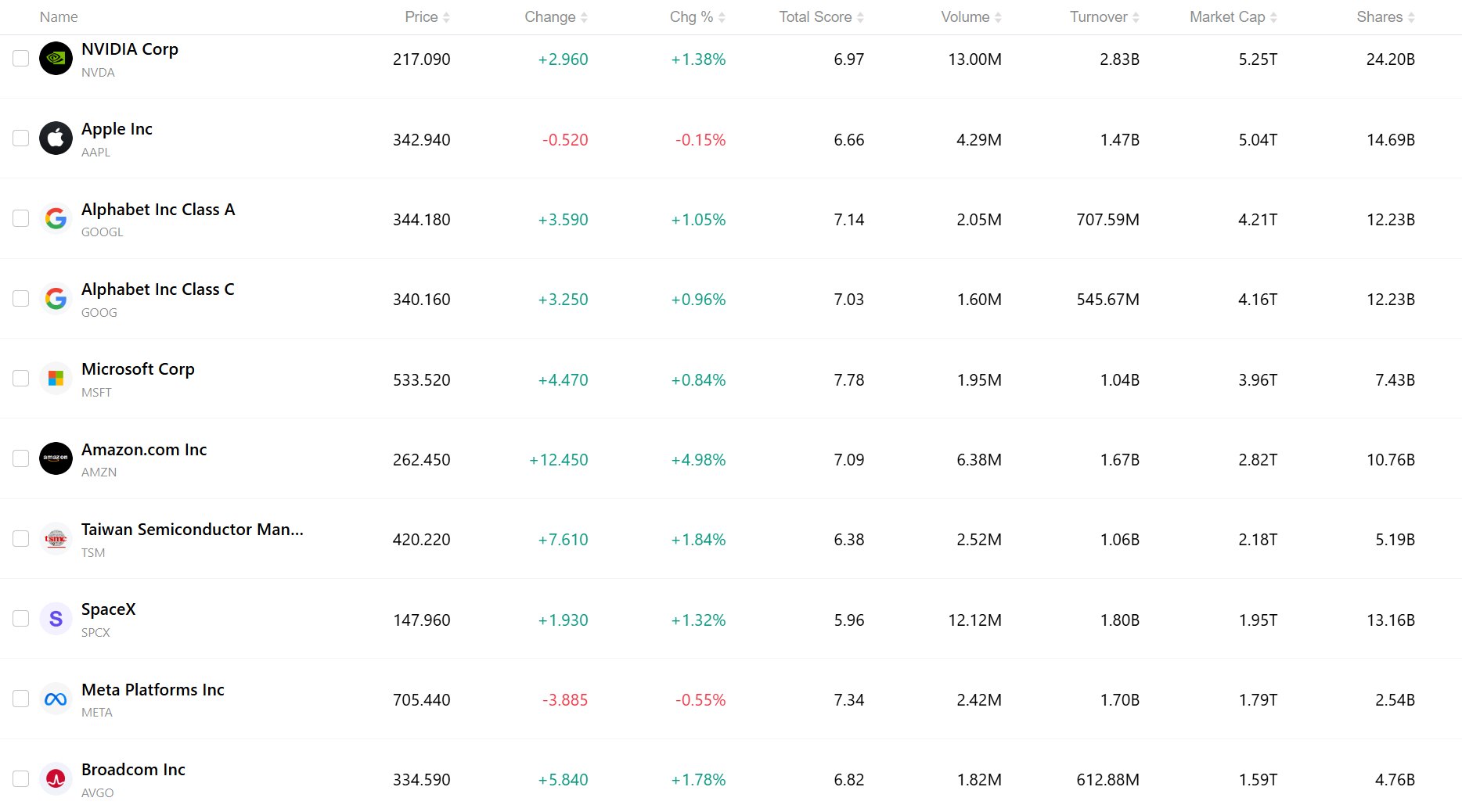
Top 10 Most Traded Stocks
The table below lists the ten most actively traded stocks in the latest market. Supported by massive trading volumes and exceptional liquidity, these assets have become key benchmarks for tracking global market dynamics.
Recommended Articles







Comments (0)
Click the $ button, enter the symbol, and select to link a stock, ETF, or other ticker.