


SK Hynix Stock Outlook: Can Explosive Growth in AI Inference Demand Drive Sustained Growth Through 2030?



AI Podcast


Surging AI inference demand is projected to expand infrastructure scale significantly by 2030, driving memory architecture upgrades in HBM, server DRAM, and tiered storage. Major makers like SK Hynix, Samsung, and Micron are positioning accordingly, supported by multi-year capital expenditure cycles. However, SK Hynix faces near-term pressures from macroeconomic factors, legacy DRAM competition, and yield execution risks. Techncially, 1.39 million won marks a key medium-term recovery level, while 1.20 million won serves as a critical short-term risk threshold. Long-term performance hinges on HBM4 adoption, supply-demand dynamics, and sustainable AI returns.
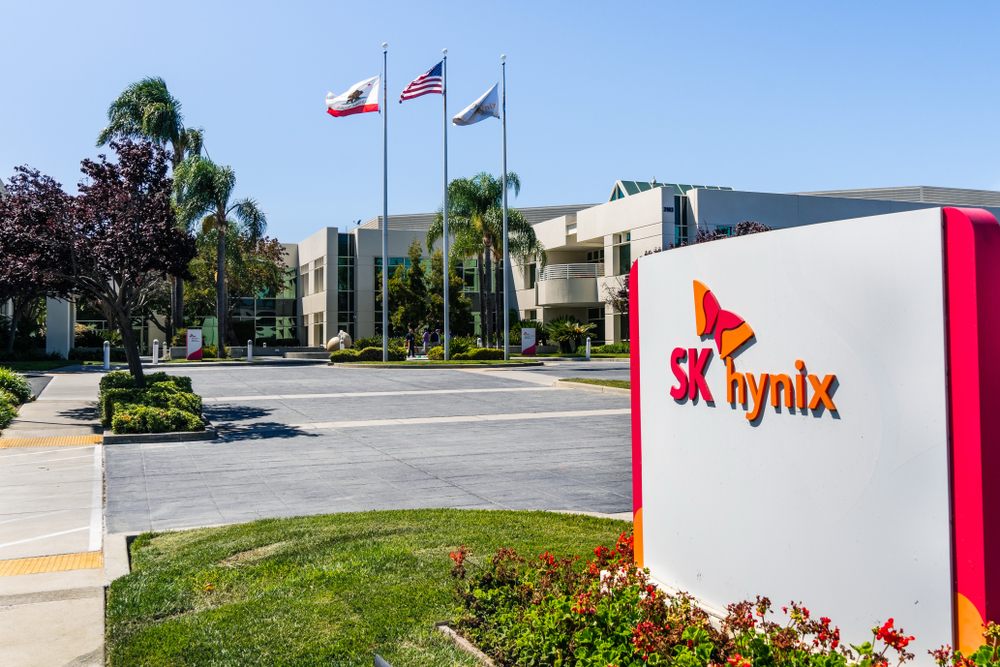
TradingKey - SK Hynix (SKHY) Head of R&D Ahn Hyun stated on October 14 at the 2026 Semiconductor Exhibition in Seoul that as AI inference demand grows, the performance scale of AI infrastructure could expand by about 20 times by 2030.
Ahn Hyun pointed out that three changes are occurring simultaneously in the AI inference market: tasks are becoming more complex, the volume of information processed per request is increasing, and inference requests continue to grow. These shifts will elevate data center requirements for computing power, memory bandwidth, and storage capacity.
AI Inference Drives Memory Architecture Upgrades
The KV cache is used to store and reuse key-value data during model inference. High-frequency data is typically stored in GPU HBM, some data can be transferred to system DRAM, and low-frequency data may be offloaded to SSDs through tiered storage.
As model size and context length increase, AI servers require memory with higher bandwidth, larger capacity, and lower cost.
SK Hynix is advancing 3D stacked DRAM and High Bandwidth Flash (HBF) while improving the capacity, bandwidth, and energy efficiency of HBM. Whether these related technologies can generate revenue still depends on mass production yields and customer adoption.
Three Major Memory Makers Position for AI Memory
Samsung Electronics has unveiled a technology roadmap addressing AI memory bandwidth and capacity bottlenecks, spanning 3D memory, zHBM, and zNAND-O, though these efforts currently remain focused on concept demonstrations and R&D planning.
Micron (MU) recently stated that AI data center construction is driving up demand for HBM and server DRAM. Some institutions expect memory supply tightness to persist through 2027 to 2028, though actual supply and demand will still depend on AI capital expenditures, capacity expansion by manufacturers, and changes in customer procurement.
The three companies have different focus areas: SK Hynix is focused on demand for HBM, server DRAM, and next-generation storage driven by AI inference; Samsung relies on its comprehensive product line to advance HBM, DRAM, and NAND technologies; while Micron is boosting order visibility through HBM capacity expansion and long-term supply agreements.
JPMorgan (JPM) believes that AI inference demand will continue to drive data center construction, with related capital expenditures likely sustaining a multi-year cycle. Morgan Stanley (MS) projects that global AI infrastructure investment will approach $3 trillion by 2028, with the majority of spending yet to be deployed. This forecast encompasses multiple categories of infrastructure investment and cannot be directly equated to the memory chip market size.
ASML (ASML) stated that demand for AI-related equipment could outpace supply capacity until at least 2028, with some customers already inquiring about lithography system orders for 2029 and 2030.
These assessments suggest that AI infrastructure investment could sustain a multi-year trend, but the ultimate scale will depend on computing power demand, returns on capital expenditure, equipment supply, and the pace of memory capacity expansion.
SK Hynix Outlook: Explosive Growth in AI Inference Demand, Can Stock Price Hit New Highs Before 2030?
Whether AI inference demand can support SK Hynix's financial performance depends on HBM4 orders, shipment scale, mass-production yields, product pricing, and server DRAM demand.
If investment in AI servers continues to grow and prices for HBM and server DRAM remain stable, the company is expected to benefit from an improved product mix. However, if Samsung Electronics and Micron expand supply, or if ChangXin Memory Technologies (CXMT) increases DDR5 shipments, legacy DRAM prices and profit margins could come under pressure.
On October 15, SK Hynix closed down 11.06% at 1.262 million won (approx. $941). South Korean chip stocks fell sharply that day, primarily driven by U.S. inflation data pushing up interest rate expectations and the market reassessing the return on AI capital expenditures.
CXMT's advancement into 4F² DRAM represents a medium-term competitive factor, which currently impacts mainly the legacy DRAM market. Its actual effect on SK Hynix's HBM business will depend on customer qualification and commercial shipments.
SK Hynix Long-Term Technical Analysis: 1.39 Million Won is the Key Medium-Term Recovery Level
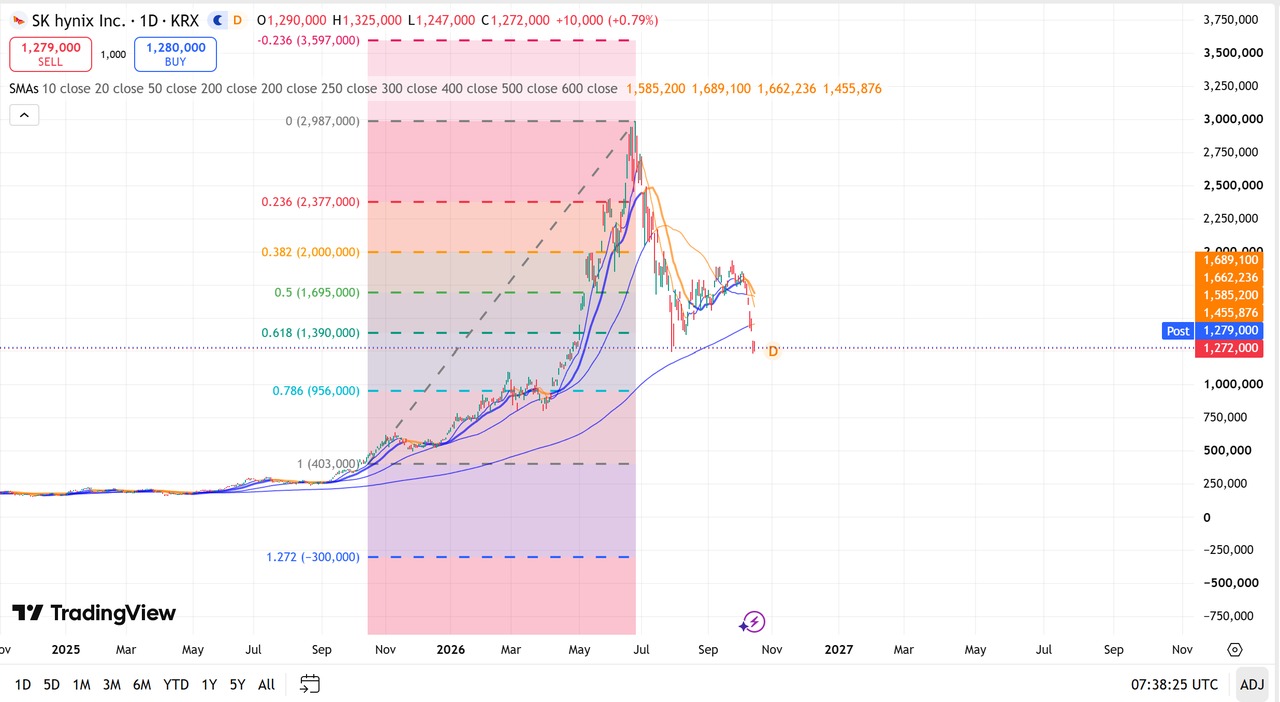
[Source: TradingView]
Based on the split-adjusted daily chart from the 52-week low of 403,000 won to the high of 2.987 million won, the Fibonacci 0.382, 0.500, 0.618, and 0.786 retracement levels are approximately 2.00 million, 1.695 million, 1.39 million, and 969,000 won, respectively.
As of the close on October 15, the stock price had fallen below the 0.618 retracement level of 1.39 million won. In the short term, initial focus should be on the 1.20 million–1.26 million won zone. If it reclaims 1.39 million won, resistance at 1.695 million and 2.00 million won can be observed. If it breaks below 1.20 million won, the next support level is 969,000 won.
Based on split-adjusted swing calculations, 2.987 million won marks the previous high. If HBM demand continues to grow, profitability improves, and the stock price breaks above and consolidates over this level, the Fibonacci 1.272 and 1.618 extension levels are approximately 3.69 million and 4.58 million won, respectively.
The long-term trend through 2030 remains dependent on HBM4 shipment volumes, DRAM prices, profit margins, and shifts in industry supply and demand.
Overall, SK Hynix's long-term performance will continue to be driven by high-end memory demand. The 1.39 million won mark serves as an important medium-term recovery level, while 1.20 million won is a short-term risk level. If supply growth outpaces demand or AI capital expenditure slows, the stock price could undergo further adjustment.
This content was translated using AI and reviewed for clarity. It is for informational purposes only.
Recommended Articles








Comments (0)
Click the $ button, enter the symbol, and select to link a stock, ETF, or other ticker.