


US Stocks Close: Nasdaq Drops Over 2%, Chip Stocks Fall Broadly, Micron Falls Over 5%, CoreWeave Plunges Nearly 12%



AI Podcast


On Friday, October 16, US stocks declined as tech and AI-related shares extended losses amid concerns over Chinese semiconductor competition and debt-funded AI infrastructure expansion. The Nasdaq fell 2.14% and the S&P 500 dropped 1.09%, while energy stocks rose. CoreWeave faced severe distress signals as total debt exceeded $51 billion. Macroeconomically, Federal Reserve Chair Kevin Warsh avoided pre-announcing rate decisions, and the US Treasury reported a five-year high fiscal deficit of $1.99 trillion for fiscal year 2026. Additionally, SoftBank considered a nearly $30 billion acquisition of Allied Universal to advance AI robotics.

TradingKey - On Friday, October 16, ET, US stocks moved lower as tech and artificial intelligence (AI)-related shares extended this week's losses. Investor concerns over Chinese semiconductor competition and debt-funded AI infrastructure expansion persisted, while rising oil prices also drew attention to the inflation outlook. Energy stocks bucked the trend to move higher, partially cushioning the Dow's decline.
At the close, the Dow Jones Industrial Average fell 0.34% to 52,002.41 points; the Nasdaq Composite Index fell 2.14% to 26,140.03 points; and the S&P 500 Index fell 1.09% to 7,659.44 points.
Tech Stock Performance
CoreWeave (CRWV) extended its decline by 11.91% to $61.39, bringing its weekly loss to 25.21%.
CoreWeave's bonds have traded at distressed levels for three consecutive days. Its 9.625% notes due 2032 closed with a yield of around 14%, while Reuters reported that the yield on its 2031 notes exceeded 16%—a level typically viewed as a distress signal. Five-year CDS closed at 1,117 basis points, implying an approximately 63% default probability over five years, comparable to Lehman Brothers' CDS levels days before its bankruptcy filing. Since their issuance in June, the 2032 notes have dropped below 80 cents on the dollar, touching the distressed territory as conventionally defined by the market.
The performance of mega-cap tech stocks on October 16 is shown in the chart below:
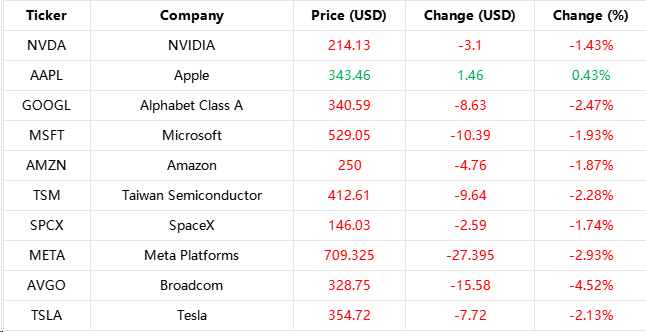
The Philadelphia Semiconductor Index fell 3.83% to 11,137.29 points, with all 30 constituents suffering losses. Among them, Arm Holdings (ARM) fell 6.94%, AMD (AMD) dropped 5.95%, Intel (INTC) lost 5.79%, Micron Technology (MU) fell 5.63%, Marvell Technology (MRVL) slipped 5.56%, and KLA (KLAC) declined 5.00%.
Memory stocks extended their decline, with Seagate Technology (STX) down 7.50%, Western Digital (WDC) down 6.86%, SanDisk (SNDK) down 6.85%, SK Hynix (SKHY) down 6.58%, and Micron Technology (MU) down 5.63%. The semiconductor sector remained under pressure this week. CNBC reported that market concerns over competition from Chinese vendors were among the factors weighing on the sector's performance.
Company News
CoreWeave's Total Debt Exceeds $51 Billion as AI Expansion Financing Draws Attention
CoreWeave's total debt has exceeded $51 billion, according to CNBC. As tech companies continue to issue debt to build out AI infrastructure, investor concerns over debt levels and debt-servicing capabilities are rising. Michael Rosen, chief investment officer at Angeles, said the surge in debt issuance warrants attention, with particular caution needed against over-borrowing, though he noted that systemic risk remains distant for now.
Tesla Unveils Second-Generation Roadster; JPMorgan Maintains Neutral Rating
Tesla unveiled the second-generation Roadster at SpaceX's testing facility in McGregor, Texas. According to a JPMorgan report, the two-seater sports car was co-developed by Tesla and SpaceX and features ten cold-gas thruster nozzles, a multi-mode underbody suction system, and active aerodynamic technology. JPMorgan noted that the unveiling mainly demonstrated the vehicle's engineering capabilities, with limited details on commercialization plans, while some features may face regulatory restrictions. The report also mentioned that management acknowledged safety was not the primary optimization goal for this model. The bank maintained its 'Neutral' rating on Tesla and its $415 price target set on September 28, making no adjustments based on the unveiling.
Gurman: iPhone Duo Supply Remains Tight, Adequate Stock May Take Until November
Tech reporter Mark Gurman stated that Apple launched the iPhone Duo ahead of schedule in order to bring it to market early, even while supply was insufficient. He believes that more adequate supply of the product may not be available until at least November. Gurman also noted that Apple has not clarified whether physical retail stores will have walk-in stock on launch day, meaning customers queuing at stores may be unable to purchase the device.
SoftBank Reportedly Considers Acquiring Allied Universal in Potential Deal Worth Up to Nearly $30 Billion
SoftBank is considering an acquisition of U.S. security services company Allied Universal, with a potential equity valuation of up to $18 billion, according to Bloomberg, citing people familiar with the matter. Including approximately $12 billion in debt, the total deal value could approach $30 billion. Following the news, SoftBank's ADRs fell as much as 10%. The report noted that Masayoshi Son aims to leverage the deal to drive the application of AI robotics in the security industry, potentially replacing some human security personnel with robots in the future. Discussions remain in early stages, and no final decision has been made.
Industry & Macro News
Warsh Refuses to Pre-Announce Rate Decisions for Rest of Year, Reaffirms Price Stability Goal
Federal Reserve Chair Kevin Warsh stated Friday local time while attending an International Monetary Fund (IMF) meeting in Bangkok that global economic performance has broadly aligned with the Fed's expectations since the September rate hike, but he will not reveal policy decisions in advance for the remaining two interest rate meetings this year. Regarding recent signals from other officials that there is "no rush to raise rates this month," Warsh neither explicitly supported nor refuted them. He emphasized that the Fed no longer pre-announces policy actions by releasing information in advance, and reaffirmed the goal of achieving price stability.
US Lawmaker Introduces Bipartisan Bill to Revoke Russian Energy Transaction Licenses
Representative Gregory W. Meeks, the ranking Democrat on the US House Foreign Affairs Committee, introduced a bipartisan bill aimed at blocking a diesel purchase and import arrangement reached by the Trump administration with Russia. The bill seeks to prohibit the US International Development Finance Corporation from investing in Russia's energy sector, revoke relevant general licenses already issued by the US Treasury Department's Office of Foreign Assets Control, and ban the future issuance of such licenses, while requiring the administration to impose sanctions on Russia's energy sector. Meeks criticized the arrangement, saying it would fail to lower the cost of living for Americans and instead provide funding to Russia. The bill is currently at the proposal stage, and the relevant restrictions have not yet taken effect.
US Fiscal Deficit Reaches $1.99 Trillion in FY2026, Hitting Five-Year High
Data released by the US Department of the Treasury on October 16 showed that for fiscal year 2026 ended September 30, the US fiscal deficit widened by $217 billion year-over-year to $1.99 trillion, the highest level since fiscal year 2021. The fiscal deficit as a percentage of GDP rose from 5.8% in the previous fiscal year to 6.2%. Full-year fiscal revenue grew by 3% year-over-year to $5.40 trillion, while fiscal spending increased by 6% to $7.40 trillion, both reaching record highs. Among expenditures, debt servicing costs grew by 12% to reach $1.36 trillion. Tariff refunds also affected fiscal revenue. Following a prior US Supreme Court ruling striking down most tariffs implemented by the Trump administration, $145 billion in tariffs were refunded in fiscal year 2026, causing net tariff revenue to fall 11% year-over-year to approximately $173 billion.
This content was translated using AI and reviewed for clarity. It is for informational purposes only.
Recommended Articles








Comments (0)
Click the $ button, enter the symbol, and select to link a stock, ETF, or other ticker.