


AMD Stock Forecast: Muse Drives AI Agent CPU Demand Growth, Can Shares Hit a New High Again?



AI Podcast


Personal AI agent applications are driving exponential growth expectations for server CPU demand, prompting major institutions to raise AMD’s price target. Mizuho and Citi project the addressable CPU market to expand significantly by 2030, with AMD positioned to benefit substantially from Meta-driven demand and potentially overtake Intel in server CPU revenue by 2028. Technically, AMD experiences a high-level pullback while maintaining a bullish moving-average alignment. Short-term momentum has weakened, with the 20-day moving average and the 0.236 Fibonacci level serving as critical support references, though losing these thresholds invalidates the shallow-pullback thesis and risks extended correction.
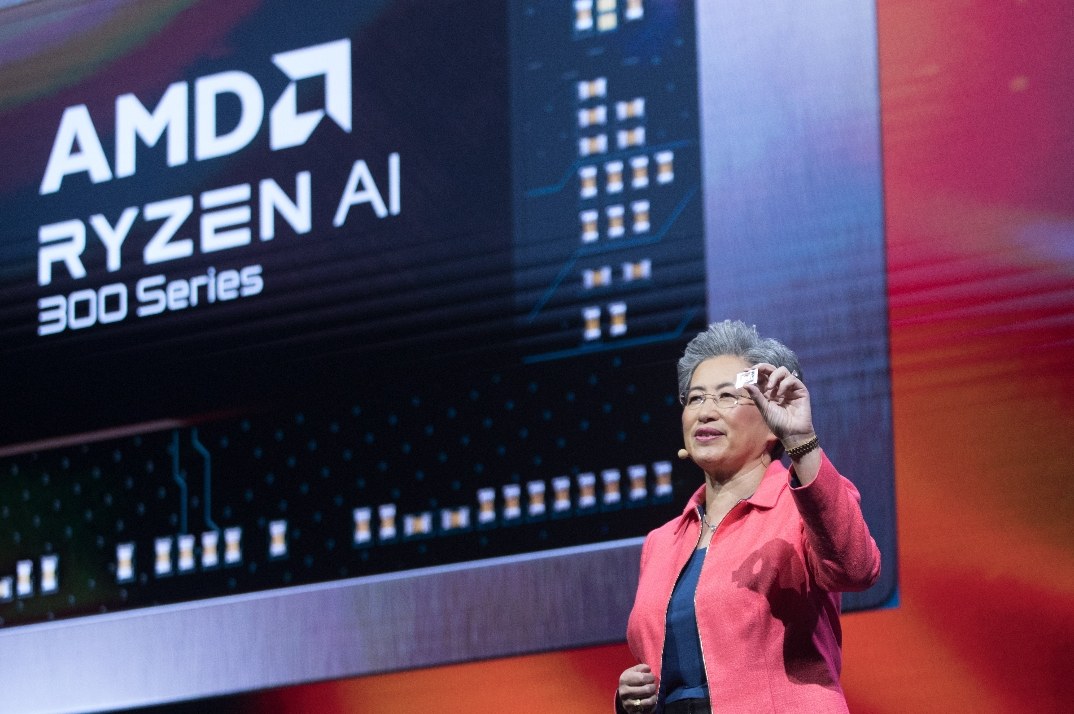
TradingKey - With the rollout of personal AI agent applications such as Meta Muse, market expectations for server CPU demand continue to heat up. Mizuho raised its price target on AMD from $580 to $705, while Citi raised its target to $800, believing AMD (AMD) is poised to be a major beneficiary of the new round of CPU demand expansion.
Compared with chatbots that wait for user prompts, AI agents can continuously execute tasks, call tools, and run code. This shift not only increases GPU inference demand, but may also drive up the consumption of CPUs, memory, and networking infrastructure.
AI Agents Unlock Incremental CPU Market
Mizuho analyst Vijay Rakesh expects the market for dedicated AI agent CPUs to reach $80 billion by 2030, representing a compound annual growth rate (CAGR) of about 123% over the next four years, while the market for head-node CPUs will reach $68 billion, with a CAGR of roughly 61%. By contrast, the traditional CPU market is projected at $60 billion, with a CAGR of only about 2%.
According to Mizuho's forecasts, the total addressable market for overall server CPUs will grow to approximately $209 billion by 2030, representing a CAGR of about 32%, lower than AMD's expectation of over $220 billion. This implies that new demand will primarily come from AI agents and related system architectures, rather than the natural expansion of traditional server businesses.
Meanwhile, a report released by Citi on October 6 provided higher market expectations. The bank expects the total addressable market for global CPUs to expand from $29 billion in 2025 to $300 billion in 2030, representing a CAGR of roughly 60%.
The two sets of forecasts pertain to the server CPU market and the total global CPU market, respectively. Because their coverage scopes and calculation assumptions are not fully aligned, the difference between the two cannot be directly interpreted as a forecast divergence for the same market, but both point to incremental CPU demand driven by AI agents.
AMD Benefits From Meta Demand as Competitive Landscape Shifts
Citi pointed out that Meta is one of the largest customers for AMD's server business; therefore, the expanded deployment of agentic applications like Meta Muse is expected to drive demand for AMD server CPUs. This is also a key basis for the bank raising its price target on AMD to $800.
Mizuho expects AMD's server CPU revenue to grow from $12 billion last year to $44 billion by 2028; over the same period, Intel's related revenue is projected to rise from $17 billion to $41 billion. If these forecasts materialize, AMD will further narrow its revenue gap with Intel and overtake it in 2028.
AMD Stock Technical Analysis
Source: TradingView
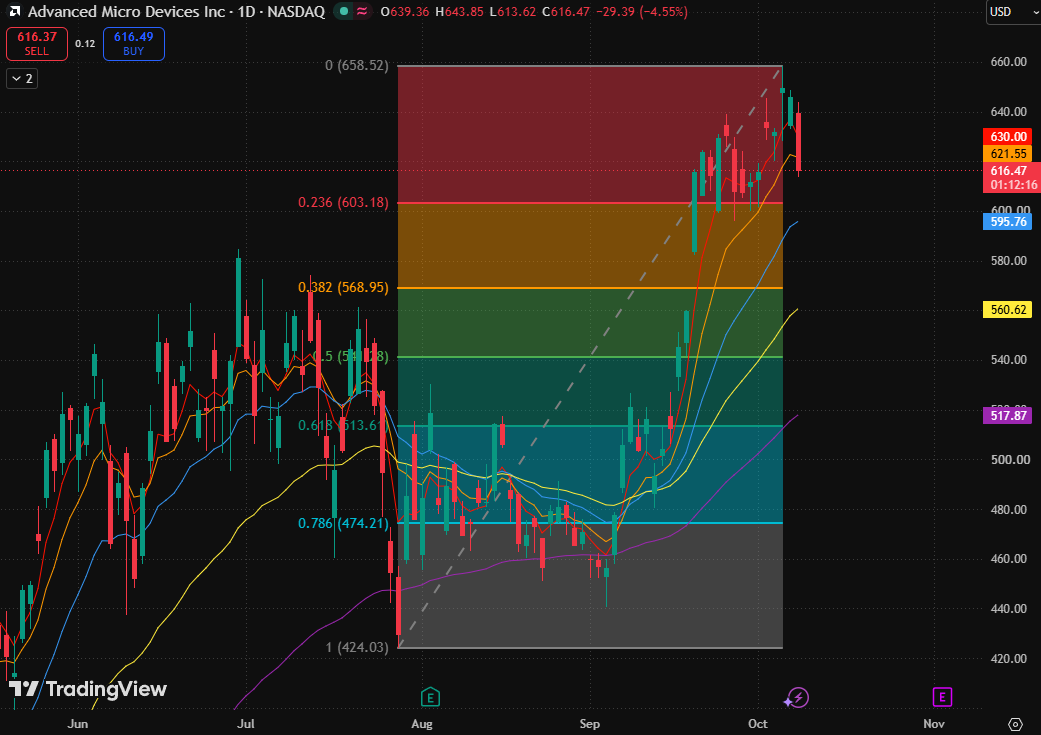
Looking at the daily chart of AMD stock, the share price has pulled back from a high of $658.52 and currently remains above the 0.236 Fibonacci retracement level ($603.18). The current move represents a high-level pullback within an uptrend; while short-term upward momentum has been interrupted, a medium-term trend reversal has not yet been confirmed.
Moving averages remain in a full bullish alignment: 5-day moving average ($630.10) > 10-day moving average ($621.60) > 20-day moving average ($595.79) > 80-day moving average ($560.64) > 160-day moving average ($517.88). However, the current price has fallen below the 5-day and 10-day moving averages, indicating that short-term momentum has weakened ahead of the medium-term trend, and the 20-day moving average will serve as the next level of support reference.
On the upside, only if the stock price reclaims and holds above the 5-day moving average ($630.10) will it be positioned to resume its advance toward the previous high ($658.52). Before short-term moving averages are reclaimed, a single bullish rebound candle is insufficient to confirm that the correction has ended.
On the downside, if the stock price breaks below the 0.236 Fibonacci retracement level, the correction will extend toward the 20-day moving average. The main risk is that if the key pivot is lost, the 20-day moving average also fails to hold. At that point, the thesis of a 'shallow pullback at high levels' will be invalidated, and the price could shift toward a third confluence zone rather than merely consolidating along short-term moving averages.
This content was translated using AI and reviewed for clarity. It is for informational purposes only.
Recommended Articles









Comments (0)
Click the $ button, enter the symbol, and select to link a stock, ETF, or other ticker.