


Alphabet Stock Forecast: Gemini 4 and 82% Cloud Growth Put AI Spending Under the Microscope



AI Podcast


Alphabet demonstrates robust performance driven by Google Cloud, strong Search resilience, and rapid Gemini adoption. However, surging artificial intelligence infrastructure spending and projected 2026 capital expenditures of $195 billion to $205 billion have compressed free cash flow, presenting the primary investment risk. While regulatory pressures in the U.S. and Europe persist, technical indicators show a cautiously bullish setup above $343.79, with a key breakout level at $357.84. The upcoming earnings report will test whether AI-driven revenue can adequately outpace escalating capital expenditure.
Alphabet (GOOGL) begins October with a tremendously strong growth profile among the mega-cap tech companies, but investors are more and more concerned with the cost of that growth. Alphabet Class A shares ended trading on October 5 at $346.47, up 0.86% on the day, giving the company a market capitalization of approximately $4.24 trillion. Search remains strong and Google Cloud continues to post extraordinary growth, as does Gemini, but the growing risk is in the company’s infrastructure spending.
What is interesting is how Alphabet is no longer just trying to protect Search from disruptive AI. The company is using AI in a number of areas, including Cloud and Search as well as selling TPUs and enterprise software, while also spending at a level that has begun to significantly affect free cash flow. The company’s next earnings release needs to show that the revenue side of the company’s AI investment is keeping pace with spending.
Reported Nuclear Deal Highlights the Power Constraint
The most recent development was on October 6, when Reuters, citing Bloomberg, reported that Google is close to a multi-year deal with Constellation Energy to buy nuclear power for at least $1 billion. Neither company had confirmed the deal at the time of writing, so I would treat this as a reported deal in progress, not a completed deal.
The strategic importance is clear. Reliable electricity is becoming a critical input to Artificial Intelligence, on par with chips, networking and data center capacity. As Google extends its computing power, it relies more on the long-term reliability of the electricity grid, making energy procurement not only a sustainability issue, but a direct constraint on the Company's future growth of Cloud and AI.
Gemini 4 Argon Raises the Competitive Stakes
On September 30, Google introduced their latest frontier model, Gemini 4 Argon. Argon is made to tackle longer-term professional tasks in software development and other fields such as finance, law, and cybersecurity. It is equipped with an output token limit of up to 1,000,000 tokens and can sustain deep reasoning across complex, long-horizon workflows. Argon is initially available only to cyber defenders through Google’s Fairwind program, with a broader release date not announced.
Google missing their previous model release dates is not new, and choosing not to launch Gemini 3.5 Pro earlier this year raised some eyebrows. The upcoming release of Gemini 4 gives DeepMind a chance to once again prove themselves at the cutting edge. The potential for arguably Alphabet’s first ‘shovelware’ is real. They do not need to build a new user base and can leverage their current user base in Search and other Alphabet products.
Gemini Already Has Massive Distribution
In Q2, Alphabet said the Gemini app had 950 million MAUs, with daily active users tripling YoY. Gemini's model APIs were processing 22 billion tokens a minute, up from 16 billion a quarter earlier, with almost 90% of the Fortune 100 utilizing Gemini Enterprise. It shows adoption is real, and fast.
As Alphabet continuous to monetize Gemini, they have a natural advantage from AL tech. There is no reason Gemini can not be used for search, or other areas. The real test for me is if they can continue to increase usage while simultaneously improving Cloud and Search economics.
Google Cloud Is the Fastest-Growing Engine
Alphabet posted $119.8 billion in revenue for Q2 with a 30% operating income increase, expanding its operating margin to 34%. A major revenue driver was Google Cloud, which reported an 82% increase in revenue to $24.8 billion. Cloud’s operating income increased to $8.8 billion from $2.8 billion the previous year, demonstrating strong profitable growth with the surge in AI demand.
Drivers of this growth were Enterprise AI Infrastructure and Enterprise AI Solutions as well as core Google Cloud Platform (GCP) services. In this quarter, Alphabet also started recognizing revenue from the sale of its TPU chips. Previously, Alphabet was monetizing its AI through Cloud. With the sale of TPU chips, Alphabet is participating in the AI Infrastructure cycle as a chip manufacturer as well as a software company.
Search Remains More Resilient Than Bears Expected
Traditional search and advertising were positive, with Google Search and other advertising revenue up 17% and YouTube advertising up 13% year over year. Total Google advertising revenue increased to $81.6 billion from $71.3 billion the previous year.
Despite the positive report, one of the biggest bearish cases for Alphabet is that the growth of AI assistants leads to reduced traditional search and weakening advertising economics. Management has said the integration of AI features with Search have increased query volumes rather than decreasing. If this remains the case, Alphabet can integrate Generative AI features with its Search infrastructure rather than compromising its primary profit engine.
The $195 Billion to $205 Billion Capex Plan Is the Main Risk
The main risk has shifted from Google’s biggest customer, the advertising industry, to Google’s own capital expenditures.
Alphabet expects its capital expenditures for 2026 to be in the range of $195 billion to $205 billion. The increase is driven by the need for more infrastructure to meet AI and Cloud demands.
During the second quarter of 2026, Alphabet’s capital expenditures were $44.9 billion, and its operating cash flows were $39.1 billion. This produced negative free cash flow of approximately $5.9 billion, the first negative free cash flow quarter in Alphabet’s history. Rapid infrastructure spending has outgrown Alphabet’s cash flow during this buildout.
I will be watching Cloud the most closely in Q3. Spending on Cloud can positively impact the bottom line for many years. Monetizing Gemini and Search and the recently announced TPU will accelerate growth even more. I am cautious about the competitive AI industry and if Alphabet will be forced to keep increasing infrastructure costs faster than revenue and operating cash flow can keep pace.
Antitrust Risk Has Improved in the U.S.
Alphabet's U.S. legal risk decreased in September when a U.S. judge refused to force Google to sell its AdX ad exchange and instead imposed behavioral remedies and an antitrust compliance monitor on Google. The risk has decreased substantially.
While these major legal actions are appealed, Google has other ongoing legal challenges involving the Digital Markets Act. Some of these acts and orders require Google to make changes to its business operations to adhere to anti-trust laws, and give rival companies access to more of Google's business, thereby increasing competition. Google has argued that some of these changes could cause security and privacy risks.
Poland Adds Another Regulatory Headwind
Poland’s competition authority announced on October 5 that it suspects Google abused its dominant position during its negotiations with local news publishers by, among others, failing to provide them enough information to evaluate Google’s offers. Violations of laws protecting competitive processes could lead to fines up to 10% of Google’s global revenue.
While an investigation is underway, I’ll treat this as more regulatory overhang. Alphabet’s core risks remain the sum of the competition cases in the U.S. and Europe.
Waymo Adds Another Long-Term Option
Waymo further expanded its public ride-hailing service in September, by adding Denver, San Diego and Tampa to the 11 cities where the service was already available. Las Vegas followed on September 14, bringing Waymo to 15 major U.S. cities. While Waymo’s public ride-hailing service is still relatively small compared to Alphabet’s other main businesses, the service is available in 15 major U.S. cities and expanding.
I view Waymo as having the potential to become a significant Alphabet business if the potential market for autonomous ride hailing services grows. Other Bets is still consuming capital, and in the long term, I view the investment case as having strategic value.
Q3 Earnings Will Test the AI Economics
Stock Analysis projects Alphabet's Q3 earnings for October 28 after the market close, though the company had not formally confirmed the date at the time of our cutoff. Current market expectations are for approximately $127 billion in revenue and about $3.04 in EPS, excluding unusual investment-related gains, which positively impacted Q2 GAAP earnings.
I am most interested in Google Cloud growth, Search advertising, Gemini usage, capex and free cash flow. Alphabet’s operating position is incredibly strong, but the valuation is increasingly based on the assumption that large investments made to the business will result in long-term, profitable growth rather than simply maintaining the business’s competitive position.
Alphabet Technical Analysis: GOOGL Holds $345 as Triangle Compression Tightens
Alphabet ended October 5 at $346.47. The stock has sideways movement between the descending resistance and the rising support trendline on the 4 hour chart. Currently GOOGL is trading above $343.79 and $345.40, and has bounced back to reclaim the moving averages. To confirm a breakout, the stock needs to breach the descending resistance trendline.
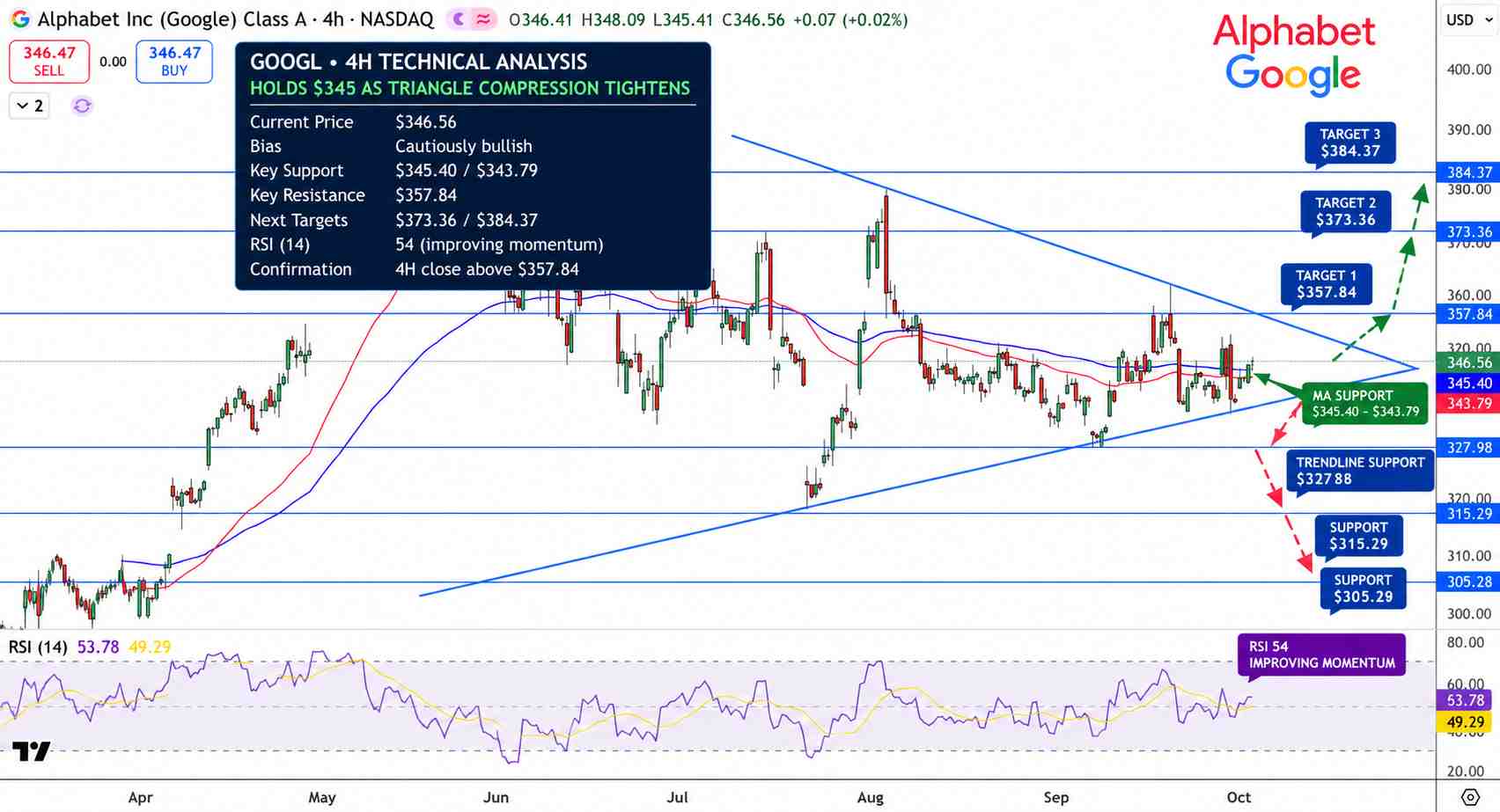
Alphabet Stock Price Chart - Source: Tradingview
Relative Strength Index (RSI) is at 54. Buyers have the edge but not overbought, giving them the opportunity to push for a further rally.
A 4 hour close above the descending trendline at $357.84 would project the next target at $373.36. Rising support would protect the trend at $327.98. In the bullish scenario, additional target would be at $384.37. I remain bullish on GOOGL as long as price is above $343.79 with $357.84 being the key level for breakout.
Key Levels
Latest completed close: $346.47
Major support levels: $345.40 to $343.79, $327.98, then $315.29
Major resistance levels: $357.84, $373.36, then $384.37
RSI: approximately 54, mildly bullish
Breakout target: $373.36 above a confirmed $357.84 break
Why is Alphabet stock in focus now?
Alphabet is in focus because Google Cloud is growing 82%, Gemini 4 Argon has launched, Search is still strong, and infrastructure spending has exploded. Now investors will decide if Alphabet will transform the massive AI investment into persistent revenue and cash flow in Search, Cloud, TPUs and Enterprise AI.
What level confirms a stronger GOOGL breakout?
A 4-hour close above $357.84 would strengthen the breakout and make $373.36 the next big target. A break below $327.98 and trendline support would negatively impact the overall setup.
Bottom Line
Alphabet is constructive in October with an impressive AI growth profile, especially among large-cap tech. With the integration of Gemini into Google’s services and the continuing strong growth of the Cloud and Search businesses as well as TPU sales and the growing distribution of Gemini, the company has multiple levers for growth. In addition, Alphabet has the financial firepower to fund this growth.
The main risk is capital intensity. While the company reported strong financial results, the combination of peak investment (capex) and the rapid build out of Alphabet’s computational infrastructure creates a negative impact on free cash flow. Technically, GOOGL is cautiously bullish above $343.79. On the other hand, we are just starting to fund the next phase of Alphabet’s growth and we will have to see if the company is able to develop AI products and services quickly enough to justify the investment.
Recommended Articles







Comments (0)
Click the $ button, enter the symbol, and select to link a stock, ETF, or other ticker.