


Nvidia Stock Forecast: Rubin Ramp and $108 Billion Q3 Outlook Keep AI Growth Accelerating



AI Podcast


Nvidia achieved record financial performance in October 2026, driven by fiscal Q2 revenue more than doubling year-over-year to $96.2 billion, robust Data Center growth, and strong gross margins of 75.0%. Management projects Q3 revenue of approximately $108 billion, supported by the scaling of Blackwell Ultra and the full production ramp of Vera Rubin. Strategic initiatives include a $150 billion share buyback authorization and a proposed acquisition of Hugging Face. Key operational risks involve data center power constraints, customer financing challenges, and regulatory scrutiny. Technically, the stock remains bullish above the $233.17 support level, targeting a breakout past $242.15.
Nvidia (NVDA) continues to reach record highs in October 2026. On October 5th, NVDA closed at $238.90, up 2.12% with an intraday high of $240.10. As a result, the market capitalization of NVDAis ~5.77T making it the most valuable publicly traded company.
While sentiment around NVDA has been quite bullish for quite some time, I do think the debate is beginning to shift. Investors are beginning to discuss the constraints that limit Nvidia’s growth, as opposed to discussing whether customers want NVDA’s accelerators. Blackwell Ultra is ramping, Vera Rubin is in full production, and data center revenue has more than doubled. The bigger constraint is whether customers can secure adequate power and financing, and data center space to deploy Nvidia’s accelerators.
Nvidia Expands Buyback Capacity by $150 Billion
On September 28, Nvidia disclosed that the board increased the company’s authorization for share repurchases by an additional $150 billion. Based on the SEC filing, “the repurchase of NVDA common stock shall occur from time to time in open market purchases, privately negotiated transactions or otherwise in compliance with all applicable securities laws and regulations”.
Nvidia increased its share buyback authorization by $150 billion on September 28, the largest share repurchase authorization increase in history. Management currently expects the authorization to cover repurchases through fiscal year 2028, and currently has about $235 billion remaining under the authorization.
The buyback program demonstrates management’s confidence in the financial markets and Nvidia’s future cash generation potential to consistently execute its strategic imperatives and generate strong cash flow.
The buyback program also creates confidence in management’s financial stewardship in that they expect to maintain product leadership and fund significant share repurchases going forward.
Hugging Face Deal Expands Nvidia Beyond Hardware
On September 3, 2026, Nvidia announced that it signed an agreement to acquire Hugging Face for approximately $12.93 billion. The agreement states that about $11.9 billion will be paid to the Hugging Face shareholders, and the remainder, up to $1 billion, will be given out as equity-based retention awards to employees in the form of incentive compensation. The closing of the transaction is subject to customary conditions and regulatory approvals and is anticipated to occur in the first half of 2027.
Nvidia has stated that Hugging Face will continue to be open and interoperable with various models, frameworks and clouds. Hugging Face is already one of the most popular destinations for open AI models. For Nvidia, this means a stronger software moat, through CUDA, and an earlier position in the developer workflow.
There are concerns, however, that through this acquisition, Nvidia will work to favor its chips, and deteriorate the relationships Hugging Face previously had with various clouds. Because of this and other concerns, this acquisition and many like it, will be under strong regulatory scrutiny. Although Nvidia will expand its software moat with this acquisition, it has created a similar challenge for itself in terms of regulation and other ecosystem management.
Q2 Revenue More Than Doubled
Nvidia achieved fiscal Q2 revenue of $96.2 billion, a YoY increase of 106% and an 18% increase from the prior quarter. Data Center revenue was $89 billion, a YoY increase of 117% and 18%. GAAP operating income increased by 124% to $63.7 billion and GAAP net income increased 126% to $59.7 billion.
GAAP diluted EPS was $2.46 and non-GAAP diluted EPS was $2.22. Gross margin was 75.0% on both a GAAP and non-GAAP basis, compared to 72.4% and 72.5% respectively in the prior year. The combination of triple-digit revenue growth and an increasing gross margin shows Nvidia is converting demand into exceptional profitability at scale, and shows the health of the business.
That is the part of the story I find most impressive. Nvidia is not merely shipping more accelerators. Customers are moving toward Blackwell and Rubin type systems that bundle a variety of compute and networking components as well as software.
Vera Rubin Is Ramping Into Full Production
Blackwell remains the primary source of revenue, but Nvidia says Vera Rubin is already ramping into full production. The company has racks deployed with partners like CoreWeave, Google Cloud, Microsoft Azure, Oracle Cloud Infrastructure and Nebius. Spectrum-6 networking systems designed for the Rubin platform are also arriving at large AI factories, Nvidia says.
The annual product cadence is Nvidia’s biggest competitive edge. Customers deploying Blackwell and Blackwell Ultra are already preparing infrastructure for Rubin, which further decreases the risk of a long transition gap between product generations. It also pushes the technical bar higher for AMD and for custom accelerators built by hyperscalers.
Nvidia is broadening its product portfolio beyond GPUs. The company unveiled a standalone AI CPU, called Vera, to complement its accelerators for AI agent workloads. Like management expects, if Vera gains traction in the market, it could further expand Nvidia’s customer base beyond its existing GPU customer base.
The $108 Billion Q3 Guide Sets Another High Bar
Nvidia expects about $108B in revenue for fiscal Q3 2027 (plus or minus 2%). That represents a big jump from the $96.2B in revenue generated in Q2 2027. Management expects non-GAAP gross margins to be approximately 74% and GAAP gross margins to be about the same (plus or minus 50 basis points).
Most importantly, Nvidia's guidance assumed no Data Center compute revenue from China. Without the Chinese Data Center market, the guidance still seems very optimistic. China was one of Nvidia’s largest markets for accelerators prior to the export ban. Export restrictions mean Nvidia has very little access to sell its high-end accelerators to the market. So far, the constraint has not been a major issue because of the strong demand from U.S. hyperscalers, as well as, sovereign AI projects, startups, and enterprises.
The Q3 guidance is now the most important near-term benchmark. An actual result above $108 billion with margins close to 74% would show Blackwell Ultra demand is very strong and Rubin's production ramp remains on track. A significant miss would be a warning sign because expectations are higher and the stock is trading at all-time highs.
AI Financing Is Becoming a New Systemic Risk
Nvidia is partnering with major capital providers to establish independent financing platforms designed to mobilize over $500 billion of third-party capital for AI infrastructure over time. The partners include Apollo, BlackRock, Blackstone, Brookfield, Goldman Sachs, and KKR. Nvidia states the purpose of these financing platforms is to provide funding for ecosystem partners and customers rather than shifting the entire cost to Nvidia.
According to Reuters, lenders are cautious on structures backed by AI computing equipment due to the fact that advanced GPUs can quickly become obsolete as a new generation is released. Banks typically model the useful economic life of equipment at 3 to 4 years, while Nvidia says the useful life can be much longer. If equipment is expected to be productive for a shorter period of time, lenders are unwilling to provide as much funding against the equipment, and may require other collateral.
This is becoming a major concern because the AI boom is also becoming a capital boom. If developers and infrastructure companies are too reliant on debt to finance Nvidia systems, collections can slow even if the demand for compute remains.
Power May Become a Bigger Constraint Than Chip Demand
According to Morgan Stanley this week, Nvidia and Broadcom seem relatively protected from the current U.S. data center power shortage, but other constraints may affect broader deployment. Nvidia can still get orders even if customers don't have the means to build out the power infrastructure to support the order.
The power issue is structural. Alphabet, Microsoft, Meta and Oracle, and other hyperscale/cloud companies are investing heavily to secure long term nuclear, natural gas and renewable energy sources. That's because the companies will need to build out new data centers and supporting infrastructure to meet customer demand. Nvidia's constrains are tied to how quickly the rest of the data center infrastructure ecosystem can be expanded.
In my opinion, this is one of the most clear risks to the overall market and offers a fair valuation on Nvidia shares given the other constraining factors.
Valuation Still Requires Near-Perfect Execution
At the recent close, Nvidia’s valuation was approximately $5.77 trillion. Stock Analysis shows a trailing P/E ratio of close to 30 and forward P/E of 19. Nvidia’s valuation is showing extreme expectations for future growth and not reflective of the semiconductor industry.
Investors have re-rated Nvidia as the core infrastructure and global platform for artificial intelligence (AI). Similar valuations to Nvidia’s current growth rates are not that extreme, but there is little room for slowdowns. Currently, Nvidia is experiencing exceptionally strong demand for its products. Nvidia must not only continue the strong demand for its products, but also manage the product transition from Blackwell to Rubin. Finally, they must maintain gross margins, and ensure customers can afford and have the infrastructure to support the systems they are ordering. Any major disruption to these areas could affect the positive sentiment around Nvidia.
Nvidia Technical Analysis: NVDA Breaks $233.17 as Bulls Target $242.15
Nvidia closed at $238.90 on October 5 after breaking the $233.17 resistance level and hitting an all-time high of $240.10 on the day. Nvidia is clearly above both of its moving averages and printing higher lows and higher highs. A bullish trend line from the July lows also supports the structure.
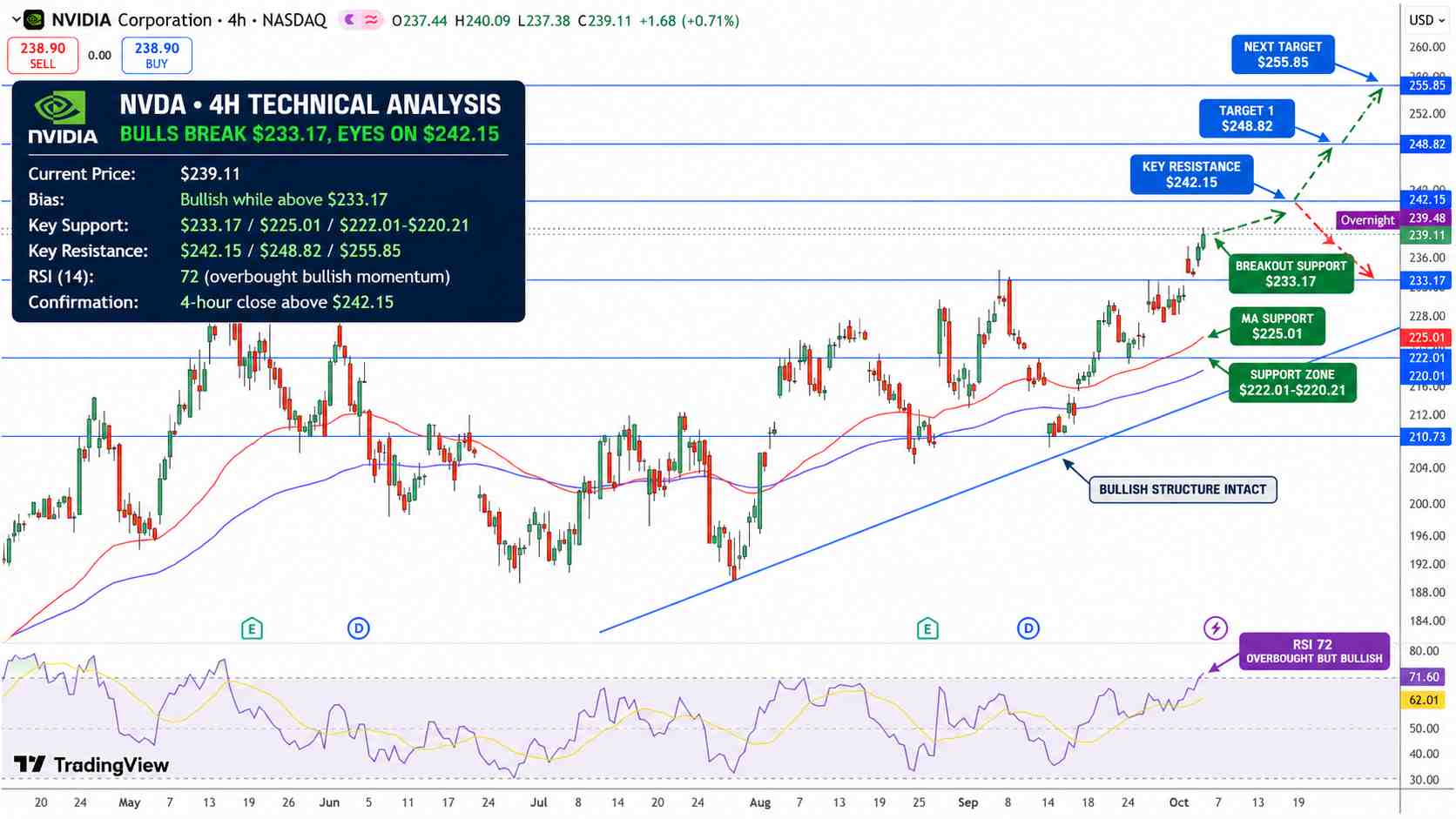
Nvidia Stock Price Chart - Source: Tradingview
NVDA’s RSI is in overbought territory at 72 after touching 62 on its signal line. The overbought conditions and the approach toward the $242.15 resistance level increase the chances of minor consolidation before resuming the upside move.
The upside momentum would require a 4-hour close above the $242.15 resistance level, with the next target at $248.82. Beyond that, the next target is $255.85. On the downside, a break below the $233.17 would be a bearish sign and the 50 period moving average at $225.01 would also provide support. The next major support after that would be the cluster between $222.01 and $220.21.
My bullish outlook is based on Nvidia holding above $233.17. With the overbought conditions and RSI, I would expect a retrace before continuing higher.
Key Levels
- Latest completed close: $238.90
- Major support levels: $233.17, $225.01, then $222.01 to $220.21
- Major resistance levels: $242.15, $248.82, then $255.85
- RSI: approximately 72, overbought but bullish
- Breakout target: $248.82 above a confirmed $242.15 break
Why is Nvidia stock in focus now?
Nvidia’s current quarter is ablaze because fiscal Q2 revenue more than doubled, Data Center growth was above 100%, Vera Rubin is in full production, and management is guiding for another record quarter with $108 billion of revenue. Also, Nvidia is expanding its software ecosystem through the proposed Hugging Face acquisition while creating new ways to finance AI infrastructure.
What level confirms a stronger NVDA breakout?
A 4-hour close above $242.15 confirms a bullish extension, and a target of $248.82 becomes probable. A breakdown of $233.17 cancels the current NVDA breakout and increases the probability of a deeper retest to $225.01.
Bottom Line
Nvidia is entering October with perhaps the strongest Earnings potential in global technology. Q2 revenue was up 106%, the Data Center was up 117%, the gross margin was 75%, and management expects another record in Q3. Vera Rubin going into production, while Blackwell Ultra continues to scale, gives Nvidia the potential to keep its product lead.
The risks now are more financing related. The availability of power for Data Centers, China restrictions, customer deployments, and the pace of AI rollouts will all play a big role in determining just how quickly Nvidia can meet customer demand. NVDA is still bullish above $233.17, however the overbought condition of the RSI on the 4-hour chart suggests a move to the downside and higher volatility in the short term is probable. The long term outlook of AI remains strong.
Recommended Articles







Comments (0)
Click the $ button, enter the symbol, and select to link a stock, ETF, or other ticker.