


Amazon Stock Forecast: AWS AI Boom Drives Growth as $220 Billion Capex Raises the Stakes



AI Podcast


Amazon’s AWS experienced a growth acceleration to 37%, supported by expanding AI and custom chip segments, alongside robust retail and advertising performance. Despite these operational strengths, capital expenditures are projected to reach approximately $220 billion in 2026, resulting in negative trailing free cash flow and increasing financial pressure. To mitigate infrastructure costs, Amazon is pursuing asset-light financing strategies, such as special purpose vehicles. Fundamentally, sustainable AWS margin expansion remains critical to validate massive AI investments. Technically, the stock maintains a bullish outlook while trading above the key support zone of $253.28 to $253.77.

TradingKey - Amazon (AMZN) starts October with AWS reporting its best growth in 4.5 years. Advertising is also growing quickly and the retail business is improving. AMZN closed at $259.92 on October 7, up 1.42% for the day after gaining 1.95% on October 6. The company is now valued at $2.80 trillion.
What I find interesting is that I no longer consider Amazon’s AI spending a defensive investment. The high-30% growth rate of AWS has returned, the AI and chip businesses both have $25 billion+ annualized run rates, advertising and retail are also improving. The biggest concern is whether Amazon can keep up this growth and fend off competition as the company continues to build out its infrastructure. Capital expenditures are expected to be about $220 billion in 2026, and negative free cash flow has already been reported.
Amazon Cuts More Corporate Jobs as Efficiency Push Continues
On October 8, Amazon confirmed layoffs affecting fewer than 1,000 white-collar employees, primarily in its Stores unit. These layoffs follow a larger round of about 30,000 job cuts that began last year and continued into January. Amazon states these layoffs are not connected to demand.
As previously reported, Amazon is cutting thousands of employees who work in corporate and retail functions. Although Amazon has made major corporate cuts over the past year, Amazon continues to spend massive amounts on data centers and other similar projects. These projects give Amazon a ton of operating leverage.
Just like with the last layoff announcement, Amazon continues to cut corporate and retail employees while rapidly deploying massive amounts of capital to other areas of the business, like data centers and custom chips. AWS is already highly profitable, generating $16.6 billion of operating income in Q2, while advertising remains a fast-growing revenue stream.
AWS Growth Accelerates to 37%
Reported results of the recent quarter by Amazon brought in a lot of positive news for the cloud. AWS, the cloud division of Amazon, reported a 37% year over year growth with revenues of $42.2 billion. This was the fastest growth in 18 quarters and gave AWS an annualized revenue run rate of $169 billion. Operating income of AWS for the quarter was $16.6 billion which was an increase of 63% over the previous year.
The recent AWS results show that growth accelerated materially despite intense competition from Microsoft Azure and Google Cloud.
In addition to its AI and chip businesses, which each exceeded $25 billion annualized revenue run rates and were growing at triple-digit percentages year over year, Amazon stated that AWS overall grew 37%. So AWS has multiple growth segments that include AI, cloud, and chip technologies.
Bedrock Is Broadening the Model Ecosystem
AWS is also including more AI platforms within Bedrock. On October 5, Amazon announced the public preview of Bedrock Managed Agents powered by OpenAI, which uses a version of OpenAI's Agents API and integrates with AWS IAM, and other AWS services.
Amazon is effectively applying the same framework to Bedrock that it uses across its broader cloud business. Like its competitors, AWS does not need a single foundation model to succeed. It has the flexibility to monetize infrastructure, inference and enterprise tooling across models from OpenAI, Anthropic, and others.
Customers are also moving to the edge. Flexibility is becoming increasingly more important, and Bedrock is also likely to gain in value as more AI models are created. This will be especially beneficial if enterprises want to use agents within their current security and billing framework for AWS.
Qualcomm Deal Expands Amazon’s AI Chip Options
Qualcomm recently announced a multi-year partnership with Amazon focused on custom AI data center silicon and high-speed optical interconnects. Amazon will have the option to purchase up to $60 billion of Qualcomm AI chips and related products over the term of the agreement. Qualcomm also gave Amazon warrants that enable them to purchase up to $4 billion of Qualcomm stock.
Understanding the difference is important. The $60 billion figure is the ceiling for potential purchases tied to the commercial agreement. I would say the $60 billion figure is an example of strategic optionality rather than a commitment to future spending.
From a broad strategic perspective, the deal makes sense. Amazon designs its own AI chips (Trainium) and Graviton CPUs. It also purchases large quantities of Nvidia chips. Adding Qualcomm further decreases dependence on any single supplier, and could increase economics if Amazon can optimize workloads across various chip architectures.
Amazon Explores a More Asset-Light Way to Fund GPUs
The cost of Amazon's AI buildout is now the biggest financial concern for the stock. Reuters reports Amazon is considering spinning off approximately $8 billion of Nvidia Grace Blackwell chips into a special purpose vehicle (SPV) funded by outside investors.
As per the given structure, Amazon would lease the chips while the SPV raises debt and potentially outside equity. The transaction was not complete at the cut-off for the preparation, and so I would consider it a financing proposal as opposed to a completed balance-sheet strategy.
If implemented, this structure would reduce the amount of AI hardware Amazon owns directly, and shift the risk of depreciation and residual value to outside investors. While this would be the case from a theoretical standpoint, the leased commitments would still represent an economic obligation.
For shareholders, this is a reminder that the AI buildout is transforming corporate finance, as well as cloud economics.
The $220 Billion Capex Plan Raises the Stakes
During Q2, Amazon increased its 2026 capital-spending outlook by about 10% to around $220 billion. Reuters reported that, during the same time, Amazon CEO Andy Jassy claimed that, due to high customer demand, AWS still wasn't able to meet customer demand, even with the recent increase in capacity.
Amazon's scale is enormous. Amazon's trailing twelve-month (TTM) operating cash flow was 161.4billion,a33%increasefromthepreviousyear.However,TTMfreecashflowwas-7.6 billion. The main driver was a $66.1 billion year-over-year increase in purchases of property and equipment, net of proceeds and incentives, mostly related to AI.
The largest challenge with Amazon is how quickly cash gets consumed with its record-level investments in order to maintain growth. While Amazon is highly cash-flow generative, the concern is that capital expenditures and investments may exceed cash flow, given the rapidity and pace of its growth initiatives.
There is an opportunity to assume a bullish stance on Amazon if comp (Compounding) AWS Operating Income continues to outpace its capital intensity.
Community Investment Addresses Data-Center Constraints
While there may be positive developments on the regulatory front for Amazon, the tech giant also announced a $1 billion-plus investment on October 2 in community building around its U.S. data centers over the next five years. The Built Together program will address such issues as workforce development, energy and water affordability and local project priorities.
As mentioned previously, AI has come to mean anything that requires computing power and is not constrained by GPU supply. Data-center permitting is becoming increasingly difficult as state and local governments get push back on utilities (electricity, water) and land-use permitting. While it will probably be positive for Amazon in the near term, doing community investment will likely be necessary to get new data centers built. Overall, the investment may be positive for the communities, but probably extends the timeline for the buildout of Amazon Web Services (AWS) data centers.
Retail and Advertising Are Improving Alongside AWS
Amazon's strength lies in having more than one growth driver. Q2 net sales increased 20% to $200.6 billion, operating income was up 43% to $27.5 billion. North America sales grew 16% to $116.2 billion and International sales were up 15% to $42.2 billion.
Improved North America and International operating income of $9.1 billion and $1.7 billion, respectively, further evidence continued improvement in retail profitability from better fulfillment, automation, and logistics.
Advertising also remained strong, with year over year growth of 26%. Like retail, advertising directly benefits from Amazon’s shopping intent data. Strong retail and advertising earnings provide operating leverage to subsidize Amazon’s investment in AI. This is important, as it decreases Amazon’s reliance on AWS for operating leverage.
Anthropic Creates Strategic Value and Accounting Volatility
Anthropic, Amazon's strategic partner, was the primary driver of $53.4 billion of non-operating, pre-tax other income during Q2. This accounting gain, along with other mark-to-market changes, created significant volatility in Amazon's earnings. Because of mark-to-market accounting, large swings in EPS can occur from one quarter to another and should not be used to measure business performance.
Focus should be on core businesses (retail and AWS), operating income, segment margins, and cash flow for the upcoming quarter.
Q3 Earnings Will Test the Return on AI Spending
Amazon anticipates Q3 revenue in the range of $197B to $202B, up between 9% and 12%. Operating income is expected between $22.5B to $26.5B, compared to $17.4B in the same quarter last year.
Amazon’s investor relations calendar did not show a scheduled Q3 earnings call as of October 8. Stock Analysis expects Amazon to release earnings on October 29 after the market close, and that is when I would expect Amazon to report earnings.
I will look most closely at AWS growth and operating income. Capital expenditures and free cash flow will also be of interest. I will also watch advertising and retail margins. The key question will be if AWS can remain in the mid-to-high-30% growth range and Amazon can provide better capital efficiency.
Valuation Still Assumes Strong AI Execution
At the October 7th close, Amazon's market capitalization was about $2.80 trillion. According to Stock Analysis, the company's trailing P/E is 20.9, and forward P/E is 27.6. The trailing P/E is influenced by the recent Anthropic accounting gain, therefore, the forward P/E is more indicative of the operating multiple.
For me, the core of Amazon's business remains strong. Amazon Web Services (AWS) growth has re-accelerated and Amazon's retail and advertising business margins have improved. The risk is that free cash flow continues to be negative despite revenue growth and increased investment in AI.
What most strengthens my view is another quarter of AWS growth above 35% and evidence that increased AWS infrastructure spending has improved operating margins. What would most concern me is further elevated level of cloud-related capital spending without improvement in margins and cash flow.
Amazon Technical Analysis: AMZN Breaks Descending Trendline as Bulls Target $267.29
Amazon closed October 7 at $259.92, breaking above the descending trendline and reclaiming the $253.49 to $253.77 resistance zone. I like the strong bullish follow through after the long consolidation, with price now trading above both the 50 SMA and 100 SMA and the rising support trendline.
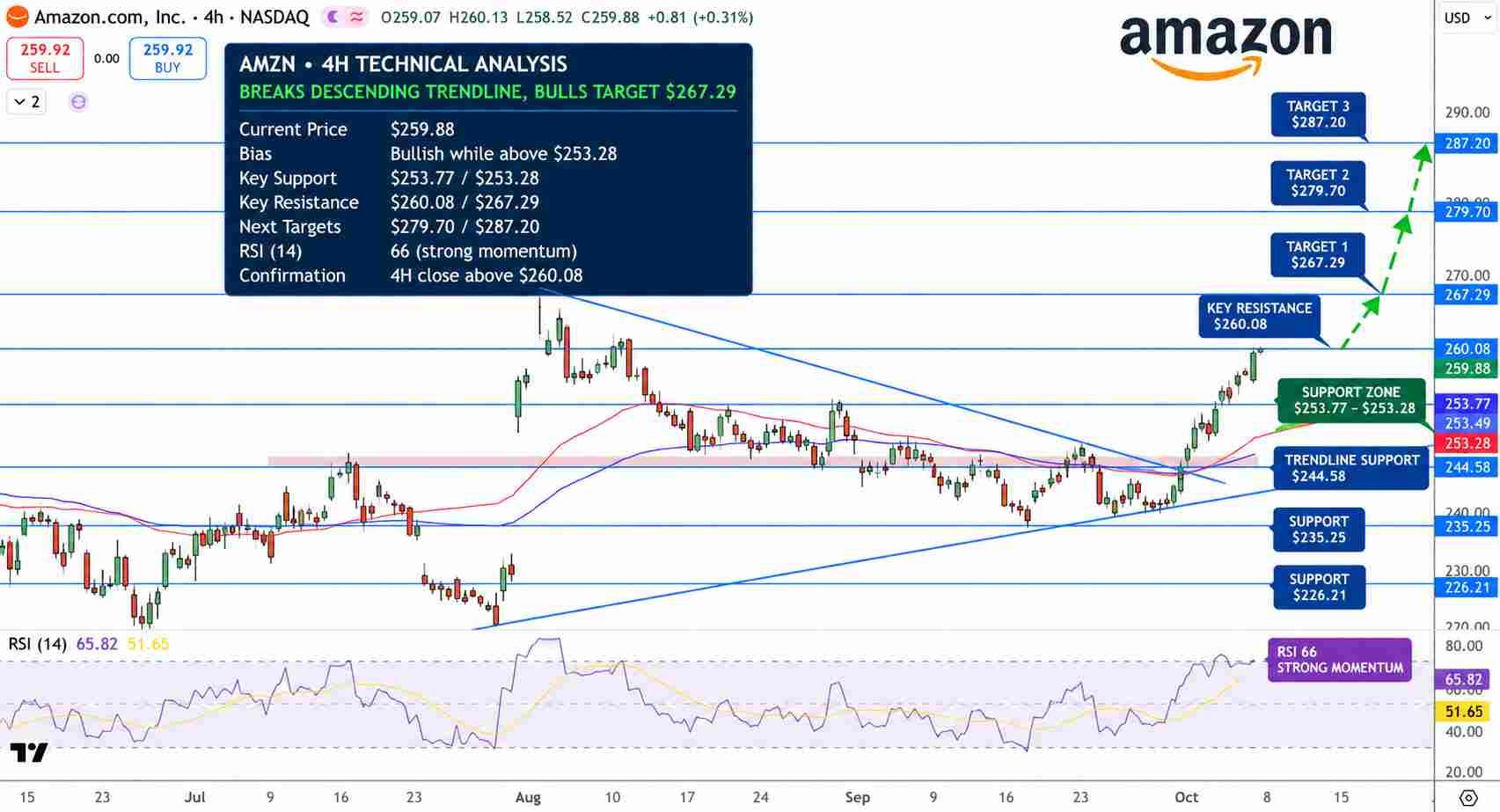
Amazon Stock Price Chart - Source: Tradingview
RSI is at 66, above its signal line at 52, approaching overbought territory but not yet above the conventional 70 threshold. This suggests a short consolidation is possible before a continuation of the trend.
I see the near-term resistance at $260.08, with the larger resistance at $267.29, the high from September 16th. A 4 hour close above $260.08 will expose the larger resistance, and further buying may bring $279.70 and $287.20 into focus.
On the downside, the rising support trendline and former resistance at $253.77 to $253.28 should provide support. A break below this zone would bring the support at $244.58 into play. I remain bullish as long as Amazon is trading above $253.77 to $253.28.
Key Levels
• Latest Completed Close: $259.92
• Major Support Levels: $253.77 to $253.28, then $244.58
• Major Resistance Levels: $260.08, $267.29, then $279.70
• RSI: approximately 66, bullish
• Breakout Target: $267.29 above a confirmed $260.08 break
Why is Amazon stock in focus now?
Amazon is in focus because AWS growth accelerated to 37%, management raised 2026 capex to about $220 billion, and the company is exploring new financing structures to back their AI build out. Retail margins and advertising are also improving, as are their custom-made chips and silicon partnerships.
What level confirms a stronger AMZN breakout?
A 4 hour close above $260.08 would extend the bullish trend, strongly argue for $267.29 and keep the $253.28 to $253.77 zone as the first important support. A breakdown below $253.28 would weaken the bullish breakout and increase the risk of a deeper pullback to $244.58.
Bottom Line
Amazon enters October with perhaps the best operating combination in mega-cap tech. AWS is growing 37%. Amazon’s advertising business is booming. And Amazon’s chip and AI businesses have already surpassed significant annualized revenue run rates.
There is some risk with Amazon. Amazon has a very capital-intensive business model. In the most recent trailing-12-month period, Amazon had negative free cash flow. Amazon expects about $220 billion of capital spending in 2026. To offset those negative free cash flows, Amazon needs measurable growth in AWS and operating margin improvement to validate the spending. Technically, Amazon is bullish above $253.28 to $253.77. Fundamentally, the next major test is whether AWS can keep accelerating, and if Amazon needs to make another capital expenditure commitment to achieve that.
Recommended Articles










Comments (0)
Click the $ button, enter the symbol, and select to link a stock, ETF, or other ticker.