


Boeing Stock Price Forecast: How Will Winning an Over $20 Billion Navy Fighter Jet Order Impact BA Stock?



AI Podcast


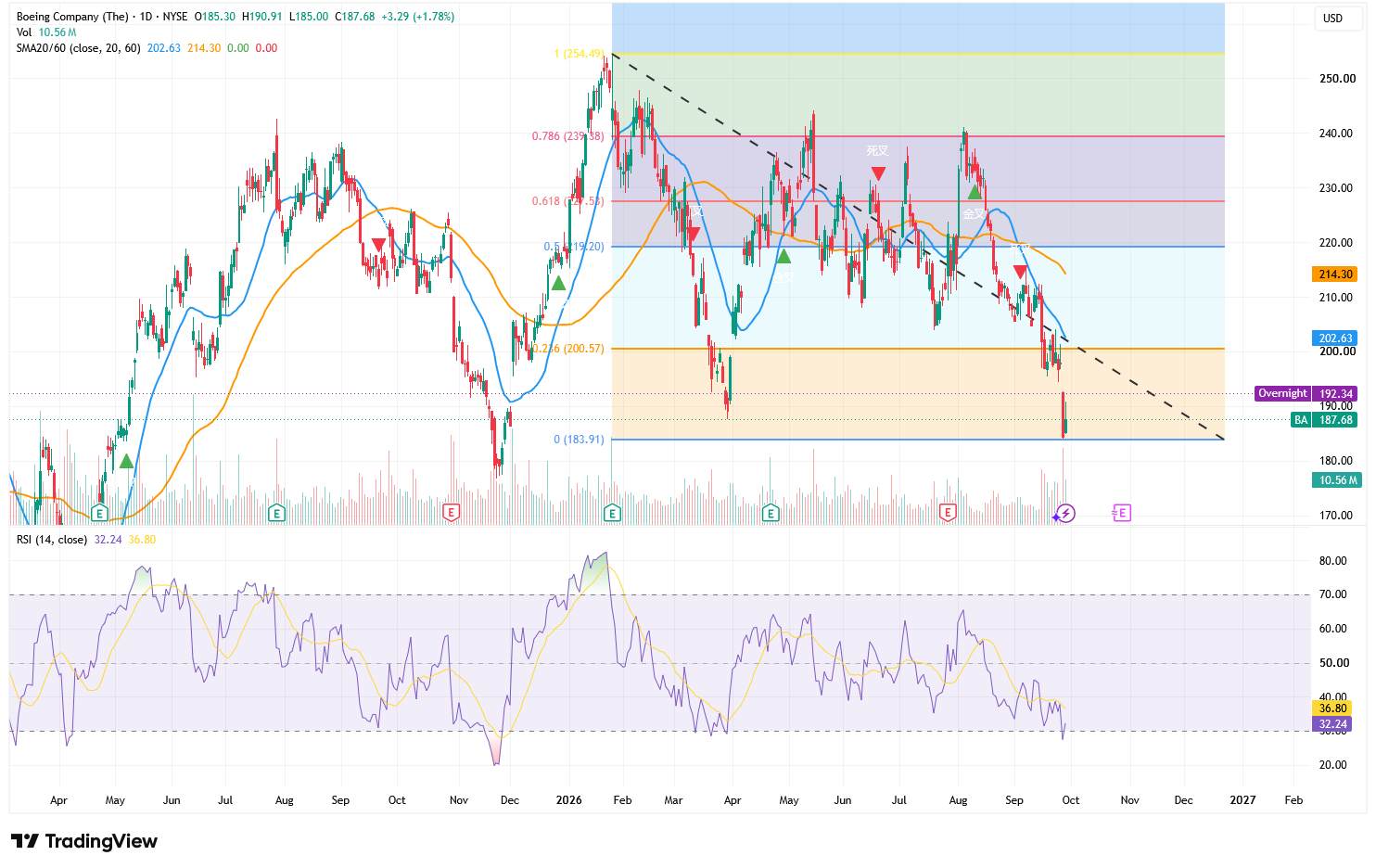
Boeing has secured a $20+ billion U.S. Navy F/A-XX sixth-generation fighter contract, bolstering its long-term defense pipeline following the F-47 award. While this strategic breakthrough revitalizes its military aviation business and lifts investor sentiment, short-term earnings impact remains limited due to developmental timelines. Fixed-price execution risks persist given past program delays. Technologically, the stock has rebounded over 2% to $191.81, nearing oversold RSI levels at 32.24. However, a sustained trend reversal requires breaking key moving averages and resistance near $200–$203 on heavy volume, with immediate support watched at $183.91.
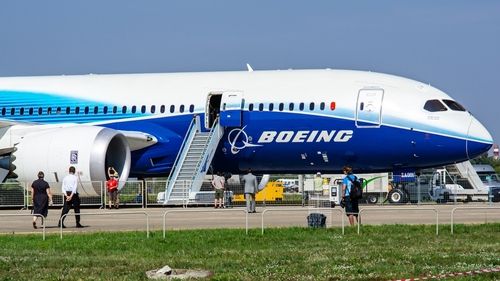
TradingKey - Boeing (BA) won the U.S. Navy's next-generation carrier-based fighter F/A-XX development contract, valued at over $20 billion.
Under the contract, Boeing will be responsible for the full-scale development of the F/A-XX and deliver multiple test aircraft for ground testing, airworthiness verification, systems evaluation, and weapons integration. The program is scheduled to enter service in the 2030s, gradually replacing the F/A-18E/F Super Hornet and EA-18G Growler, while operating alongside the F-35C and unmanned combat aircraft.
Following the announcement, Boeing shares rose over 2% to $191.81 in after-hours trading.
Two Sixth-Generation Fighter Contracts Change Boeing Defense Business Outlook
The F/A-XX is the second consecutive U.S. sixth-generation fighter project awarded to Boeing. In March 2025, the company won the U.S. Air Force's F-47 project, and now it has defeated Northrop Grumman to capture the U.S. Navy's next-generation carrier-based fighter contract.
This means Boeing has entered both the Air Force and Navy future fighter ecosystems, securing a vital position in the next generation of U.S. military aviation. For Boeing's defense unit, which has faced ongoing losses and project delay pressures in recent years, this represents a strategically significant breakthrough.
Boeing has long produced the F/A-18 and EA-18G for the U.S. Navy, but those production lines are nearing their end. Without a major new program, the company's fighter manufacturing business in St. Louis could face declining orders.
The addition of the F/A-XX will sustain its carrier-based fighter business and provide long-term workload for local engineering, manufacturing, and supply chain teams.
The F/A-XX will also serve as the core of the U.S. Navy's next-generation air dominance system. Compared with active-duty carrier aircraft, the new fighter is expected to offer longer range, greater stealth capabilities, and more advanced sensors, as well as the ability to command or team with collaborative combat aircraft. Its primary goal is to enhance the sustained operational capabilities of carrier air wings in long-range and high-threat environments.
From a market perspective, this order not only expands Boeing's long-term project pipeline, but also improves investor perceptions of its defense business competitiveness. Boeing's defense division has posted operational losses over the past four years; securing the F-47 and F/A-XX contracts gives the company an opportunity to rebuild its revenue base in major military aircraft programs.
However, despite the contract's massive size, its contribution to Boeing's short-term revenue and profits may be limited. Sixth-generation fighters remain in the development stage, and future revenue will need to be recognized incrementally as testing, budget appropriations, and production milestones progress, rather than being booked all at once.
At the same time, the market is watching whether Boeing can avoid the problems seen in past defense projects. The KC-46 tanker and T-7A trainer both previously suffered delays, cost overruns, and impairment charges, demonstrating that large fixed-price contracts can carry high execution risks for the company. If the F/A-XX experiences deviations in technology, schedule, or supply chain, program profit margins could also be impacted.
Boeing Stock Technical Analysis
Source: TradingView
Boeing secured a U.S. Navy fighter jet contract worth over $20 billion, helping boost the company's defense backlog and long-term revenue visibility while easing market concerns about its over-reliance on commercial aviation. In the short term, the news has pushed BA's stock price into a rebound, but technicals have yet to confirm a trend reversal.
Boeing's stock price currently remains below its 20-day moving average of $202.63 and 60-day moving average of $214.30, and the downward trendline has not yet been convincingly broken. To the upside, focus first on the resistance zone of $190–$192, followed by $200.57–$203. Only a breakout above this area on heavy volume would give the stock a chance to further rebound to $214–$219.
Key support below is located near $183.91; if the daily chart breaks below this level, the price may drop further to $180 or even the $170 area. The RSI has fallen to 32.24, approaching oversold levels, indicating that momentum to chase the selloff further may be weakening, though no clear reversal signal has appeared yet.
Overall, this Navy contract is positive for Boeing's medium- to long-term fundamentals, but R&D cycles, project execution, and profit realization will still take time. Whether the short-term rebound can continue critically depends on whether the stock can break through $200–$203 and reclaim the 20-day moving average.
This content was translated using AI and reviewed for clarity. It is for informational purposes only.
Recommended Articles












Comments (0)
Click the $ button, enter the symbol, and select to link a stock, ETF, or other ticker.