


Arm Stock Forecast: Can AI CPU Demand Support ARM After Its Sharp Selloff?



AI Podcast


Arm Holdings reported strong Q1’27 revenue growth of 22% year-over-year to $1.29 billion, driven by surging data center demand and expanding AI infrastructure. Despite robust fundamentals, including a 100%+ increase in data center royalty revenue and a $2 billion AGI CPU customer demand pipeline, soaring R&D costs reduced GAAP operating income. Trading at roughly 59x trailing sales, the stock reflects high growth expectations. Technically, ARM recently declined from above $330 to close at $283.33, testing key moving averages with an RSI around 38. Sustaining a close above $299.41 is critical for recovery, while key support holds near $262.42.
TradingKey - Arm Holdings (ARM) plunged in the past few sessions after rebounding from a multi-month low earlier this week. The stock closed at $283.33 on September 28, down 8.70% from its previous close. The stock had been trading above $330 earlier this week. However, recent price action has not deterred Arm from solidifying its foothold in the datacenter. Arm is also expanding its AI infrastructure. The ultimate question is, how much should investors be willing to pay for Arm’s growth?
Royalty Growth Is the Strongest Fundamental Signal
Arm’s Q1’27 report showed a 22% revenue growth from the same period last year to $1.29 billion. Breaking it down further, Arm’s royalty and license revenues showed a 22% and 23% growth, respectively. The take home pay for investors should be Arm’s datacenter business and the continued strength of Arm’s client engagement. For Arm’s datacenter business, royalty revenues more than doubled in the same period last year. While Arm did not disclose absolute numbers for its datacenter business, the more than 100% revenue growth shows positive product shipments for Arm’s Neoverse offerings. Engagement for Arm’s client datacenter business is robust. Arm also disclosed that the annualized contract value for its licensing business grew 13% to $1.73 billion.
AGI CPU Opens a New Revenue Path
The introduction of AGI CPU changes how Arm approaches selling its IP. Traditionally, Arm sells its IP in a couple of different ways. First, Arm charges customers to license its IP. Second, Arm sells its IP and charges customers to build compute subsystems for the customer. With AGI CPU, Arm has expanded beyond IP and Compute Subsystems into its own production silicon products. Arm designs and sells the AGI CPU while working with manufacturing and supply-chain partners to secure production capacity.
Arm has indicated it has delivered initial products to multiple customers and secured manufacturing capacity for an initial $1 billion opportunity across fiscal 2027 and fiscal 2028. From Arm’s disclosure, customer demand exceeds $2 billion across those two fiscal years, but that demand is not the same as recognized revenue or guaranteed sales. Arm has described the chip model as offering roughly 50% illustrative gross margin and higher gross-profit dollars than its royalty model, but actual AGI CPU margins have not yet been disclosed. The more interesting disclosure for Arm will be manufacturing margins on the orders.
Data Center Adoption Is Broadening Beyond One Customer
Other customers besides the hyperscale data center are adopting Arm-based data center chips. NVIDIA and Google are two prominent ecosystem adopters: NVIDIA’s Vera CPU is Arm-based, Google uses Arm-based Axion CPUs, and AWS continues to expand Graviton. In addition, Arm has disclosed its IP is being adopted by data center customers through its work with AWS and other Arm-based data center processors. Because Arm has a flexible business model, the company should benefit from additional customers adopting its data center IP through various means. For example, Arm could charge customers for data center chips, licensing data center IP or both.
September Launches Expand the AI Infrastructure Portfolio
Arm Neoverse Compute Subsystems (N4) launched on September 8. They allow Arm’s customers to more quickly fabricate data center chips from Arm-based compute subsystems. Arm monetizes N4 primarily through its IP and Compute Subsystems business model; revenue does not require a partner to publicly announce a chip shipment. Arm’s September 28 discussion concerned NVIDIA’s Open Agent Safety Platform, showing how Arm CPUs and Arm-based DPUs can participate in agentic-AI security. It was an ecosystem announcement, not a disclosed Arm sales contract or revenue contribution.
Mobile AI Still Matters
The server market is not Arm’s only source of potential revenue. In September, Arm also introduced CSS for Mobile 2, which incorporates components for agentic AI and mobile computing. While the agentic AI market is only nascent, mobile remains a large market for Arm. New Arm-based designs take some time to gain market acceptance; in the interim, Arm will focus on licensing the designs. Should the data center market become more volatile, Arm’s focus on mobile AI designs will provide a cushion.
Profitability Shows the Cost of Expansion
Q1 reported a decline in GAAP operating income from $114 million to $91 million. This report attributed the decline to the company expanding research and development (R&D) spending. Other-than-GAAP operating income increased to $531 million, resulting in other-than-GAAP diluted earnings per share (EPS) of $0.45, up from $0.35 in the prior year. There are material distinctions between GAAP financial statements and the adjusted/other-than-GAAP financial statements.
Arm is experiencing increasing costs associated with expansion to broaden its technology offerings and investments in “direct-to-silicon” products and solutions. During the quarter, cash flow from operations was $902 million, resulting in free cash flow of $665 million. Arm reported its results benefitted from accelerated collections of accounts receivable and favorable tax payments. Favorable cash collections are not expected to be recurring.
Q2 Guidance Keeps Growth Expectations High
For Q2 2027, Arm predicted revenue between $1.33 and $1.43 billion. With the midpoint of this range representing 22% year-over-year growth, the expectation is non-GAAP EPS of $0.47, with a potential deviation of $0.04. Arm expects its license and other revenue to increase by around 30% year-over-year, and royalty revenue to increase by a low-teens percentage. Royalty revenue increases are based on the company’s expectations and are not reflective of any reported results. Arm is expected to report financial results on November 4 after the market close.
Valuation Leaves Little Room for Delays
Arm had a market capitalization of $302.6 billion and revenue of $5.16 billion for the 12 months prior to September 28. Using the 12 month revenue, Arm’s valuation is approximately 59x trailing 12 month revenue. Given Arm’s business model, which includes high gross margins and exposure to Artificial Intelligence, the valuation can be justified. However, continued and repeated execution against its strategic initiatives is critical to justify the valuation. Negative surprises, such as slowing the pace of AGI chip shipments or increased operating expenses, can reduce the valuation.
Arm Holdings Technical Analysis: ARM Tests $277.77 Support After Sharp $319 Rejection
Arm Holdings’ latest completed close is $283.33, following a sharp decline from above $330. Usually, a close above a level results in an up-trend and a close below a level results in a down-trend. However, Arm should be viewed on a case to case basis due to its irregular price action.
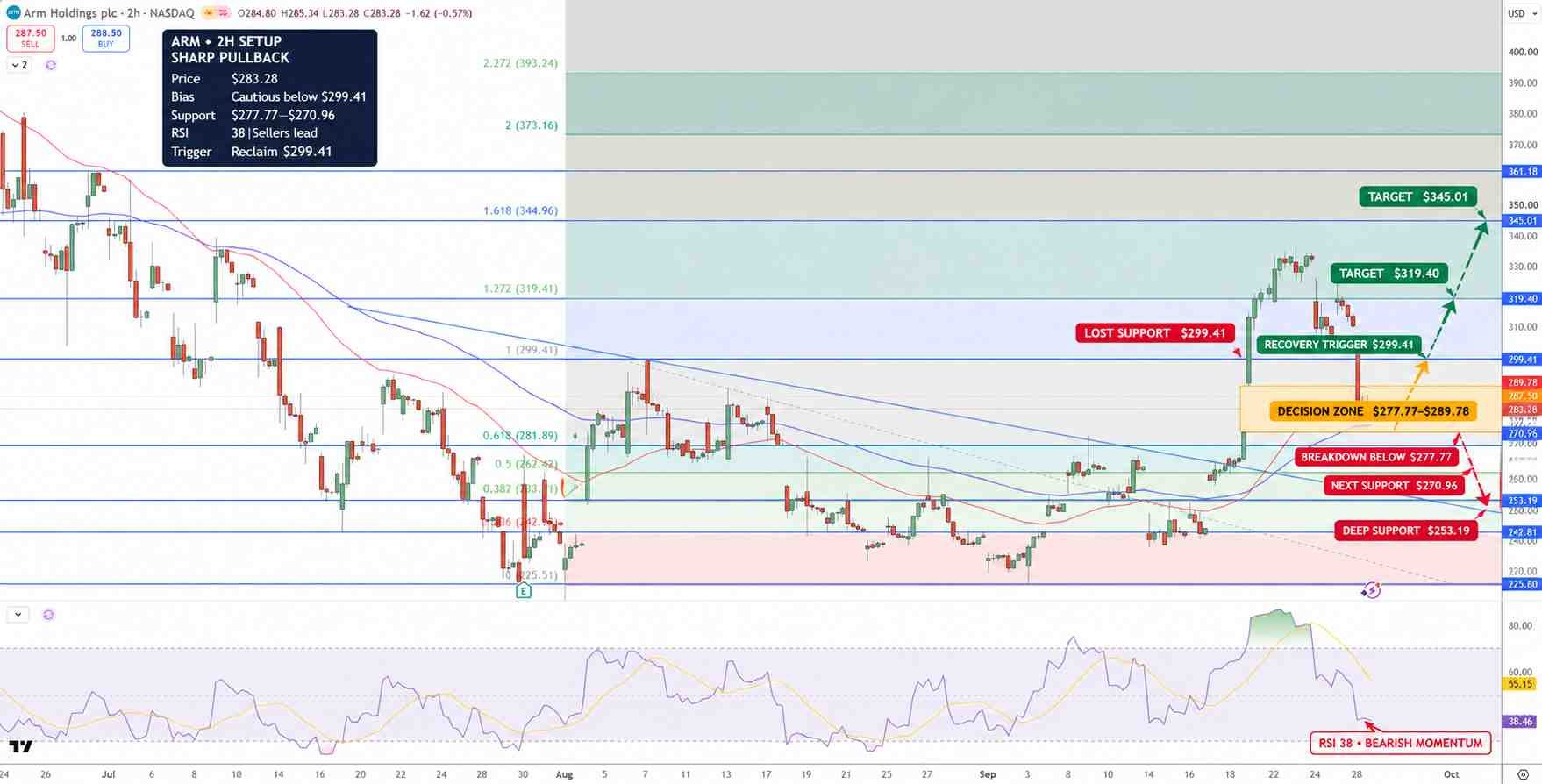
Arm Stock Price Chart - Source: Tradingview
The level of interest is the rapid decline from $330 to $319 to $299, which makes the current price action somewhat concerning as it has made a direct move towards the 20 EMA, 50 EMA, and 200 SMA. The 20, 50 and 200 moving averages act as support. RSI has also fallen from above 80, or overbought territory, to around 38.
The moving averages and RSI indicate that Arm may move towards $270 before it moves higher. The main moving average resistance is between $289 and $299. A close above the $299 resistance would move the focus to the $319 and $345 levels. Moving below $270 would redefine the level of interest to the $262.42 level first, followed by $253.19. $262 remains the key support level. My neutral to bearish bias remains as long as Arm trades below $299.
Key Levels
• Latest completed close: $283.33
• Major support levels: $277.77, $270.96 to $271.85, then $262.42
• Major resistance levels: $289.78 to $299.41, $319.40, then $345.01
• RSI: approximately 38, bearish but nearing stabilization
• Recovery trigger: $299.41 on a confirmed 2-hour close
Why is Arm stock in focus now?
September product releases broadened ARM’s AI infrastructure offerings, AGI CPU customer demand exceeds $2 billion across fiscal 2027 and 2028, and Arm’s data center royalty Streams more than doubled. September’s sell-off shifts the focus to valuation and the future of ARM’s AI products.
What level confirms a stronger ARM recovery?
If ARM posts a sustained 2-hour close above $299.41, the stock could rise to $319.40, and possibly higher. If the stock falls to $270.96 or below, a drop to $262.42 and potentially $253.19 could occur.
Bottom Line
AI is obviously the future. ARM’s AI offerings are increasing and the company is expanding into higher-revenue production silicon, although AGI CPU profitability has not yet been demonstrated in reported results. Data center royalty streams and the initial AGI CPU products delivered to customers are positive developments.
Can ARM meet demand for AI? The roughly 59x P/S ratio suggests investors are betting on it. If Royalty Streams and profitable AI chips don’t materialize, ARM will be in trouble.
While ARM is above $270.96, expect it to rise. A drop to $277.77 could be supported. A fall to $262.42 is possible if it breaks $270.96.
Recommended Articles






Comments (0)
Click the $ button, enter the symbol, and select to link a stock, ETF, or other ticker.