


Today’s Market Recap: Brent Crude Nears $100, Gold and Bitcoin Under Pressure as US-Iran Conflict Escalates



AI Podcast


On September 7 ET, escalating U.S.-Iran conflicts disrupted Strait of Hormuz shipping and drove Brent crude near $100, fueling inflation fears. Strong August nonfarm payrolls raised September Federal Reserve rate hike expectations to roughly 60%, pressuring spot gold, while Bitcoin fluctuated near $79,500 following a $320 million Liquid Network security incident. Meanwhile, Japan reported a record foreign exchange reserves decline due to yen interventions, and upcoming U.S. CPI and PPI data remain critical for monetary policy direction. Additionally, U.S.-China AI safety dialogues and UN warnings highlighted growing global focus on technology governance risks.

Tracking Market Trends
TradingKey - On September 7 ET, U.S. financial markets were closed for Labor Day, leaving global market trading relatively quiet. However, the escalating U.S.-Iran conflict pushed international oil prices to a six-week high and renewed market concerns about energy inflation and global central bank monetary tightening. Meanwhile, last week's robust U.S. August nonfarm payrolls data continued to affect markets, keeping expectations for a September Fed rate hike at an elevated level as investors await this week's PPI and CPI inflation data for new policy clues.
In commodities, crude oil continued to move higher. Brent crude (UKOIL) rose 1.52% to close at $97.30, hitting an intraday high of $98.06; WTI crude (USOIL) closed at $91.23, reaching an intraday high of $92.17. The U.S.-Iran military conflict continued to spread to energy facilities and tanker transit, dropping vessel traffic through the Strait of Hormuz to its lowest level since May and driving markets to price in higher supply disruption risks.
In precious metals, gold (XAUUSD) remained under pressure. Spot gold fell 0.56% to $4,406.05. Friday's U.S. August nonfarm payrolls report was significantly stronger than expected, prompting markets to re-bet on a September Fed rate hike, with current pricing reflecting roughly a 60% probability of a rate increase. Meanwhile, persistent gains in oil prices further exacerbated inflation fears, placing pressure on non-yielding gold.
In cryptocurrencies, Bitcoin (BTC) continued to fluctuate around $80,000, trading near $79,500 on Monday. Bitcoin briefly broke above $82,000 last week, but pulled back again after strong nonfarm payrolls data elevated Fed rate hike expectations.
Market Highlights
US-Iran conflict escalates further as Iran warns of potential strikes on Middle East energy infrastructure. Iran stated that if the US continues attacking its assets, it will retaliate against energy infrastructure in the Middle East region. This follows a significant escalation in attacks on oil tankers and warships by both sides, as well as an attack on Saudi Aramco's Jazan refinery. As military operations spread further from maritime shipping to energy facilities, market concerns over long-term disruptions to Middle East oil supply have mounted noticeably.
Strait of Hormuz shipping volume drops to lowest since May, Brent crude nears $100. As military actions targeting vessels between the US and Iran continue to increase, commercial ship transit through the Strait of Hormuz has fallen to its lowest level since May. Brent crude rose to a high of $98.06 on Monday, just a step away from the $100 mark. Market analysts warn that if shipping through the Strait of Hormuz deteriorates further, international oil prices still face significant upside risks.
Liquid Network suffers security incident involving approximately $320 million in Bitcoin. Bitcoin sidechain Liquid Network stated that approximately 4,000 Bitcoins were transferred out of its federation wallet, valued at around $320 million at the time, representing the vast majority of the wallet's original ~4,200 Bitcoins. Liquid subsequently suspended new transactions, and multiple trading platforms also paused deposits and withdrawals related to L-BTC. The party executing the operation claimed to be a "white hat hacker," and the incident has once again drawn market attention to the security of cryptocurrency infrastructure.
Japan's foreign reserves post record decline in August as yen hits seven-month high. Data from Japan's Ministry of Finance shows that as of late August, Japan's foreign exchange reserves fell to $1.208 trillion, down $79.6 billion from the end of July. The 6.18% drop represents the largest single-month decline on record. This follows massive foreign exchange market interventions by the Japanese government to halt the continuous depreciation of the yen. Meanwhile, rising expectations of further rate hikes by the Bank of Japan pushed USD/JPY below the key psychological threshold of 155.
US CPI and PPI this week to decide whether the Fed hikes rates in September. Last week's data showed US nonfarm payrolls added 162,000 jobs in August, far exceeding market expectations, while the unemployment rate remained at 4.1%, pushing the market to raise Fed rate-hike expectations again. Traders currently price in roughly a 60% probability of a 25-basis-point rate hike in September. The US will release PPI on Thursday and CPI on Friday, which will be the most crucial set of inflation data prior to the Fed's rate decision on September 16.
US and China plan AI safety dialogue for mid-September. Sources say the US and China are preparing to hold an artificial intelligence safety dialogue in mid-September, where both sides are expected to discuss potential security risks posed by advanced AI systems as well as related governance issues. Against the backdrop of escalating US-China competition over AI chips, models, and technology exports, this dialogue will draw close attention from the tech industry and capital markets.
UN human rights chief warns AI could pose "existential" risks. UN High Commissioner for Human Rights Volker Türk said on Monday that the rapid development of artificial intelligence could pose significant risks to humanity, stating he will push AI companies to strengthen risk controls. Risks of concern to the UN include the potential impact of AI on public services, communication systems, and democratic institutions, as global discussions on AI regulation continue to heat up.
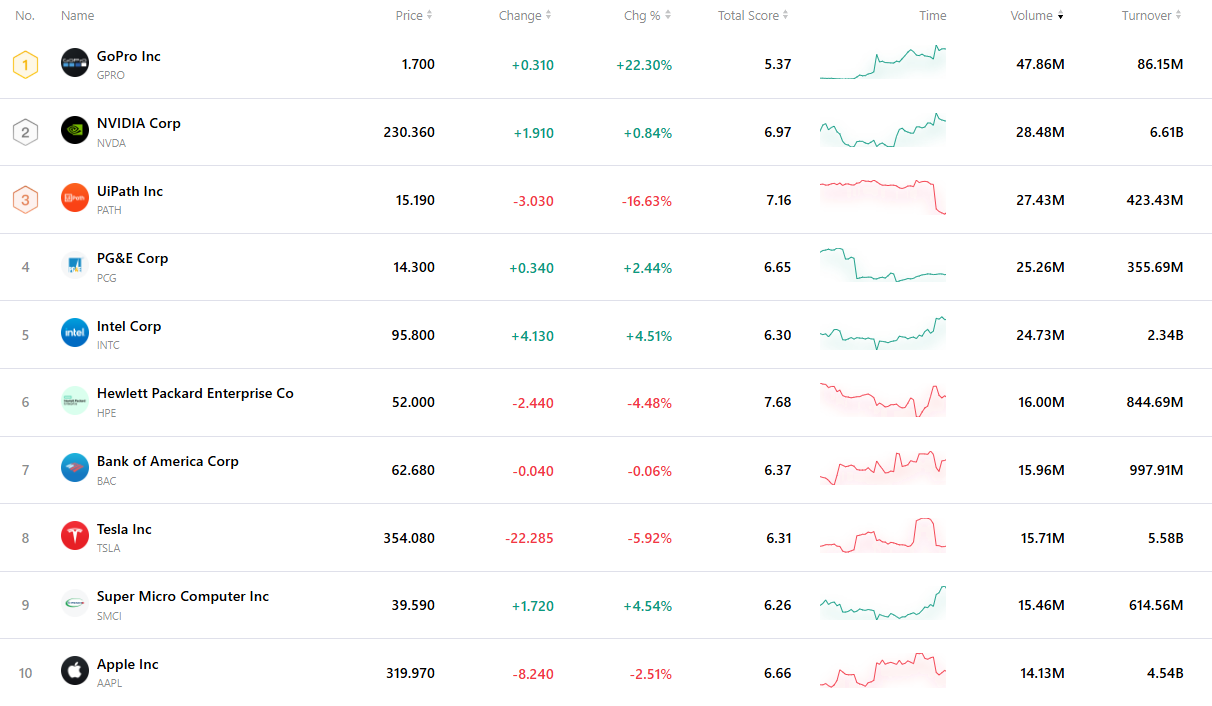
Top 10 Most Active Stocks
The table below lists the ten most actively traded stocks in the current market. Supported by massive trading volumes and exceptional liquidity, these assets have become key benchmarks for tracking global market dynamics.
This content was translated using AI and reviewed for clarity. It is for informational purposes only.
Recommended Articles









Comments (1)
Click the $ button, enter the symbol, and select to link a stock, ETF, or other ticker.