


Buffett Successor Greg Abel in Rare Interview: Berkshire to Hold Japanese Trading Houses for Decades, Details $10 Billion Alphabet Investment



AI Podcast


On September 3, Tokyo time, Berkshire Hathaway CEO Greg Abel outlined the firm's long-term capital allocation strategy. Berkshire plans to hold its stakes in five major Japanese trading houses for decades, potentially increasing investments and yen-denominated debt issuance. Alphabet has emerged as its third-largest common stock holding following a $10 billion investment, driven by confidence in AI applications. Additionally, rising electricity demand from AI data centers offers growth for Berkshire Hathaway Energy under strict community guidelines. While the U.S. housing market faces short-term pressures, Berkshire maintains a robust liquidity reserve of $364.7 billion.
Japanese Trading Houses: Held for Decades, May Continue to Increase Holdings
In an interview, Abel explicitly stated that Berkshire plans to hold its shares in Mitsubishi Corp., Mitsui & Co., Itochu, Sumitomo, and Marubeni for "decades." Berkshire began investing in these five trading houses about six years ago and raised its stake in each to over 10% after obtaining their approval.
As of the end of 2025, the market value of Berkshire's stock holdings in the five trading houses was approximately $35.37 billion, and it received about $862 million in dividends that year. By early September 2026, the total value of these five investments had risen to around $42 billion. Abel expects that the underlying earnings of the five trading houses will continue to grow, with future dividends and share buybacks also expected to increase.
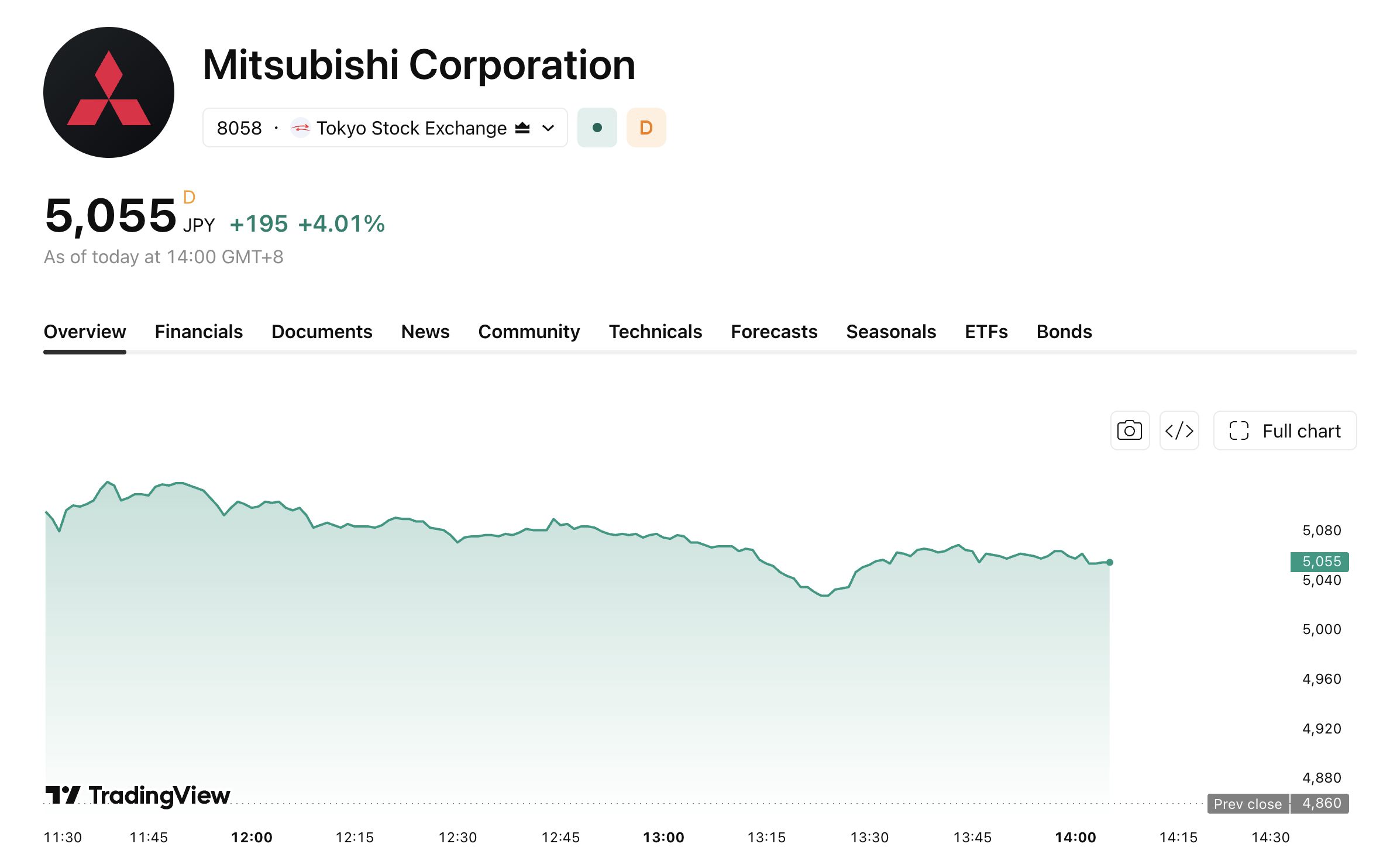
Following Abel's comments, shares of Japan's five major trading houses rallied across the board on September 3. Mitsubishi Corp. rose as much as 5.4% intraday, while Sumitomo, Mitsui & Co., Itochu, and Marubeni also saw gains exceeding 3% at one point. As of press time, Mitsubishi Corp. was up about 4%.
[Source: TradingView]
Abel stated that Berkshire may still further increase its stakes in the five trading houses at an appropriate time. During this trip to Japan, he also held discussions with the management of the five trading houses and Tokio Marine Holdings.
Regarding Japan's 10-year government bond yield recently rising to around 3%, hitting its highest level since 1996, Abel noted that none of the five trading houses view the current interest rate level as a fundamental challenge, believing that Japanese yields remain relatively moderate in absolute terms. Berkshire currently holds more than $15 billion in yen-denominated debt and may continue to raise capital through the Japanese market in the future.
Alphabet: AI Becomes Key Investment Thesis
Meanwhile, Alphabet has become one of Berkshire's most important new investments in recent years. Abel said that Buffett began leading Berkshire's initial position in Alphabet about 15 months ago.
At the end of May this year, Alphabet invited Berkshire to participate in its stock offering. The two sides subsequently discussed the investment size and discount, and Berkshire ultimately completed an investment of approximately $10 billion at a 6.5% discount.
As of the end of June, Berkshire held approximately 106 million shares of Alphabet with a market value of about $37.8 billion, making it its third-largest common stock holding. Abel noted that feedback from Berkshire's businesses during their practical use of AI increased the company's interest in Alphabet.
AI Data Centers: A New Growth Point for the Energy Business
Abel stated that the growing electricity demand from AI data centers represents a major opportunity for Berkshire and Berkshire Hathaway Energy. Last year, data centers accounted for approximately 8% of Berkshire Hathaway Energy's power load in Iowa.
However, Berkshire requires that related projects must not drive up electricity rates for other customers and should benefit existing customers overall; at the same time, they must also obtain local community approval and consider impacts such as water resources.
Housing Market and Capital Allocation
Berkshire completed its acquisition of Taylor Morrison (TMHC) in July this year, with an equity value of approximately $6.8 billion. Abel expects the asset to retain strong value over the next 5 to 10 years, but the U.S. housing market will not recover rapidly in the short term, and consumers continue to face pressure from inflation and mortgage rates.
As of June 30, Berkshire's liquid assets, including cash and short-term U.S. Treasuries, stood at approximately $364.7 billion. Despite having recently deployed significant capital into areas such as Alphabet and Taylor Morrison, Berkshire still retains a massive liquidity reserve.
In addition, Berkshire acquired an approximately 2.5% stake in Tokio Marine Holdings in March this year and established a strategic partnership with it. Abel stated that the company hopes to continue exploring opportunities for cooperation between the two sides.
Overall, the core signal conveyed by Abel in this interview remains long-term capital allocation: seeking long-term investment opportunities across areas such as Japanese trading houses, Alphabet, AI energy, and housing.
This content was translated using AI and reviewed for clarity. It is for informational purposes only.
Recommended Articles







Comments (0)
Click the $ button, enter the symbol, and select to link a stock, ETF, or other ticker.