


Tesla Surges 18% in August Ahead of Cybercab Launch as Top Wall Street Target Hits $600



AI Podcast


Tesla shares surged over 18% in August, driven by strong Q2 deliveries, significant Semi truck orders, and anticipation for the September 3 Cybercab event. While legacy automakers and some Chinese EV makers faced pressures from slowing global sales and subsidy cuts, Tesla's market focus shifted toward autonomous driving commercialization. Wall Street sentiment remains divergent, with target prices ranging from $125 to $600. Tesla's medium-to-long-term valuation increasingly depends on the successful execution and commercial scaling of its FSD technology, Robotaxi fleet, and robotics businesses rather than traditional automotive manufacturing alone.

TradingKey - Global EV sector performance diverged in August, with Tesla (TSLA) leading with a monthly gain of over 18%. The approaching Cybercab event, Einride's 500-unit Semi order, the Model Y L Launch Series nearing sell-out, and better-than-expected Q2 deliveries collectively drove the stock higher.
Sector Performance Diverges as Tesla Leads Gains
As of August 31 Eastern Time, Tesla closed at $367.95, with a monthly gain of over 18%, and its market capitalization recovered to approximately $1.43 trillion.
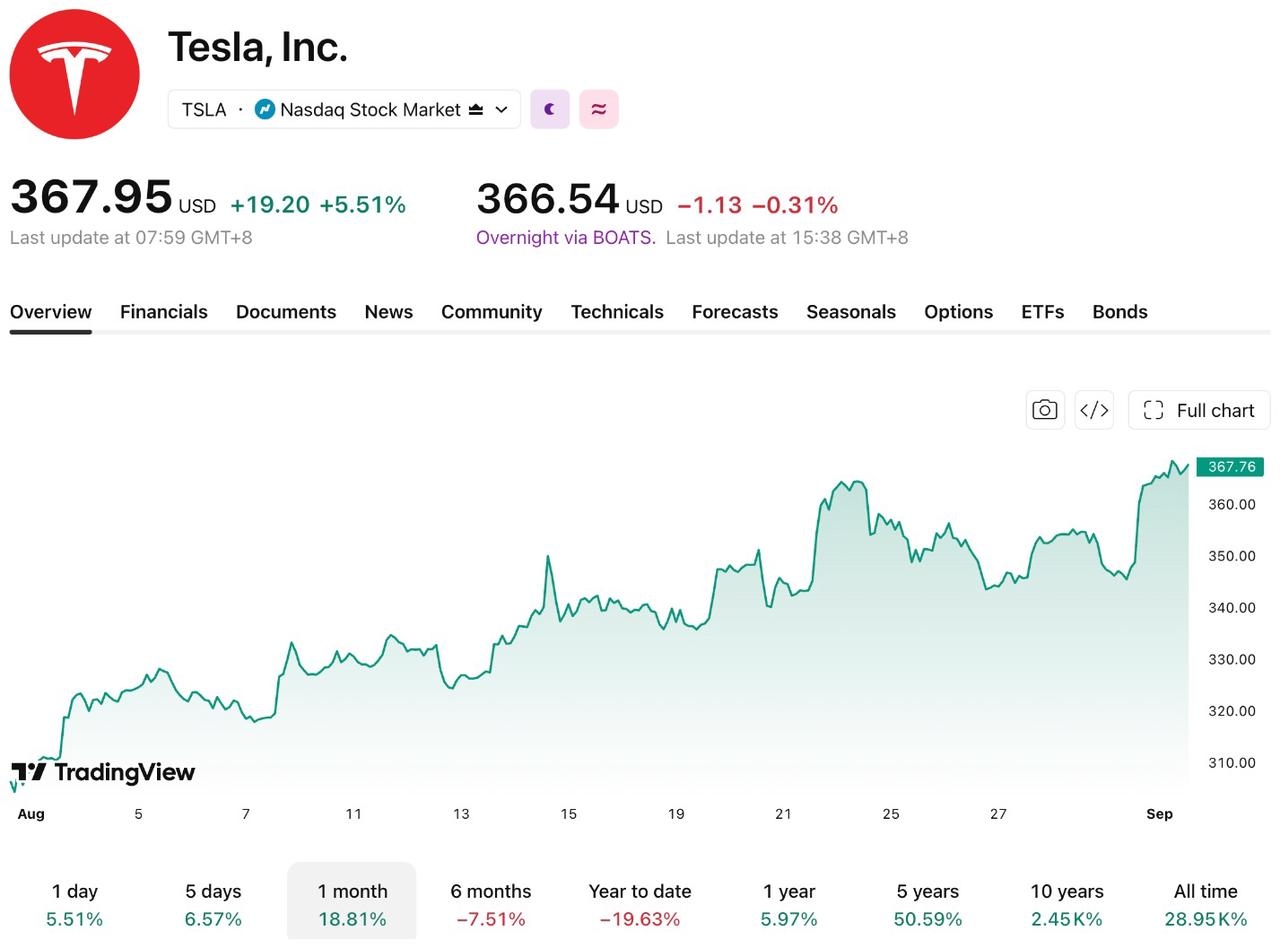
[Source: TradingView]
On August 31, Tesla gained 5.51% in a single day, with a trading volume of approximately 61.1 million shares, about 46% above its three-month average, indicating that capital had begun to flow in heavily ahead of the Cybercab launch event on September 3.
However, as of press time, Tesla remains down about 19.6% year-to-date, while Ford (F) gained about 5.77% over the same period. Since late August, as the launch event approached, the stock price recovered rapidly, and market focus has been shifting from short-term automotive profitability to autonomous driving commercialization prospects.
Among other automakers, Rivian (RIVN) rose about 5.52% in August, but remains down about 18.5% year-to-date. Among legacy automakers, Ford, General Motors (GM), and Stellantis (STLA) all saw stock prices fall in August, with Stellantis dropping near its 52-week low and registering a year-to-date decline of about 49.5%.
Chinese EV makers also weakened, as XPeng (XPEV) and Li Auto (LI) delivered below-expected interim results. BofA Securities pointed out in a late-August report that global EV sales growth in the second quarter was generally weaker than expected, mainly affected by subsidy cuts and front-loaded demand.
Cybercab Launch Boosts Stock Price Expectations
Tesla is scheduled to hold a dedicated Cybercab launch event at its headquarters in Austin, Texas, on September 3. Designed from the ground up without a steering wheel, pedals, or side mirrors, the vehicle relies entirely on the FSD system to operate. According to tech media reports, the event is invitation-only, and invitees can watch via an official livestream.
Tesla currently operates Robotaxi services in cities such as Austin, Dallas, Houston, Miami, Orlando, and Tampa. On August 20, Nevada regulators approved Tesla to deploy up to 5,000 autonomous vehicles in Clark County, providing regulatory scope for subsequent expansion.
However, the September 3 event will still focus primarily on product demonstration. Whether Cybercab can enter the paid operations stage depends on FSD performance, regulatory approvals, and insurance arrangements. If the mass production timeline or pricing announced at the event exceeds market expectations, it could prompt the market to expand Tesla's valuation logic from an automaker to a mobility service provider.
Semi Orders and Model Y L Provide Fundamental Support
On August 18, Swedish freight technology company Einride announced that it will deploy 500 Tesla Semi electric heavy-duty trucks in North America to provide freight services for customers including Amazon. This marks the largest publicly disclosed Semi purchase order to date. The first batch of vehicles is expected to begin delivery in September, with all 500 vehicles set to be deployed in batches over 24 months.
In passenger vehicles, the Model Y L Launch Series is nearly sold out in the U.S. two months after its launch, with new vehicle deliveries pushed back to early 2027, indicating that demand exceeds current production capacity. Starting at approximately $62,000 with an EPA range of 325 miles, the model is targeted at the three-row family SUV market.
In the second quarter, Tesla delivered 480,126 electric vehicles globally, up approximately 25% year-over-year and about 34% quarter-over-quarter, achieving its best-ever performance for the period and significantly surpassing Wall Street's consensus expectation of around 406,000 units.
Wall Street's Highest Price Target Reaches $600
According to data from StockAnalysis, as of September 1 Eastern Time, the average 12-month target price for Tesla given by 46 analysts is $390.09, implying an upside of about 6% from current levels. The rating breakdown includes 17 "Strong Buy", 6 "Buy", 19 "Hold", 2 "Sell", and 3 "Strong Sell".
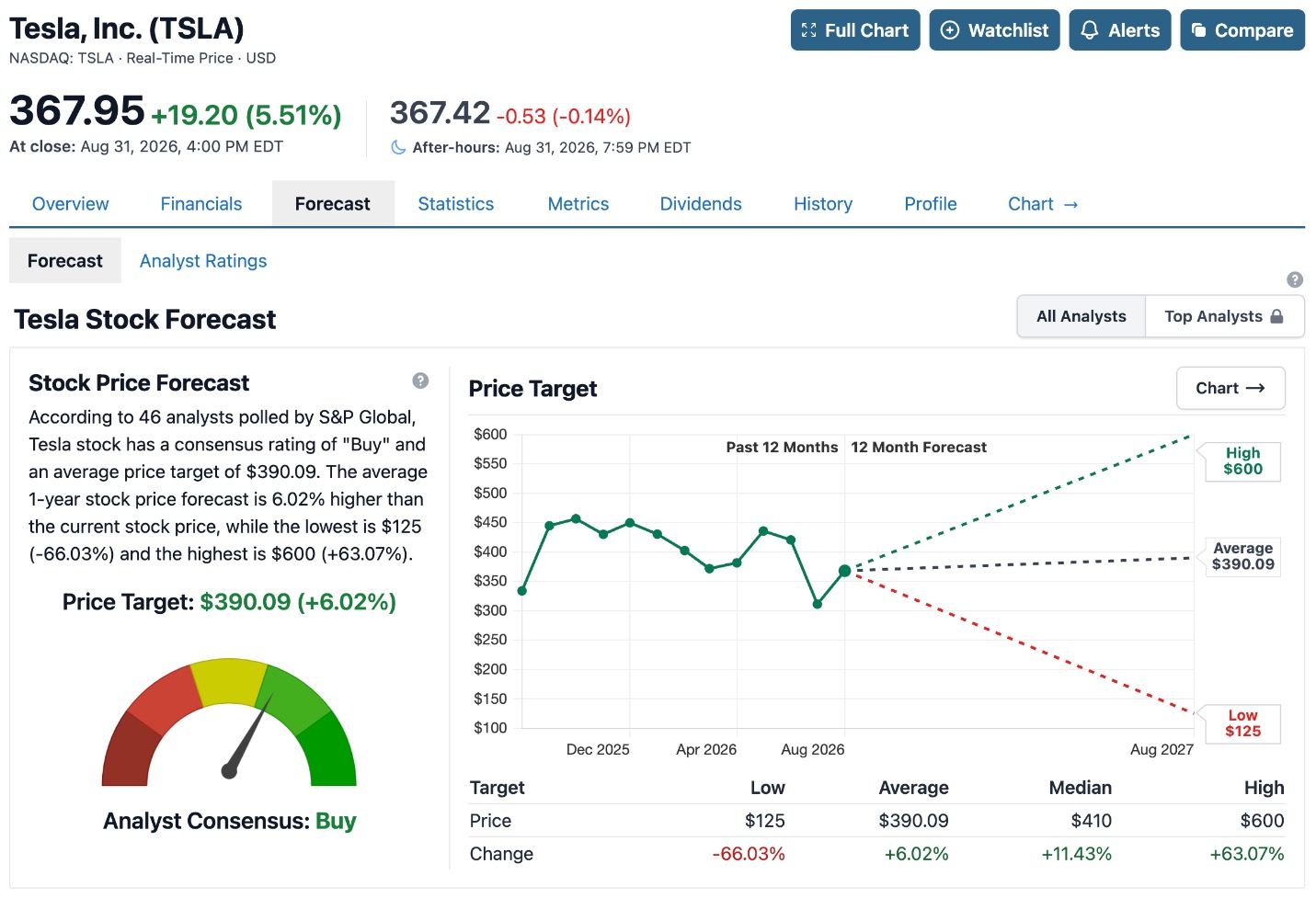
[Source: StockAnalysis]
There is significant divergence among analysts, with the highest target price at $600 and the lowest at just $125. Wedbush Securities analyst Dan Ives set a target price of $600, arguing that Tesla should not be valued as an auto stock, but rather as a physical AI platform, with its long-term value supported by FSD commercialization, Robotaxi fleet expansion, and the scaling of the Optimus humanoid robot.
JPMorgan analyst Rajat Gupta maintained a $445 target price and a "Neutral" rating on Tesla, focusing on the capability enhancements of FSD v15 and their impact on the commercial prospects of Robotaxi.
Meanwhile, GLJ Research reiterated its "Sell" rating on Tesla on August 18 and predicted that the stock price would fall to $200. Its analyst Gordon Johnson stated bluntly in a report that the takeover frequency in current end-to-end FSD testing is deeply concerning and cannot support the current price-to-earnings ratio of over 100x.
Summary
Tesla's August rally was mainly driven by expectations surrounding the Cybercab launch event, combined with fundamental factors such as Semi orders and Model Y L demand. The key highlights of the September 3 event lie in the mass production timeline, service scope, and pricing strategy: if these exceed market expectations, the stock price may continue to rise; if the event primarily showcases concepts and lacks commercialization details, earlier gains could face a pullback.
Over the medium to long term, Tesla's valuation will depend on the progress of commercializing its autonomous driving and robotics businesses. Its EV business has returned to a growth trajectory, but whether Cybercab can convert market expectations for mobility services into actual revenue remains the key to determining its future trajectory.
This content was translated using AI and reviewed for clarity. It is for informational purposes only.
Recommended Articles








Comments (0)
Click the $ button, enter the symbol, and select to link a stock, ETF, or other ticker.