


Dell Earnings Preview: AI Server Momentum in Focus, Wall Street Sees Stock Up to $650



AI Podcast


Wall Street maintains a bullish stance on Dell ahead of its fiscal Q2 2027 earnings report, driven by explosive AI server demand, with price targets reaching up to $650. Major institutions project revenue growth of approximately 50% year-over-year to $44.5 billion–$44.9 billion and EPS surges exceeding 100%. While strong enterprise AI infrastructure upgrades and massive order backlogs support a Strong Buy consensus, potential risks include gross margin compression from high component costs and potential profit-taking selling pressure if results only meet expectations, implying a post-earnings volatility of up to 17%.
TradingKey - Wall Street is bullish on the AI server boom, heavily pushing Dell ahead of earnings with price targets raised as high as $650.
On September 1, Dell (DELL) stock maintained high-level volatility ahead of its earnings report, rising 0.31% in overnight trading to temporarily stand at $458.31. Yesterday, Dell's stock saw even smaller price swings, dipping slightly by 0.05%. However, this period of minimal volatility will be broken by the earnings report released after the market close.
After the market close today, Dell Technologies will release its fiscal second quarter 2027 (Q2 FY27) financial report. Major institutions generally expect Dell to deliver a strong performance with doubling growth in both revenue and profit, projecting revenue to increase approximately 50% year-over-year to $44.5 billion–$44.9 billion, EPS to surge over 100% year-over-year to $4.90–$4.95, and single-quarter AI server revenue estimated at $15.5 billion–$16.0 billion. In addition, AI server order backlog climbed to $51.3 billion in the previous fiscal quarter, and Wall Street is watching this report closely for the efficiency of converting backlog into actual revenue as well as the pace of new order bookings.
Currently, Wall Street research teams maintain an overall rating of Strong Buy / Overweight on Dell stock, with the highest price target bullishly set at $650, representing over 40% upside from current levels, detailed as follows:
Investment Bank / Research Firm | Latest Price Target | Investment Rationale |
Melius Research | $650 | Explosive growth in AI server demand, market share shifts from competitors, and a comprehensive upgrade of enterprise AI infrastructure |
JPMorgan | $565 | Cites strong enterprise demand for agentic AI servers and raised the price target. |
Wells Fargo | $545 | Points out that Dell continues to expand its market share among large enterprises and Tier-2 cloud service providers (CSPs). |
Goldman Sachs | $510 | Commends Dell's pricing power and shipping capabilities amid tight AI server supply and demand conditions. |
Given the massive AI server backlog and sustained strong demand for enterprise AI server upgrades, major institutions remain optimistic about Dell's upcoming earnings report, demonstrating market confidence in the re-valuation of Dell's transformation from a traditional PC vendor to a global leader in AI hardware infrastructure.
However, the market may be selectively overlooking Dell's risk of gross margin compression. Component costs for AI servers (GPUs, HBM memory) are exceptionally high, resulting in lower gross margins than traditional general-purpose servers. If the high-margin storage business fails to ramp up volume as expected, overall profit margins could be dragged down, representing a major potential downside risk for its stock price.
Wall Street options markets imply a post-earnings single-day stock price volatility as high as 9.5%–17%. If revenue or guidance merely meets expectations, or especially misses them, profit-taking selling pressure could easily emerge at near-term highs. From a technical analysis perspective, Dell's stock price could drop below the $400 mark on the downside, seeking support at $360.
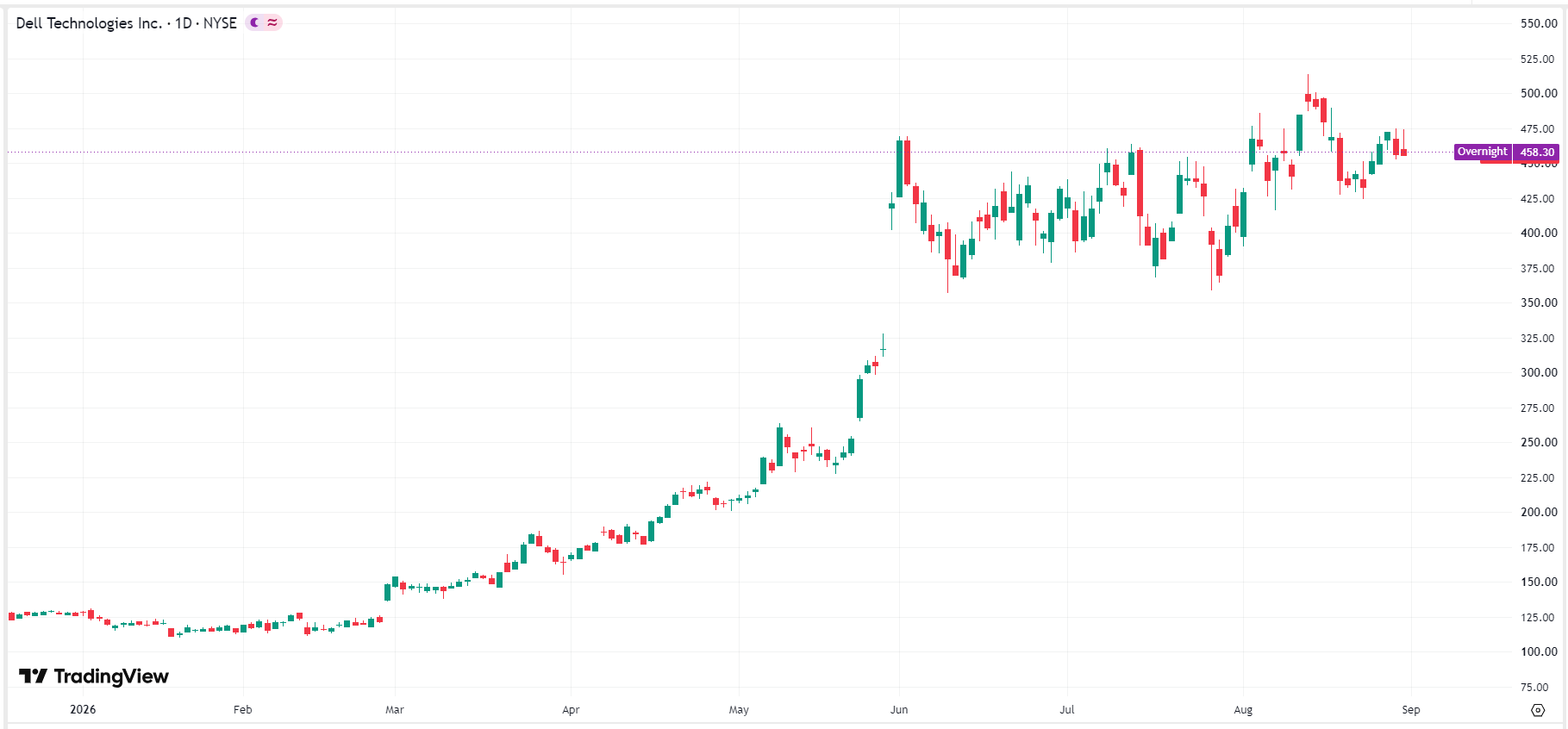 Dell stock chart, Source: TradingView
This content was translated using AI and reviewed for clarity. It is for informational purposes only.
Recommended Articles











Comments (0)
Click the $ button, enter the symbol, and select to link a stock, ETF, or other ticker.