


SpaceX Cursor Acquisition Closes: $60B Deal Adds Enterprise AI to Starlink + AI Revenue Boom



AI Podcast


SpaceX completed its $60 billion acquisition of Anysphere’s Cursor platform on August 14, issuing roughly 391 million shares and creating a 5% equity dilution. Q2 fundamentals showed robust growth, with total revenue reaching $7.8 billion, driven by Starlink and a 250% surge in the AI segment. However, immense capital intensity—including $18.3 billion in quarterly capex largely for AI and Starship—highlights significant cash burn concerns. Technically, the stock is testing the $146–$154 resistance zone, though upcoming lockup expirations and the Jackson Hole Symposium present short-term selling pressures and macroeconomic risks despite strong multi-year government contracts.
TradingKey - SpaceX (SPCX) made official the closing of its acquisition of Anysphere, an AI coding platform company, for approximately $60 billion on Aug 14. With a filing to the SEC that same day and the Cursor platform now fully owned by SpaceX, this transaction marks an important milestone. Now, SpaceX has enterprise-facing AI software beyond Grok and compute agreements. It also means that trade-offs are to be expected for SpaceX stock due to the hundreds of millions of shares that were issued. For the second quarter, we know that SpaceX is a well-established billions dollar machine. The total revenue was reported at $7.8 billion, an increase of 92%.
Starlink also reported an increase of 66% at $4.29 billion. AI also reported an increase of 250% at $2.56 billion. During the three months of this fiscal period, the company spent $18.3 billion to buy equipment, while revenue came in at $7.8 billion. This has caused some employees to question the company's AI investments and when/how the company's cash inflows will increase from these large expenses. It is important to note that there has been a recovery in SPCX following the August 14 sell off and the stock is currently testing the resistance zone of $146-$154.
The Jackson Hole Symposium, scheduled for August 21-22, will help answer whether the activity at the Fed will help confirm the narrative about capital expenditure or if it will help drive caution in the expansion of enterprise activity.
Cursor Acquisition Officially Closed Aug 14: The Deal Structure and Dilution
The closing of SpaceX’s acquisition of Anysphere’s subsidiary, Cursor, was confirmed on August 14, with the issuance of approximately 389.3 million Class A shares, and an additional 1.75 million Class A shares to the shareholders and vesting RSU holders of Cursor, respectively. The transaction is valued at $60 billion, making it the largest purchase of a venture-funded company.
While maintaining cash flow critical to satisfy SpaceX’s capital expenditures in excess of $18 billion per quarter, the acquisition created significant dilution. As of the closing, there were approximately 7.70 billion Class A shares, the new issuance representing a 5% increase to the equity base. This dilution is independent of the August 6 lockup release, where 912 million shares became eligible to be sold, and the August 20 lockup event. The cumulative effect will lead to a very short period of pressure on the stock from an over supply, even with the operating business performing well.
Strategic Logic: Cursor Deepens Enterprise AI Adoption and Compute Utilization
Prior to the closing of the transaction, both parties were collaborating on developing AI models and coding products and services. With Cursor now part of SpaceX, the complete integration of the compute infrastructure, Grok AI models, and developer tools can be realized to create a more integrated enterprise AI suite.
The economics of enterprise coding assistants are straight-forward. They provide recurring subscription income, but also use a lot of inference capacity. So, if Cursor improves the utilization of SpaceX’s AI infrastructure (which is very costly to build), the acquisition could make data-center economics better. This is an inference, but it relates to SpaceX’s existing compute strategy.
Q2 Fundamentals Remain Exceptionally Strong: Revenue $7.8B, AI +250% YoY
SpaceX reportedQ2 revenue of $7.8 billion, up 92% YoY from $4.1 billion. Starlink's segment reached $4.29 billion (66% YoY growth, representing over 50% of total revenue) and the AI segment reached $2.56 billion (250% YoY growth). Starlink ended Q2 2026 with 12 million satisfied broadband customers (up from 6 million in Q2, 2026) with ARPU somewhat negatively impacted by the offering of lower price tiers and international expansion.
Revenues from enterprise and government segments grew by 108%, with the Connectivity segment achieving an operating income growth of 79%, illustrating evolving and higher value business segments vs. the consumer broadband segment. This illustrates considerable potential for aviation, maritime connectivity and government segments as well as direct-to-cellular connectivity.
AI Capital Intensity: $15.8B Q2 Capex on AI Alone — The Utilization Question
The core issue is capital intensity. Management suggests SpaceX is spending money on AI infrastructure capital in anticipation of extremely high and long duration contracts. However, if the infrastructure is not fully utilized, the AI capital expenditures of over $15.8 billion, which reflects roughly twice the company's revenue (over $18 billion), is a significant concern for most companies, while for SpaceX, this represents preliminary investments meant to support the foundation for even larger businesses in the future.
Starship Remains the Key to Long-Term Space Economics
SpaceX continues to spend significant capital on SpaceX Starship, having completed Starship's Flight 13 on July 24. SpaceX wants Starship to become much more reusable along with an ability to carry much bigger payloads than the newer, Falcon 9. The next iteration of the StarLink network is the V3 Starlink constellation that Starship is made to carry, which is central to SpaceX's plan to deploy the next generation of its satellite network. SpaceX also is launching the current generation of Starlink satellites; scheduled launches include sweeps on August 18th from Vandenberg and August 20th from Cape Canaveral.
Starship would fundamentally alter orbital economics; fully reusable Starships could deploy constellations of satellites at much lower marginal costs to provide internet connectivity. However, the program remains expensive until operational, and delays to implementing full reusability will extend the elevated cost period.
Government Contracts Add Stability: $6B+ Multi-Year Awards
Still undervalued in SpaceX’s fundamentals is business with the U.S. government. Releases in Q2 noted more than $6 billion worth of multi-year awards from the government. Starshield and the U.S. government’s national security sector are integrating launch missions that further cements SpaceX’s business with the government. Government contracts are another way to lessen risk and diversify from both Starlink and frontier AI. Few companies can offer end-to-end services, from designing to manufacturing to launching satellites, using a fully integrated reusable rocket system.
IPO Proceeds Provide Cushion: $85.7B Raised, But Burn Rate Is Extreme
In June, SpaceX conducted its IPO. It raised $85.7 billion in net proceeds after selling 638.9 million shares for $135 each. The IPO proceeds allow the company to more effectively pursue the goals of Starship, Starlink V3, AI data centers, and Cursor integration. However, with a quarterly burn rate of over $18 billion, proceeds would only cover 18-20 quarters of funding with a constant burn rate. This funding is multi-year, but also shows SpaceX is still an extremely capital-intensive company that cannot fully fund its projects.
SpaceX Technical Setup: $146 Resistance, $154 Breakout Target, Lockup Risk Aug 20
SpaceX stock recovered on the 4-hour chart from the sell off on Aug 14. Price is now testing the $146.86 to $154.36 resistance zone. Price sits nicely above the moving average of $133.95 and has reclaimed the Fibonacci levels of $121.50, $131.17 and $139.00. RSI is at 64 and slightly above the signal line at 62. This indicates momentum is strong and could continue.
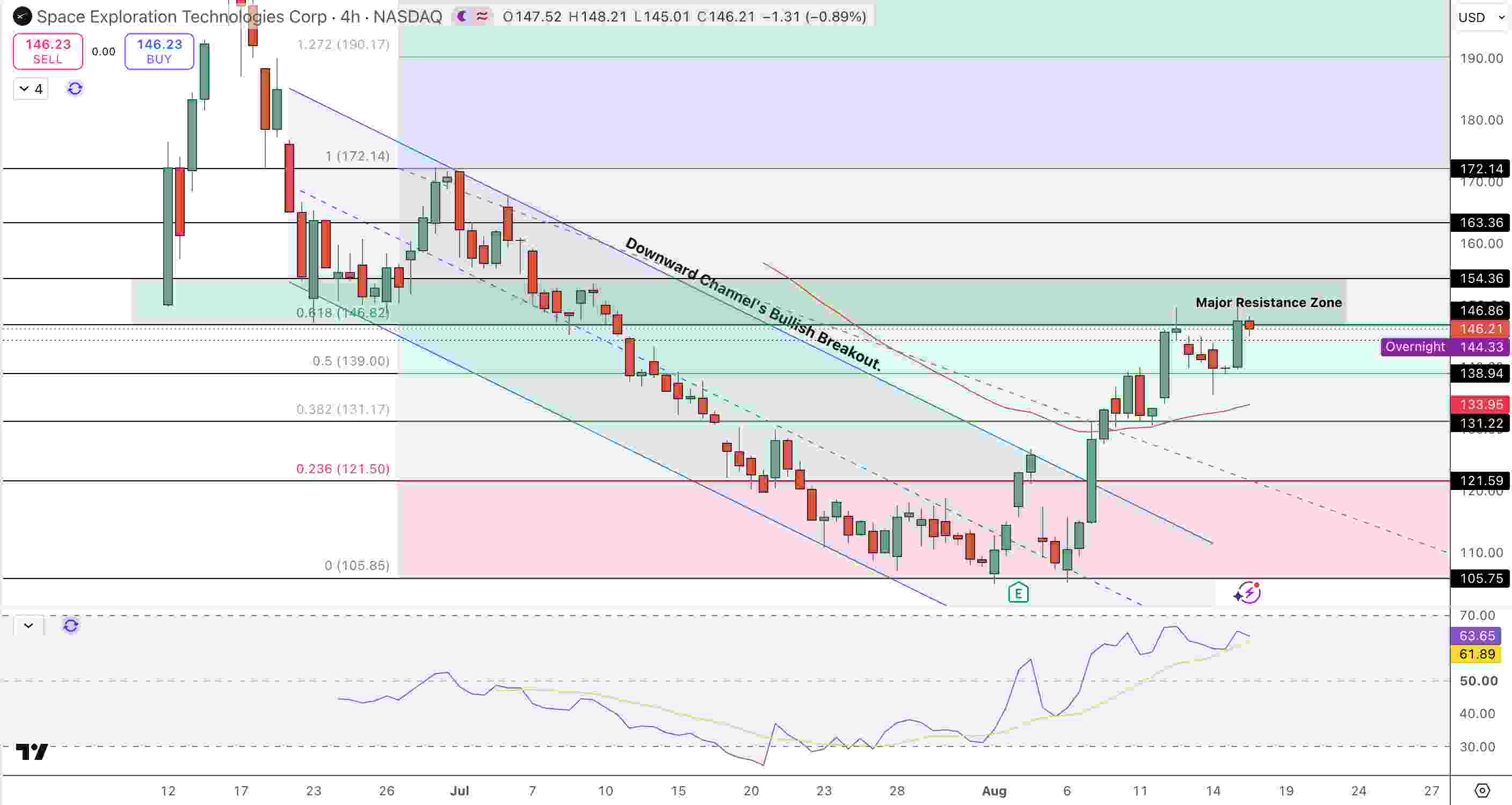
SPCX Price Chart - Source: Tradingview
A move above $154.36 could extend the reversal and aim at $163.36 and $172.14 next. $138.94 is our first stop if bulls get rejected. The current technical risk is August 20 lockup release, which could cause short-term selling pressure, even if the fundamentals of the company remain intact.
In general, we see strong value in SPCX based on the current technical analysis. Right now, the RSI at 64 shows that the stock is likely to gain more value and is not overbought. $154.36 is the first resistance level. Beyond that, the possible targets could be $163.36 and $172.14. However, $139.00 and $138.94 could act as first level of long-term support, followed by $133.95, the 50-EMA and $131.22 should price head towards Jackson Hole.
Bottom Line
SpaceX closed the Cursor deal for $60B on Aug 14. Starlink earned $4.29B, a 66% growth and 12 Million subscribers, while the AI division earned $2.56B and a startling 250% growth. Enterprise connectivity and government contracts grew by over 100%, with over $6B in contracts. Raising capital is brutal. SpaceX reported $18.3B in Capital expenditures in Q2, mostly on AI, of which $15.8B was spent in the quarter, making free cash flow conversion the most important metric going forward instead of focusing on growth.
Technical: SPCX rallied back from the selloff on Aug 14 and retested the resistance between $146-154. A break above $154 could take the stock to the next resistance between $163-172. The Aug 20 lockup will expire, releasing stock, which is likely to create a selling pressure, despite the positive fundamental backdrop. Jackson Hole on Aug 21-22, could either confirm or contradict the positive narrative on capital spending.
For investors: Currently, SpaceX is a Multibillion dollar revenue stream company, with many different streams from Starlink to government contracts and AI. However, the company burns capital at an astounding rate and issues shocking amounts of equity to fund growth. The concern is if cash inflow from Starlink and AI will be able to fund the company’s activities without another round of equity raise. The outcome of Jackson Hole will give an indication of capital spending for the remainder of 2026 and beyond. This is analysis, not investment advice.
Recommended Articles





Comments (0)
Click the $ button, enter the symbol, and select to link a stock, ETF, or other ticker.