


Super Micro Computer Q4 Revenue of $11.1 Billion Slightly Misses Estimates, Yet Stock Jumps Over 7% After Hours: How Did SMCI Restore Market Confidence?



AI Podcast


Super Micro Computer reported fourth fiscal quarter revenue of $11.12 billion, slightly below expectations, but its stock surged over 7% following a strong non-GAAP gross margin rebound to 17.6%. CEO Charles Liang attributed margin expansion to product mix optimization and enterprise customer growth. Despite short-term delivery delays from infrastructure bottlenecks, order momentum remained robust, with new orders exceeding $60 billion. Furthermore, the company issued fiscal first-quarter net sales guidance well above consensus estimates. While management pivots toward balancing scale and profitability, intensifying competition from Dell, HP, and AWS poses ongoing monitoring risks for investors.

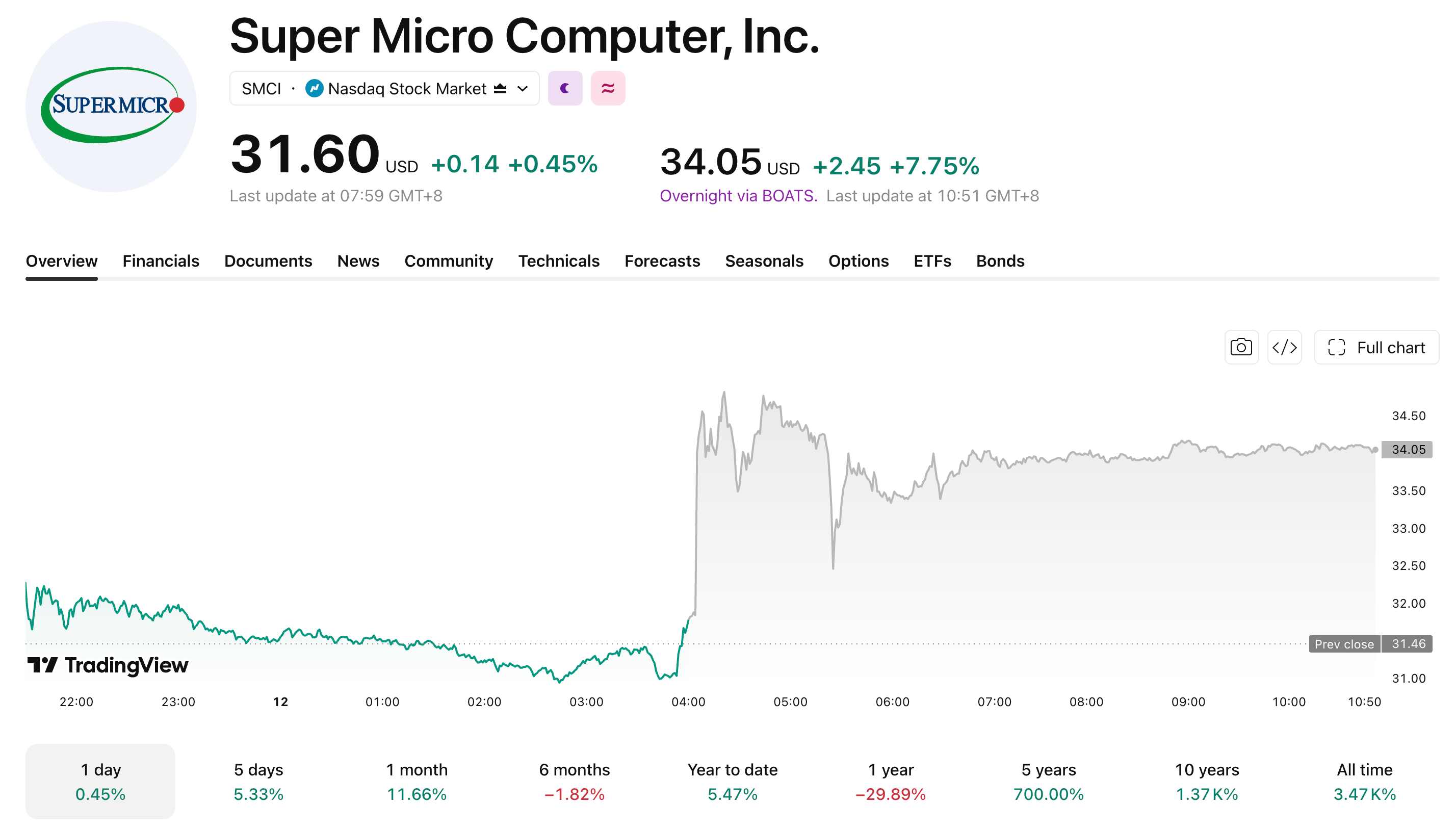
TradingKey - After hours on August 11 ET, AI server maker Super Micro Computer (SMCI) reported its fourth fiscal quarter financial results, with quarterly revenue reaching $11.12 billion, slightly below analyst expectations of $11.55 billion, but its stock price once surged over 10% after hours before closing up 7.56%. As of press time, the stock was still up 7.75% in overnight trading, trading at $34.05.
[Source: TradingView]
What led the market to overlook the revenue shortfall was a strong rebound in gross margin. The quarterly non-GAAP gross margin rebounded strongly to 17.6%, officially delivering on the optimistic expectation made in July that "gross margin would recover significantly from a low of around 8% to 15%-17%." This solid figure thoroughly shattered previous deep market doubts that the company was "trapped in a vicious price war and unable to recover its gross margin."
Founder and CEO Charles Liang noted that the improvement in gross margin was mainly attributable to an increased proportion of enterprise customers and higher adoption of DCBBS solutions, both of which boosted the company's pricing power.
CFO David Weigand further revealed that approximately 75% of the quarter-over-quarter improvement came from product mix optimization, with the remainder driven by one-off favorable factors such as lower tariff costs and inventory adjustments.
There were still flaws on the revenue side. Management explained that some customers delayed deliveries due to issues with power supply, cooling systems, and network readiness, which were short-term disruptions rather than a slowdown in demand, with the delayed revenue expected to be recognized in subsequent quarters.
What truly boosted market confidence was the order data. In the earnings release, Liang stated that the company added hundreds of enterprise customers over the past year, with new orders in the fourth quarter exceeding $60 billion, driving the backlog to a record high. This indicates that despite quarterly revenue slightly missing expectations, customer demand has not weakened, and delivery delays remain a short-term issue.
While the gross margin recovery had already surprised the market, next quarter's guidance was even more impressive. The company expects first-quarter fiscal net sales of $14.5 billion to $15.5 billion, with a midpoint of $15.0 billion, approximately 25% above analysts' average expectation of $11.99 billion; adjusted earnings per share are projected at $1.01 to $1.10, with the midpoint about 43% higher than the average analyst estimate. Full-year revenue for fiscal year 2027 is expected to be between $65 billion and $72 billion, well above Wall Street's current consensus expectation of roughly $53 billion.
Super Micro Computer is shifting from pursuing scale alone to placing equal emphasis on scale and profitability; however, competitors such as Dell (DELL), HP (HP), and AWS are all accelerating their deployment of AI infrastructure. For now, judging from the after-hours market reaction, investors remain bullish on the long-term demand for AI computing power.
This content was translated using AI and reviewed for clarity. It is for informational purposes only.
Recommended Articles











Comments (0)
Click the $ button, enter the symbol, and select to link a stock, ETF, or other ticker.