


Today’s Market Recap: S&P, Dow Snap Winning Streak,Nvidia Drops 3%, Intel Plunges 4%, Coherent Crashes 10%



AI Podcast


On Eastern Time August 10, U.S. markets faced headwinds as tech stocks, led by NVIDIA and Apple, declined. The S&P 500, Dow Jones, and Nasdaq all retreated. While Microsoft and Amazon gained, Intel plummeted over 4% following a $15 billion stock offering. Macro trends included rising oil prices amid geopolitical uncertainty and gold reaching two-month highs. NVIDIA is partnering with six financial firms to raise $500 billion for AI infrastructure, sparking market risk concerns. Meanwhile, Meta, Microsoft, and Anthropic continue aggressive AI developments, while South Korea announced a 5 trillion won semiconductor fund to strengthen its domestic supply chain.

Tradingkey - On August 10, Eastern Time, tech stocks weighed on U.S. markets, causing both the S&P 500 and the Dow Jones Industrial Average to decline; at the close, the Dow Jones Industrial Average fell 0.11% to 53,975.98; the Nasdaq Composite Index fell 0.32% to 26,605.36; the S&P 500 fell 0.06% to 7,753.11.
Among the 'Magnificent Seven,' Nvidia(NVDA) and Apple led the declines, while Microsoft and Amazon bucked the trend with gains of over 1%. Apple(AAPL) closed down 1.5% after an institutional downgrade, and NVIDIA fell nearly 3% on news of negotiations for a $500 billion AI funding round; Intel (INTC) fell more than 4% after announcing a stock offering, while the optical communications sector plummeted, with Coherent (COHR) dropping over 10%.
U.S. Treasury yields retreated, with the two-year yield pulling back from a three-week low; the yen fell as much as 1% to an August low; Bitcoin dipped below $64,000 during the session, down more than 2% from its intraday high.
Amid uncertainty over the Hormuz Agreement, crude oil extended its rally, with both WTI and Brent crude futures rising more than 4% during the session; gold rose for a second consecutive day, gaining more than 1% during the session, with gold futures hitting a closing high not seen in more than two months.
Market Headline
NVIDIA is reportedly teaming up with six Wall Street giants to raise $500 billion to bet on AI infrastructure, with CDS prices posting their biggest gain in two weeks. According to reports, NVIDIA has signed memorandums of understanding with Apollo, Blackstone, GIP (a subsidiary of BlackRock), Brookfield, Goldman Sachs, and KKR to establish an independent computing power financing platform. The long-term goal is to mobilize more than $500 billion in third-party capital through debt financing for AI infrastructure development—with all funds coming from third parties rather than NVIDIA’s own capital. Jensen Huang confirmed that “invitations were extended only to these six institutions, and not a single one declined.” Following the news, NVIDIA’s stock price briefly fell 3.2%, while credit default swap (CDS) prices posted their largest single-day increase in two weeks, reflecting market concerns about the risks associated with large-scale debt financing.
Meta(META) released the lightweight AI model Muse Glimmer, which can run locally on a single graphics card, and Zuckerberg called for lowering the barrier to entry for open-source AI. Meta officially launched Muse Glimmer on August 10. As a distilled version of Muse Spark 1.2 with 30 billion parameters, it can run on a single graphics card and is primarily designed for everyday agent tasks such as schedule management and file organization, thereby lowering the barrier to AI deployment for businesses. Zuckerberg also urged the U.S. government, stating that restricting access to foreign open-source models is not an effective solution and that the barriers to entry for open-source AI should be lowered.
Microsoft(MSFT) reportedly plans to significantly increase production of its next-generation AI chips and is in discussions with TSMC to deliver over 300,000 Maia 300 chips in 2027. According to The Information, Microsoft may release its next-generation in-house AI chip, the Maia 300, as early as September. The company has already begun negotiations with TSMC regarding manufacturing capacity for over 300,000 chips, with delivery expected in 2027—a tenfold increase compared to the current-generation Maia 200’s production volume of several tens of thousands. Microsoft’s long-term goal is to secure production capacity for over 1 million chips, but the actual scale remains uncertain due to constraints on component supply and the progress of packaging negotiations with TSMC.
Intel announced a $15 billion common stock offering at a high market price, causing its stock price to drop immediately. Intel announced plans to issue $15 billion in common stock, with the proceeds to be used for general corporate purposes. The company stated it would remain cautious in capital allocation and focus investments on emerging areas such as AI, specialized chips, advanced packaging, and external foundry services. The market reacted coolly to the news, and Intel’s stock price closed lower following the announcement.
South Korea announced the establishment of a 5 trillion won semiconductor fund to bolster its domestic chip ecosystem. On August 10, Kang Hoon-sik, Chief of Staff to the President of South Korea, stated that a 5 trillion won (approximately $3.52 billion) semiconductor fund would be established, targeting companies with growth potential in chip materials, components, and equipment, as well as fabless design firms, with the aim of enhancing South Korea’s self-sufficiency in the upstream segment of the semiconductor supply chain.
Anthropic’s Sonnet 5.5 model has been leaked; positioned to compete with DeepSeek, it is set to disrupt the mid-to-high-end AI value-for-money market. Reportedly codenamed “Fennec,” Claude Sonnet 5.5 is highly likely to be released next month. It supports a context window of approximately 2 million tokens, offers faster inference speeds and stronger agent capabilities, and its overall performance is approaching that of the flagship Fable 5, while maintaining pricing at the Sonnet tier. Following the value-for-money wave sparked by DeepSeek, this model is viewed as a strong contender in the mid-to-high-end AI market.
OpenAI has launched GPT-5.6-Cyber, a specialized version with fewer restrictions available to cybersecurity defenders. Built on GPT-5.6 Sol and available to Daybreak Red users, the model achieves a 95% response rate to requests involving advanced cybersecurity tasks such as exploit chain development. It covers numerous sensitive scenarios that previous models struggled to handle, aiming to help enterprises defend against potential future autonomous cyberattacks.
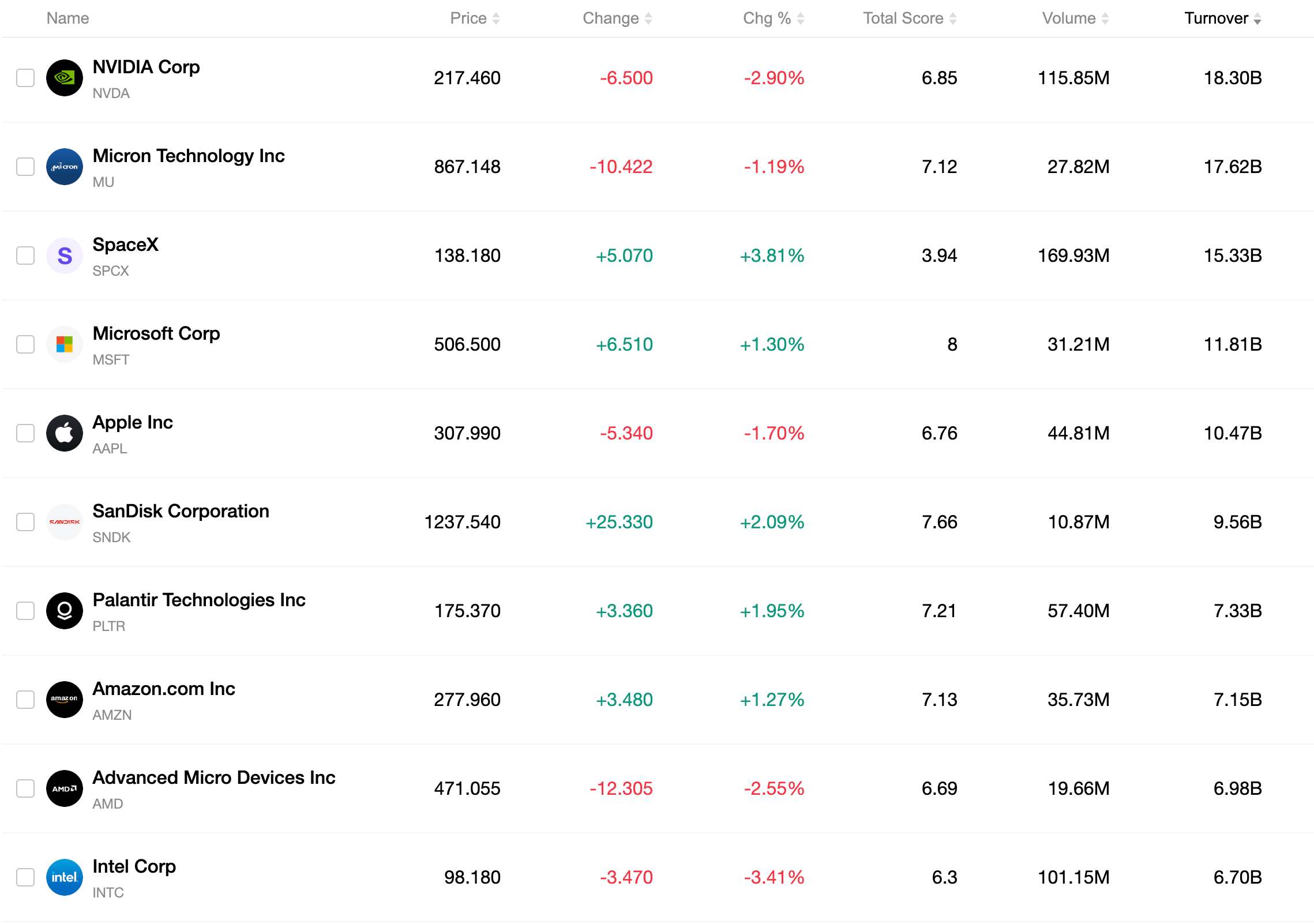
Top 10 Most Traded Stocks
The table below lists the ten most actively traded stocks in the market recently. Backed by massive trading volumes and excellent liquidity, these assets have become key benchmarks for tracking global market dynamics.
Recommended Articles








Comments (0)
Click the $ button, enter the symbol, and select to link a stock, ETF, or other ticker.