


How Much Profit Can Cisco Keep From Its $7.5 Billion AI Revenue Target?



AI Podcast


Ahead of November 12 earnings, Cisco faces margin pressure as it scales AI infrastructure shipments, which target $7.5 billion in fiscal 2027 revenue. While adjusted gross margins decline, disciplined operating expenses help drive operating profit growth. However, free cash flow is nearly fully absorbed by dividends and repurchases, with inventory and receivables warranting close monitoring. Technically, Cisco remains bearish while trading below the $101.60 resistance level, with immediate downside support situated at $91.74 and a potential extended target at $84.08.
TradingKey - Cisco Systems (NASDAQ: CSCO) closed November 6 at $93.85, down 1.95% and just $0.50 above the session low. Ahead of November 12 earnings, the stock sits closer to $91.74 support than to the $101.60 level buyers lost. The question for shareholders is how much profit Cisco can keep as it ships more networking hardware to the companies building AI data centers.
Cisco’s fiscal fourth quarter offers a clue. Cisco earned less gross profit per dollar of sales on an adjusted basis, yet its operating profit grew faster than revenue. Whether it can repeat that combination matters more to my earnings view than another big order announcement.
Two $4 Billion Figures Tell Different Stories
Cisco booked $4 billion of hyperscaler AI infrastructure orders in its fiscal fourth quarter alone. It also recognized about $4 billion of hyperscaler AI infrastructure revenue across the entire fiscal year. The figures look identical on paper, but the first records buying commitments and the second records sales Cisco could recognize.
Full-year orders totaled $9.3 billion. Cisco expects this business to generate $7.5 billion in fiscal 2027 revenue, implying roughly 88% growth from last year’s rounded figure. Subtracting annual sales from annual orders would give a misleading estimate of outstanding business because shipments can fulfill orders placed in earlier periods. What matters on Thursday is how much equipment customers took and whether the annual target still holds.
A Lower Gross Margin Can Still Produce More Profit
Morgan Stanley’s Meta Marshall cut Cisco to equal weight from overweight, citing the risk that gross-margin pressure could slow fiscal 2028 earnings growth, Investor’s Business Daily reported. Cisco’s last quarter shows why that risk deserves a closer look. Adjusted gross margin fell to 66.3% from 68.4% a year earlier. On a GAAP basis, gross margin rose to 64.1% from 63.2%.
For the adjusted comparison, follow the money one line further. Revenue rose 18% to $17.3 billion while adjusted operating expenses rose only 5%. That left $6.2 billion of adjusted operating income, up 23%, and a 35.9% adjusted operating margin. If Cisco can handle larger cloud orders without a comparable increase in sales and engineering costs, total operating profit could keep growing even as gross margin falls. Cisco reports those margins for the company as a whole, so the figures do not establish the profit on an individual deployment.
Enterprise Networks Give Cisco a Second Source of Demand
Cloud customers buy equipment in large batches, so a deployment slipping across quarter-end can move reported sales. Cisco also sells switches, routers and wireless equipment to businesses upgrading their own networks. Networking revenue grew 28% last quarter, with campus networking contributing alongside AI infrastructure and data-center switching.
Security offers another way to earn more from those customers. Cisco AI Defense joined ServiceNow’s Control Tower Alliance on October 28, giving companies a way to connect AI security with the systems they use to oversee deployments. The financial evidence I’d look for is customers paying for that protection when they renew or expand a contract.
Cash Flow Leaves Less Room Than EPS Suggests
Cisco generated $14.2 billion in fiscal 2026 operating cash flow and spent roughly $1.4 billion on capital equipment and other capital expenditures. That left $12.77 billion in free cash flow, down from $13.29 billion a year earlier. Dividends of $6.6 billion and repurchases of $6.1 billion absorbed nearly all of it.
A faster hardware build can tie up cash in components before customers pay their invoices. That makes inventory and receivables worth reading alongside earnings per share. I would be more comfortable with higher inventory if shipments and collections followed. Fourth-quarter operating cash flow rose 27% year over year to $5.4 billion. Across the full year, it was flat, partly because Cisco made its final $2.3 billion U.S. transition-tax payment. I’ll watch whether collections keep pace with sales as AI shipments grow.
The Margin Benchmark for November 12
Cisco guided to fiscal first-quarter revenue of $18 billion to $18.2 billion, adjusted EPS of $1.32 to $1.34 and adjusted gross margin of 65% to 66%. Even the top of that margin range is below last quarter’s 66.3%. A modest sequential decline would therefore fit the existing outlook. On the call, I’ll listen for whether management expects product costs or customer pricing to push margins lower as shipments rise.
Cisco Technical Analysis: $91.74 Is the Next Support
Friday’s close at $93.85 left Cisco just above its $93.35 low. What catches my attention is where the selling began. Buyers had already stalled near $118.46 and then $112.23, forming two lower highs along the descending trendline. Losing $101.60 extended that pattern. It also gives traders a level to judge the next bounce against.
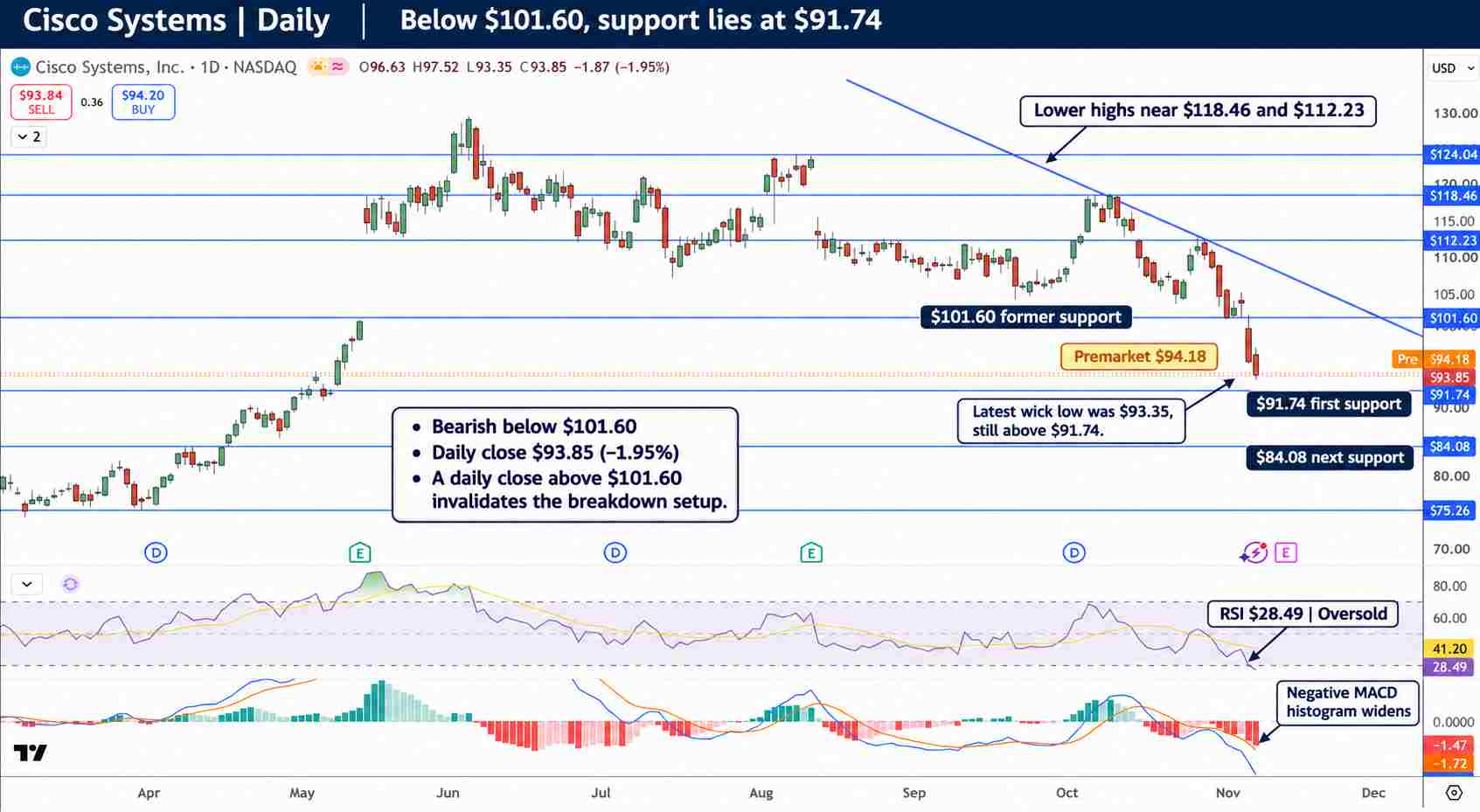
Cisco Price Chart - Source: Tradingview
Daily RSI is oversold at 28.49. A rebound into earnings would be plausible, but the widening negative MACD histogram tells me selling pressure is still building. I remain bearish while rallies fail below $101.60. The first downside test is $91.74. An intraday dip and recovery there would carry less weight than a daily close below it, which would bring $84.08 into view. On the upside, a daily close back above $101.60 would invalidate my immediate breakdown call. I would then watch how buyers handle the descending trendline before treating the recovery as a change in the broader trend.
Key Levels
- November 6 regular-session close: $93.85
- Immediate resistance: $101.60
- Next upside test: descending trendline through $118.46 and $112.23
- Immediate support: $91.74
- Downside target: $84.08
- Daily RSI: 28.49, oversold
FAQ
When does Cisco report fiscal first-quarter earnings?
Cisco scheduled its results call for November 12 at 4:30 p.m. Eastern. The report covers the quarter ended October 24.
Does Cisco expect $7.5 billion in AI sales this quarter?
That target covers hyperscaler AI infrastructure revenue for the full fiscal year. Quarterly shipments will show how quickly Cisco is progressing toward it.
Bottom Line
Cisco has enough orders to make shipment growth credible. The test is whether it can turn that volume into operating profit and cash while gross margins narrow. I stay bearish on the chart below $101.60. A close under $91.74 would strengthen the downside case.
Recommended Articles











Comments (0)
Click the $ button, enter the symbol, and select to link a stock, ETF, or other ticker.