


‘Big Short’ Michael Burry Says Berkshire Has Lost Appeal in Post-Buffett Era



AI Podcast


On August 9, Eastern Time, investor Michael Burry expressed skepticism toward Berkshire Hathaway, questioning successor Greg Abel’s patience and investment discipline. While Berkshire’s Q2 net profit doubled to $25.667 billion, gains were largely driven by unrealized portfolio fluctuations. Despite shifting from net seller to net buyer of equities and reducing cash reserves to $365.5 billion, the company’s year-to-date stock performance lags the S&P 500 by approximately 9.5 percentage points. Managing the firm’s massive capital remains the central challenge, with Abel focusing on narrow AI applications and strategic equity positions to prove his ability to navigate the post-Buffett era.
TradingKey - On August 9, Eastern Time, the famous 'Big Short' investor Michael Burry turned his attention to Berkshire Hathaway ( BRK.a) ( BRK.b ). He publicly stated on Substack that he no longer considers Berkshire an attractive investment, bluntly pointing out that its successor Greg Abel lacks Warren Buffett's patience.
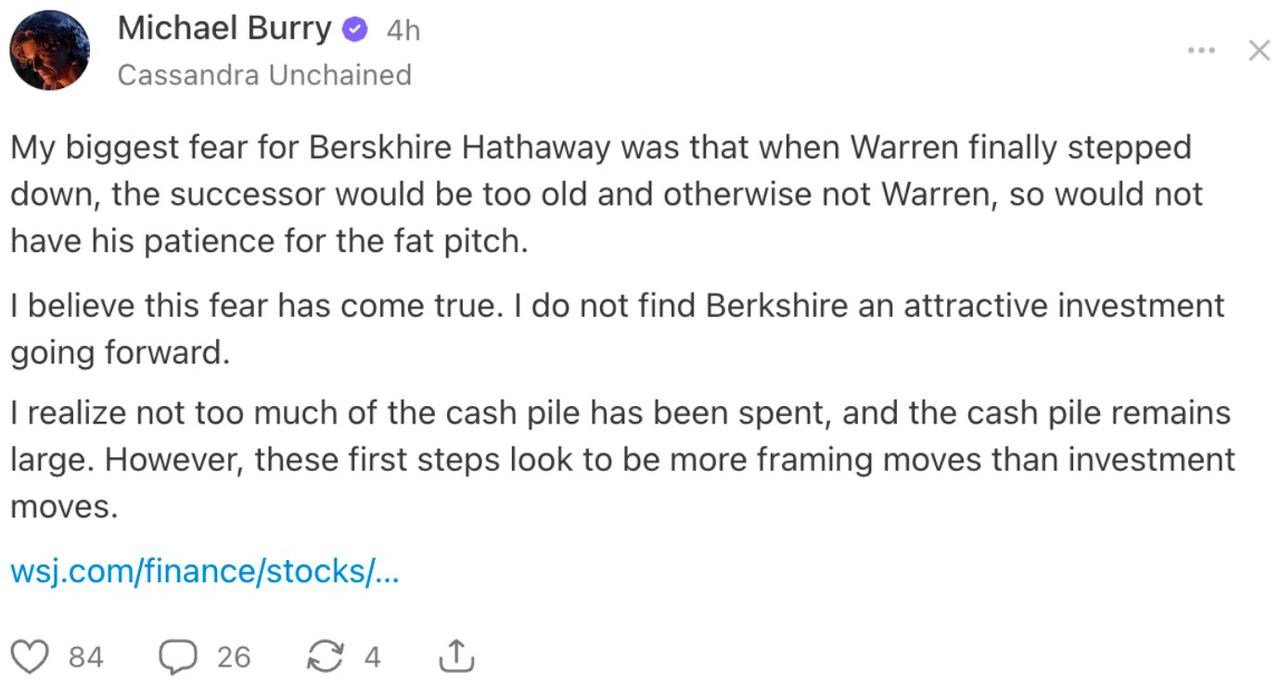
[Source: Substack]
Burry wrote in his post: 'My biggest concern about Berkshire in the past was that when Warren finally steps down, the successor would be too old and, after all, not Warren, and therefore would not have his patience to wait for the sweet spot. I believe this concern has become a reality.' He also noted that while Abel has begun deploying some cash, these moves 'feel more like framework gestures than real investment moves.'
Burry's comments came just as Berkshire delivered its second quarterly report of the post-Buffett era. Data shows that the company's Q2 net profit reached $25.667 billion, doubling year-on-year, while net profit for the first half of the year was $35.773 billion, an increase of 111%. However, the surge in profits was mainly driven by unrealized gains on stock holdings. After taking office, Abel began adjusting Berkshire's cash management strategy.
The most obvious change occurred in cash disposition. In the second quarter, Berkshire ended its streak of 14 consecutive quarters of net stock selling, net purchasing about $20 billion of stocks, while repurchasing $4.5 billion of its own shares, the highest since 2021. The company's cash reserves also fell from a record $397.4 billion to $365.5 billion, representing the first quarter-on-quarter decline in four years.
However, in the post-Buffett era, despite increased capital allocation efforts, Berkshire's stock performance has failed to keep pace with the broader market. As of August 9, Berkshire's Class B shares had risen about 3.81% year-to-date, compared to a gain of about 13.3% for the S&P 500 Index over the same period, a gap of about 9.5 percentage points.
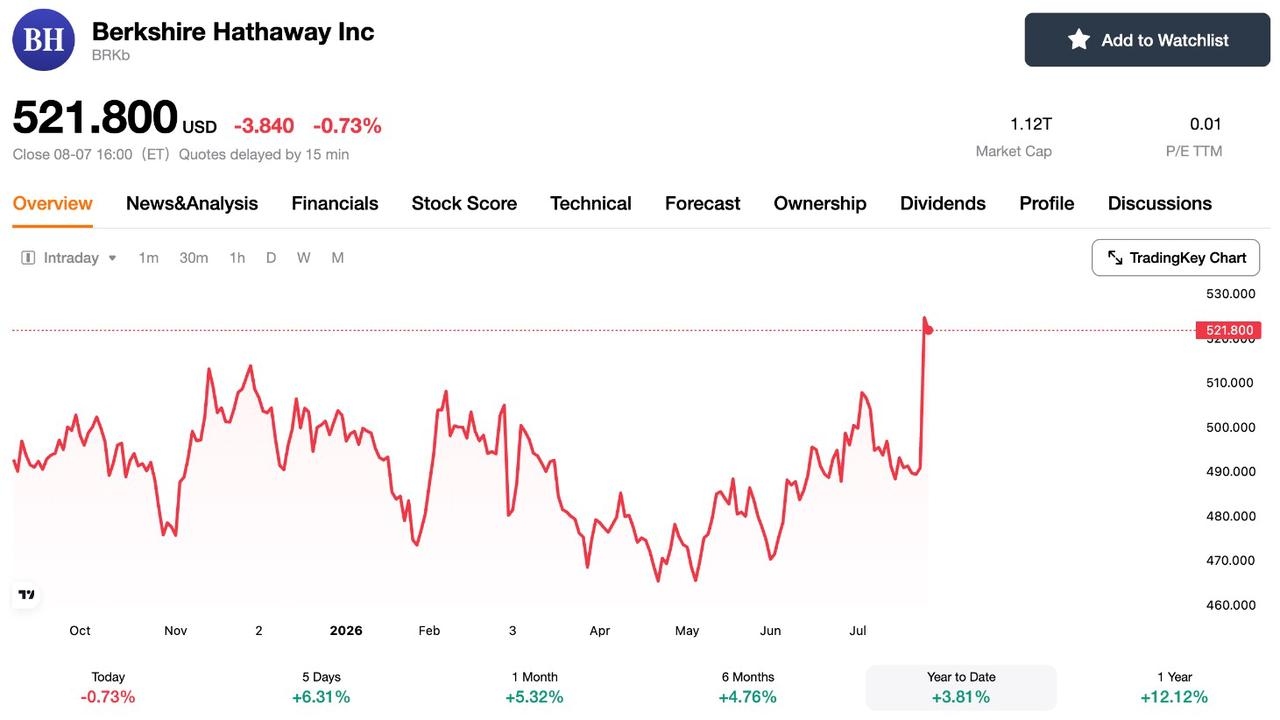
[Source: TradingKey]
Regarding specific actions in capital allocation, Abel pushed for the decision in the second quarter to establish a heavy position in Alphabet ( GOOGL ). Buffett himself confirmed that this investment was initiated by him, with Abel participating and agreeing.
Alphabet entered the top five holdings with an 8.8% portfolio weight, alongside Apple ( AAPL ), American Express ( AXP ), Bank of America ( BAC ), Coca-Cola ( KO) in the top tier. The top five holdings collectively accounted for 66% of the total fair value of equity investments. This investment also means that Abel has begun making his own judgments within Buffett's framework.
Facing persistent questions from the market about how Berkshire's massive cash pile will continue to be used, Abel gave a clear direction during the shareholder meeting's Q&A session: AI must create substantive value for business operations. Berkshire has already deployed AI in multiple business segments, focusing on narrow AI applications that can tangibly serve operations rather than pursuing generalized AI concepts.
Burry's concern may well be the unspoken doubt of many investors: how to effectively allocate nearly $400 billion in cash reserves once the legendary investor Warren Buffett departs the stage has become the core test facing Berkshire's management. At least so far, Berkshire's stock performance has not yet given an answer that satisfies the market.
This content was translated using AI and reviewed for clarity. It is for informational purposes only.
Recommended Articles






Comments (0)
Click the $ button, enter the symbol, and select to link a stock, ETF, or other ticker.