


Micron (MU) Bounces to $969 - Morgan Stanley and BofA Both Say Buy the Dip



AI Podcast


Micron Technology (MU) recovered to $969.89 by July 21 following a recent sell-off. Analysts remain polarized: Morgan Stanley cites $22 billion in non-cancelable HBM contracts and structural data center demand through 2026 as bullish indicators. Bank of America, projecting 66% upside, argues that open-source AI models actually increase memory consumption. Conversely, Michael Burry maintains a short position, citing long-term cyclical risks and potential supply pressure from Chinese competitors. Technically, the stock is testing channel resistance at $938–$992.71; failure to hold the $902.49 support level could signal a deeper reversal.
TradingKey - Micron Technology (NASDAQ: MU) recovered from a low of $848.95 on Monday July 20 to trade as high as $982.88 on Tuesday July 21, closing around $969.89. Morgan Stanley analyst Joseph Moore called last week's selloff a buying opportunity. Bank of America said open-source Chinese AI models, widely cited as a threat to memory demand, actually increase memory consumption and reiterated 66% upside. Micron was also addeMicron Technology (NASDAQ: MU) rallied from its Monday, July 20 low of $848.95 to a high of $982.88 on Tuesday, July 21, eventually settling near $969.89.
Last week's sell-off presented an excellent buying opportunity, according to Morgan Stanley analyst Joseph Moore. Bank of America also weighed in, stating that concerns over the potential impact of freely accessible Chinese artificial intelligence models on memory demand are unfounded, since these models require more memory. The bank reiterated a 66% upside rating.
Why Morgan Stanley and BofA Both Turned Bullish
Joseph Moore, Morgan Stanley analyst, acknowledged the worry on Monday's note and then quickly dismissed it: the only thing really powering memory chip demand right now is data center AI spending, which he conceded is a little bit scary to hang your hat on. Moore says data center HBM demand is structural and under-supplied through 2027. Micron's 16 non-cancelable, $22B-plus strategic customer HBM agreements, with no HBM remaining on the market till 2026, give real world backing to the claim. Under-supply results in customers having to pay what suppliers want, and explains why Micron had gross margins of 84.6% in Q3 FY2026, an incredible number for a pharma, but amazing for a hardware manufacturer.
Bank of America made a more contrarian and, perhaps, more interesting call. The standard bearish thesis has been that cheap open-source Chinese AI models will undermine Micron by decreasing the need for pricey AI inference infrastructure. BofA's report this week flips the story: these open source models are relatively more compact and quicker to execute, so they get installed on more devices and at a higher cadence and handle a larger number of requests.
This means you require more memory to run an inference server when you deploy open models at higher frequency and volume. Models like DeepSeek, Qwen and their peers will democratize the deployment of AI and, by doing so, expand the footprint of AI-enabled infrastructure. And each piece of that will require HBM. BofA's target 66% upside reflects this thesis.
Recovery Meets Skepticism
Micron's rally from $848 to $969 over the last two days follows the same sequence that unfolded three times this year. The stock takes off on an earnings release or macro-aid AI news, then it drops 20% to 30% as profit-takers and shorts take hold, before it moves higher when analysts remind the market what the contracts really state. The 52-week span of $103.38 to $1,255 reflects the extent of that price movement. Michael Burry, the famous 2008 housing short, revealed a short position in Micron. Burry's thesis (inferred from SEC filings) is that the memory cycle will eventually reverse, that CXMT will come out with a $8.5 billion DRAM IPO adding Chinese supply and that, given cyclical risk, the valuation premium Micron is getting is unjustified.
Burry's short call versus Morgan Stanley's buy call is the best encapsulation of the current MU debate. Both agree on the fundamentals: $22B in non-cancelable contracts, HBM sold-out till 2026, Q3 FY2026 gross margin of 84.6% and $250 billion of US manufacturing investment. They simply take different positions on how sustainable those factors are. Burry says the cycle will reverse, supply will come into balance and margins will get cut. Morgan Stanley says that AI infrastructure is so much a cycle that you don't need to worry about cycle risk until at least 18 months from now. MU's current level of $969 leans more to the Morgan Stanley argument, although its 30%+ drawdown from $1,255 suggests Burry's objections are not fully written off.
MU Technical Setup - Channel Resistance at $938, RSI 55, Key Levels
The 4H chart shows that MU bounced off the area of support at $902.49 and now it has taken back the 50-period EMA at $918.95 as it tests the descending channel resistance line at about $938. RSI 55 or so is still bullish but it has started to cool off after getting dangerously close to overbought territory. First target at resistance is $992.71, which also has 100-period EMA at $960.80 on its side.
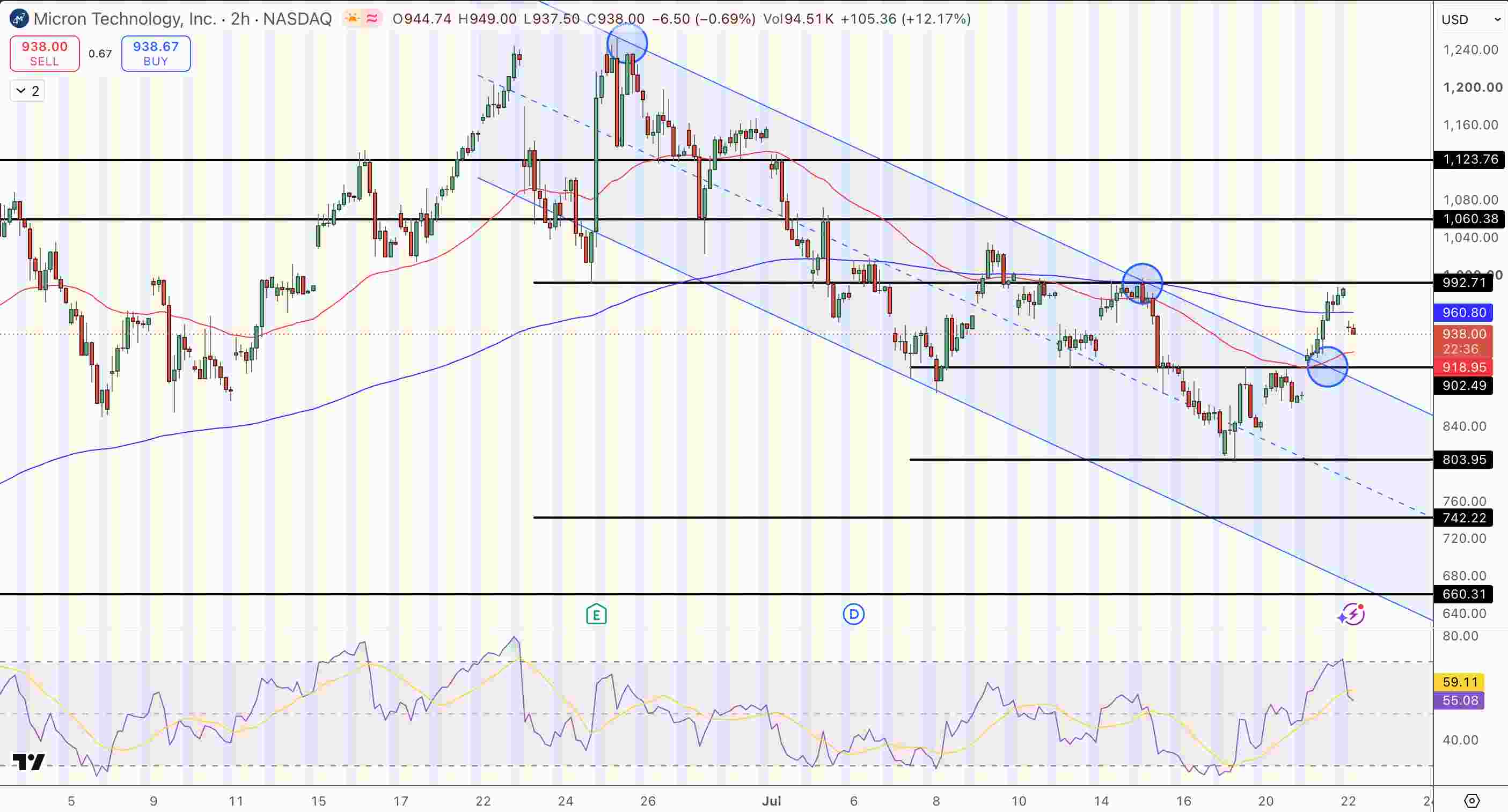
Micron (MU) Price Chart - Source: Tradingview
Once it closes above $992.71, it opens up the way to $1,060 and $1,123. Next level of support comes below $918.95 (50 EMA) at $902.49. A close below $902.49 will suggest the rebound has run into some serious problems and will re-open the $803.95 area.
- Tuesday's range: $912.70 to $982.88
- Close: $969.89
- Monday Low: $848.95
- Morgan Stanley: Joseph Moore: this is when you buy after a sell-off. Demand in the data center will remain the driver
- BofA: 66% upside. Open-source AI adds to demand, doesn't take away
- Contracts: 16 non-cancelable HBM contracts, $22B+ committed. HBM sold-out to 2026
- Channel Resistance: $938 to $992.71 (100 EMA). A breakout over $992.71 will take us to $1,060 then $1,123
- Support: $918.95 (50 EMA); then $902.49; a close under $902.49 opens up $803.95
What's Morgan Stanley Saying About Micron's Recent Sell-Off?
In a note released Tuesday, the Wall Street firm Morgan Stanley said the latest sell-off in Micron (MU) stock missed the company’s solid memory outlook for the artificial intelligence (AI) sector.
The firm pointed to more than $22 billion in non-cancelable HBM contracts, and production remaining sold out through 2026. It said that Micron has been able to secure its HBM capacity because it continues to believe that there will remain structural AI memory demand. Morgan Stanley argued that the 15%-20% pullback in Micron shares was a “disproportionate” reaction to risks which the investment bank noted won’t be material until 2026 and beyond.
What Is Bank of America’s View About AI and Micron?
Bank of America believes that the recent growth of open-source AI will be good for Micron’s memory chips, not bad. In a research note, the firm said that open-source AI models like DeepSeek and Qwen are set to continue expanding. As AI gets cheaper and easier to use, the firm argued, more and more organizations will use AI, which will drive more HBM demand across servers, edge devices and enterprise solutions.
Why Is Michael Burry Selling Micron Stock?
Michael Burry, of the movie and TV drama 'The Big Short' fame, said that Micron remains subject to the semiconductor memory cycle. The investor said that the chip maker faces competition from new Chinese DRAM supply, including CXMT's planned $8.5 billion IPO, and also an eventual slowing of AI demand growth that he believes will eventually put pressure on chip prices and margins. Burry noted that the company’s contracts keep earnings afloat through 2026, but said he’s betting on what happens beyond that point.
The Bottom Line
Wall Street's Best Investment Ideas list added Micron Tuesday. Micron has bounced off $848 following Morgan Stanley's buy call and Bank of America's call on open-source AI to raise memory demand. $938 is the channel resistance that Micron is testing right now, while the next resistance is $992.71 and the 100 EMA. If the stock gets above $992.71, the next upside levels will be $1,060 and $1,123. The floor would be at $902.49, if the stock drops through $918.95. Michael Burry shorted Micron while Morgan Stanley said "BUY" and BofA said buy.
Recommended Articles











Comments (0)
Click the $ button, enter the symbol, and select to link a stock, ETF, or other ticker.