


US Stocks Close: Three Major Indices Rebound Strongly, Philadelphia Semiconductor Index Rises Over 5%; Micron Soars 12%, Returns to $1 Trillion Market Cap; Strong Start to Earnings Season, Most Reporting Companies Beat Profit Expectations



AI Podcast


US equity markets surged as 87% of reporting S&P 500 firms exceeded earnings expectations, bolstered by a 5.21% rally in the Philadelphia Semiconductor Index. Memory chipmakers like Micron are benefiting from data center shortages, with price hikes projected through 2028. TSMC plans to raise foundry prices by up to 10% in 2027 to manage rising operational costs. Meanwhile, Apple announced a leasing program via Klarna, and Nvidia entered mass production for its Vera Rubin platform. Macro risks persist, including potential US tariffs on multiple nations and Treasury threats regarding Chinese AI intellectual property.
TradingKey - The current earnings season is off to a strong start, with 87% of the 54 S&P 500 companies that have reported earnings beating profit expectations. Additionally, TSMC is reportedly set to raise prices by 10% next year, with both developments boosting gains in chip and memory stocks. US stocks rebounded strongly, with the three major indexes all rising and the Philadelphia Semiconductor Index surging over 5%.
At the close, the Dow Jones Industrial Average rose 0.74% to 52,224.64; the Nasdaq Composite Index gained 1.29% to 25,837.21; and the S&P 500 Index rose 0.89% to 7,509.20.
Tech Stock Performance
Micron (MU) rose 12.17% to $970.82, reclaiming a $1 trillion market capitalization.
Morgan Stanley stated that severe shortages driven by data center demand are enabling memory chipmakers to raise prices. Communications last week with data center buyers showed that the severity of the shortage "shows no signs of easing." The firm believes that memory chip prices will rise by at least 25% from the second quarter to the third quarter of this year, and projects that the chip shortage will continue to worsen through 2028.
Among mega-cap tech stocks, SpaceX (SPCX) rose 3.08%, Tesla (TSLA) rose 2.53%, Broadcom (AVGO) rose 2.21%, Nvidia (NVDA) rose 1.97%, and Apple (AAPL) rose 0.35%; Google (GOOGL) fell 1.38%, Microsoft (MSFT) fell 1.13%, Amazon (AMZN) fell 0.98%, and Meta Platforms (META) fell 0.32%.
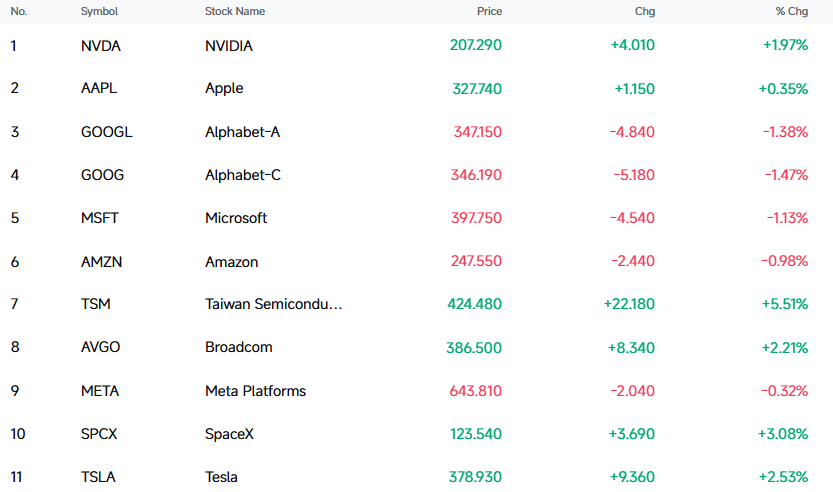
[Source: FutuBull]
The Philadelphia Semiconductor Index rose 5.21% to 12,356.16, with all 30 constituent stocks posting gains.
CPU stocks regained upward momentum, with Intel (INTC) rising 8.64%, Advanced Micro Devices (AMD) rising 8.11%, Arm Holdings (ARM) rising 7.46%, and Qualcomm (QCOM) rising 1.87%.
Bernstein Research noted in a research report that the cyclical recovery in server CPU demand, coupled with upward revisions in demand brought by agentic AI, is the core driver behind the strength in Intel and AMD's stock prices, while memory price pressure in the PC market is currently the main uncertainty. Bernstein pointed out that Intel is currently benefiting from extremely strong server demand—which represents both a cyclical recovery of years of pent-up demand following the COVID-19 pandemic and a sharp upward revision in demand driven by agentic AI. Bernstein believes that AMD benefits even more than Intel in the server CPU market because its products possess genuine market competitiveness and are continuously gaining market share. In terms of AI GPUs, the ramp-up pace of the MI450 is a key variable to focus on in the near term.
Chinese ADRs mostly declined, with H World Group (HTHT) falling 3.73%, NetEase (NTES) falling 3.46%, Atour Lifestyle Holdings (ATAT) falling 2.86%, MINISO (MNSO) falling 2.58%, Tencent Music (TME) falling 2.40%, and KE Holdings (BEKE) falling 2.33%.
Corporate News
Apple to Partner with Klarna to Launch "Upgrade" Device Leasing Program to Boost Sales
Apple (AAPL) plans to launch a leasing program called "Apple Upgrade," marking one of the biggest changes ever in the company's device sales model. According to people familiar with the matter, the service is expected to launch on July 28, initially in the US market, supporting most iPhone, Mac, iPad, and Apple Watch models. Apple will partner with Klarna Group, which will provide financial backing for the project. The program will debut in the US, launching simultaneously across Apple's physical retail stores and online platforms. The service will adopt a subscription-like model, allowing users to pay off device fees early during the leasing period, upgrade to newer models early, or keep the devices at the end of the lease term.
Google Releases Three New Gemini Models
Google announced the launch of Gemini 3.6 Flash, Gemini 3.5 Flash-Lite, and Gemini 3.5 Flash Cyber for cybersecurity. Among them, Gemini 3.6 Flash focuses on coding, knowledge work, and multimodal tasks; while reducing output token consumption, its output price is nearly 17% lower than its predecessor. Gemini 3.5 Flash-Lite targets high-throughput, low-latency scenarios. Gemini 3.5 Flash Cyber aims to enter the cybersecurity AI market at a lower cost through the CodeMender code security agent. Google revealed that Gemini 4 has kicked off "its most ambitious pre-training work to date."
Nvidia Discloses Latest Progress on Vera Rubin
Nvidia disclosed the latest updates on its next-generation Vera Rubin platform, with the Vera Rubin NVL72 having entered the mass production ramp-up phase. Nvidia stated that the platform's supply chain covers over 350 factories and 30 countries globally, with more than 300 partners already participating. Nvidia further released performance data for the Vera CPU and the Vera Rubin platform in AI agent workloads, attempting to demonstrate that as AI shifts from "answering questions" to autonomous planning, tool calling, and task execution, CPUs are becoming the new battlefield for AI infrastructure.
The full specifications, benchmark results, and architectural information of the Vera data center CPU, disclosed by Nvidia, represent critical data necessary for potential customers to comprehensively evaluate the chip. The company stated that deliveries of the Vera chip were completed in June to customers including OpenAI, Anthropic, and SpaceX.
Novo Nordisk Sues Eli Lilly for False Advertising
Novo Nordisk has accused Eli Lilly of misleading advertising regarding its best-selling weight-loss drug Zepbound and diabetes injection drug Mounjaro, violating federal and state laws regarding false advertising and unfair competition. According to the complaint, Novo Nordisk specifically took issue with an Eli Lilly advertisement titled "Watch This: Head-to-Head," which has been running since February this year. The company pointed out that when comparing the efficacy of GLP-1 drugs, the advertisement deliberately contrasted high doses of Eli Lilly's products with low doses of Novo Nordisk's products and failed to incorporate the latest clinical study data, thereby conveying misleading conclusions to consumers.
TSMC Reportedly to Raise Foundry Prices by Up to 10% Starting in 2027
TSMC plans to raise foundry prices for advanced and mature process chips starting in 2027, with price hikes of up to 10%, to cope with pressure from rising costs of materials, manufacturing equipment, and overseas new plant construction, media reported, citing multiple people familiar with the matter. TSMC has already initiated negotiations with customers regarding the price hikes, which affect 7nm and more advanced nodes. This business segment accounted for approximately 77% of TSMC's revenue in the April-to-June quarter of this year.
People familiar with the matter said the base price increase will be 5% to 10%, depending on the customer and the product. For new orders of high-performance computing (HPC) chips that exceed customers' initial forecasts, TSMC plans to charge an additional 10% to 15% premium on top of the base price increase. Consequently, the overall price hike for some advanced process chip orders could exceed 10%. For mature processes (including 12nm, 16nm, 28nm nodes, and other legacy processes), TSMC plans to raise prices by up to 10%, though the increase for some products will be below this level.
Industry & Macro News
Trump Warns Houthis: US Will 'Take Action' If Red Sea Blockaded
US President Donald Trump said that the United States would "deal with that issue" if Yemen's Houthi rebels impose a blockade on shipping and energy exports from Saudi Arabia. Trump made the remarks while meeting with the Lebanese president in the Oval Office at the White House: "So far, it hasn't happened. It may happen, but we'll deal with it." He said, "If something like that happens, we will take action. We have taken action against the Houthis before, and we haven't heard much from them since our initial steps."
Trump Reportedly to Impose New Tariffs on Dozens of Countries as Early as This Week
According to the Financial Times: As the 10% tariff rate is set to expire on Friday, US officials have prepared multiple options to allow Trump to impose new tariffs on dozens of countries. The new tariffs are expected to be comparable to the current 10% rate, but the US administration is also advancing other investigations to secure legal authorization to propose higher tariffs.
US Treasury Secretary Bessent Threatens Sanctions on Chinese AI Models
US Treasury Secretary Scott Bessent made it clear on Tuesday that the Trump administration will carefully review open-source artificial intelligence models from China to search for evidence of theft of US intellectual property, and threatened to deploy sanctions if verified.
This content was translated using AI and reviewed for clarity. It is for informational purposes only.
Recommended Articles








Comments (0)
Click the $ button, enter the symbol, and select to link a stock, ETF, or other ticker.