


Is AI Making iPhones More Expensive? Micron Among Big Winners as Global Memory Shortage Escalates



AI Podcast


On September 7 ET, surging AI data center demand for High Bandwidth Memory and server DRAM has driven memory manufacturers to reallocate capacity, creating tight consumer electronics supply. Producing HBM requires significantly more wafer input, squeezing conventional DRAM and NAND availability and raising smartphone and PC procurement costs. Companies like Apple, Huawei, and Xiaomi face mounting gross margin pressures, prompting widespread device price hikes. Meanwhile, memory makers, notably Micron, report substantial revenue growth. While rising prices elevate global smartphone market value despite declining shipments, cyclical capacity expansions and future inventory adjustments pose ongoing market risks.
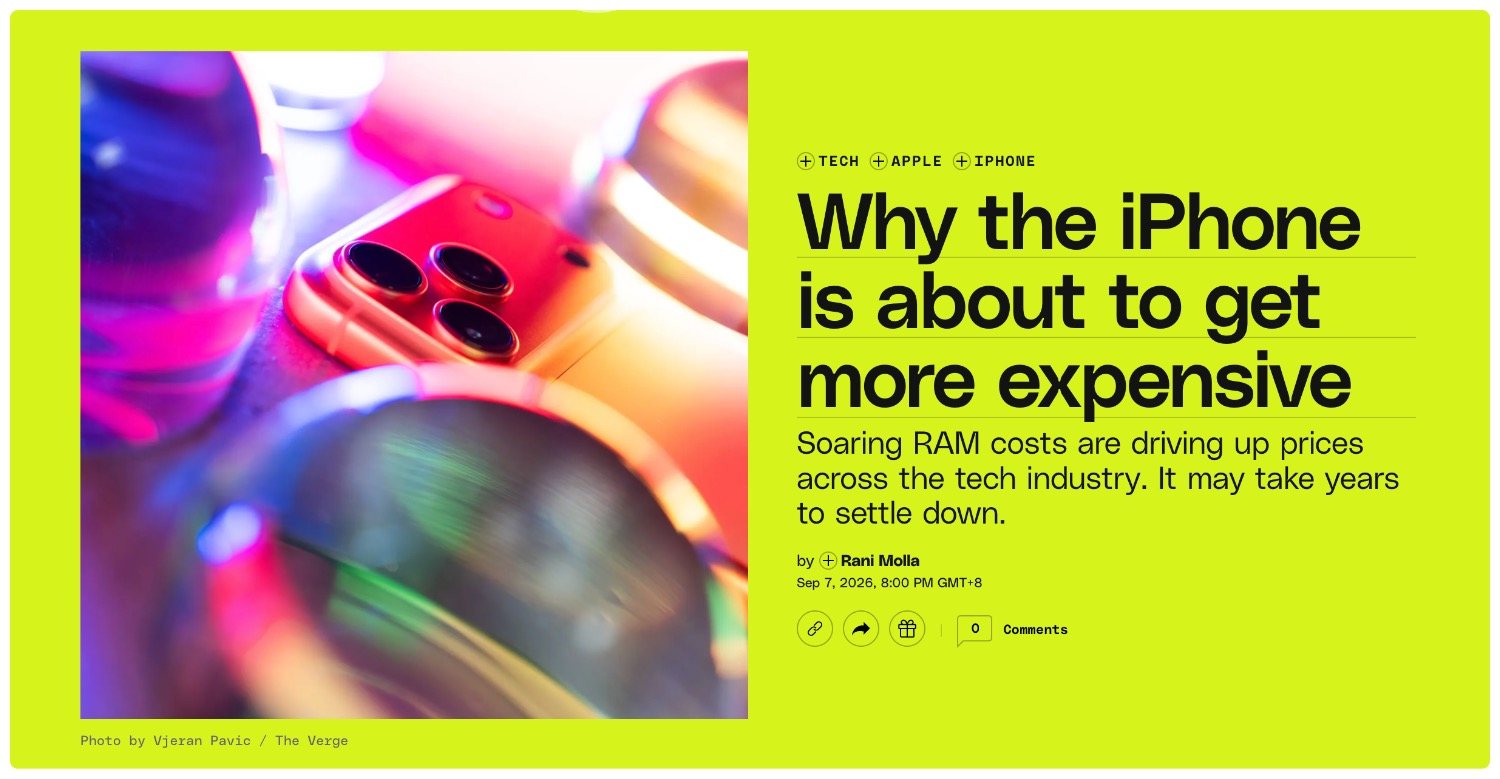
TradingKey - Strong demand for memory from AI data centers is driving up the costs of smartphones and PCs. On September 7 ET, according to a report by The Verge, demand for High Bandwidth Memory (HBM) and server DRAM from AI data centers continues to grow, and memory manufacturers are leaning toward allocating limited capacity to higher-margin AI-related products with more stable orders.
[Source: The Verge]
Based on Counterpoint's DRAM revenue metrics, Samsung, SK Hynix (SKHY), and Micron Technology (MU) together account for nearly 90% of the global market. As capacity allocation tilts toward AI, the supply of DRAM for consumer electronics has also been impacted. Citing Counterpoint data, the report stated that in the second quarter of 2026, smartphone DRAM prices rose by about 83% quarter-over-quarter.
Why HBM Expansion Affects Mobile DRAM
HBM used in AI servers and smartphone DRAM are not the same product, but both consume DRAM manufacturing resources.
HBM is formed by stacking multiple layers of DRAM chips, featuring more complex manufacturing and packaging processes. According to Micron Technology's estimates, producing the same capacity of HBM requires roughly three times the wafer input of conventional DRAM.
When AI customers purchase HBM and server DRAM in large volumes, memory makers have a stronger incentive to shift capacity toward these high-value products. Consequently, manufacturing resources available for conventional DRAM decrease, driving up procurement costs for smartphone and PC manufacturers.
In the short term, this supply-demand pressure will remain difficult to ease significantly. TrendForce projects that DRAM demand growth will continue to outpace supply growth in 2027, with HBM's ongoing consumption of capacity being a major factor behind tight supply. The situation for NAND is somewhat different; as new capacity comes online, its supply environment may begin to ease starting in the second half of 2027.
As Memory Costs Rise, Will iPhone Prices Increase?
Rising memory prices are reshaping smartphone cost structures. Counterpoint data shows that among the flagship smartphone samples it tracks, DRAM and NAND combined accounted for approximately 40% of the BOM cost in the second quarter of 2026, with DRAM surpassing the SoC to become the single highest-cost component.
Apple (AAPL) is also affected by this round of memory price hikes. Leveraging its massive procurement scale, Apple possesses strong supply chain bargaining power, but rising memory costs have already had a tangible impact on the company.
During the Q3 FY2026 earnings call, then-CEO Tim Cook stated that the memory costs paid by Apple in the June quarter were significantly higher than in the previous quarter, and were expected to rise further in the September quarter. Meanwhile, Apple CFO Kevan Parekh noted that rising memory costs were the main reason for sequential pressure on gross margin during the quarter.
Apple had previously raised prices on certain Mac and iPad products. Cook admitted that the company was "reluctantly raising prices" and described the memory price environment at the time as a "100-year flood," stating that memory prices were rising "exponentially."
Next, market attention is focused on the iPhone. The Verge believes there is a possibility of a price increase for the new-generation iPhone. However, as of September 7, Apple has not yet announced official pricing for the new-generation iPhone, nor has it confirmed that iPhone prices will be raised due to rising memory costs.
What is certain for now is that rising memory prices have already affected Apple's procurement costs and gross margin; how much of this pressure will ultimately be passed on to iPhone retail prices remains to be seen until Apple makes an official announcement.
Consumer Electronics Price Pressures Have Already Emerged
Other smartphone and PC manufacturers have already begun adjusting prices for certain products.
Around September 1, brands such as Huawei and Xiaomi raised prices on some smartphones, with single price hikes on certain models reaching 1,000 yuan. Price increases also occurred on the PC side; according to media reports, HP made a price adjustment of about 15% on August 28, while Lenovo and Asus also adjusted prices for some products around September 1.
Memory is not the sole reason for price hikes on end products, but the continuous rise in DRAM and NAND prices has already increased cost pressures for smartphone and PC manufacturers.
IDC expects global smartphone shipments to decline by 16.7% year-over-year in 2026 to slightly over 1 billion units, marking the largest annual decline on record, while the average selling price is projected to rise 27.6% year-over-year to $581. Even with the sharp drop in shipments, price increases will still drive the total value of the global smartphone market up by 6.3% to $613 billion.
Micron Becomes One of the Main Beneficiaries
While device makers face rising costs, memory manufacturers are benefiting from higher memory prices, with Micron Technology being one of the standout performers.
Micron's growth drivers are not limited to HBM. AI servers have expanded demand for both HBM and server DRAM, while tight supply of traditional DRAM supports prices.
Its NAND business also grew significantly. TrendForce data shows that Micron's NAND revenue reached $11.85 billion in the second quarter of 2026, up 99.2% quarter-over-quarter, ranking first in growth rate among the world's top five vendors and rising to third in market position.
Compared with past memory cycles that were more heavily influenced by demand from PCs, smartphones, and traditional servers, the impact of AI data centers on memory demand and capacity allocation is far more prominent in this current cycle.
However, memory remains a highly cyclical industry, and the release of new capacity, changes in consumer electronics demand, as well as customer inventory adjustments could all impact future price trends.
Whether the next-generation iPhone will see price increases due to rising memory costs remains uncertain. However, AI demand has already altered the supply-demand structure of the global memory market, leaving smartphone makers with higher procurement costs, while growing HBM demand and tight DRAM supply have made Micron one of the main beneficiaries of this memory market upswing.
This content was translated using AI and reviewed for clarity. It is for informational purposes only.
Recommended Articles







Comments (2)
Click the $ button, enter the symbol, and select to link a stock, ETF, or other ticker.