


IBM Earnings Warning Triggers Chain Reaction, Japanese IT Stocks Fall Across the Board



AI Podcast


During the Asian trading session on July 15, the Japanese IT sector experienced significant declines, with NEC, Fujitsu, and others falling amid broader market contagion. This sell-off follows IBM’s record 25% drop on July 14, triggered by weak preliminary Q2 results. IBM’s shortfall stems from a structural shift in enterprise spending: customers are prioritizing scarce AI-related hardware, diverting budgets away from software and IT services. Analysts warn this trend undermines the "additive" AI software narrative, signaling potential widespread pressure on the software sector as capital expenditure continues to favor hardware procurement.
TradingKey - During the Asian trading session on July 15, the IT sector of the Japanese stock market suffered a widespread sell-off. As of press time, NEC (6701) fell 4.44%, Fujitsu (6702) fell 5.42%, Nomura Research Institute (4307) fell 2.94%, and BayCurrent Consulting (6532) fell 6.7%.
The direct trigger for the sell-off was IBM ( IBM )'s record-breaking plunge overnight. During US intraday trading on July 14, IBM's stock price plummeted over 25%, marking its largest single-day decline since listing and surpassing the record of "Black Monday" in 1987. The decline was due to IBM's advance disclosure of preliminary second-quarter results that fell far short of Wall Street expectations: revenue of $17.2 billion (expected $17.9 billion) and adjusted earnings per share of $2.93 (expected $3.02).
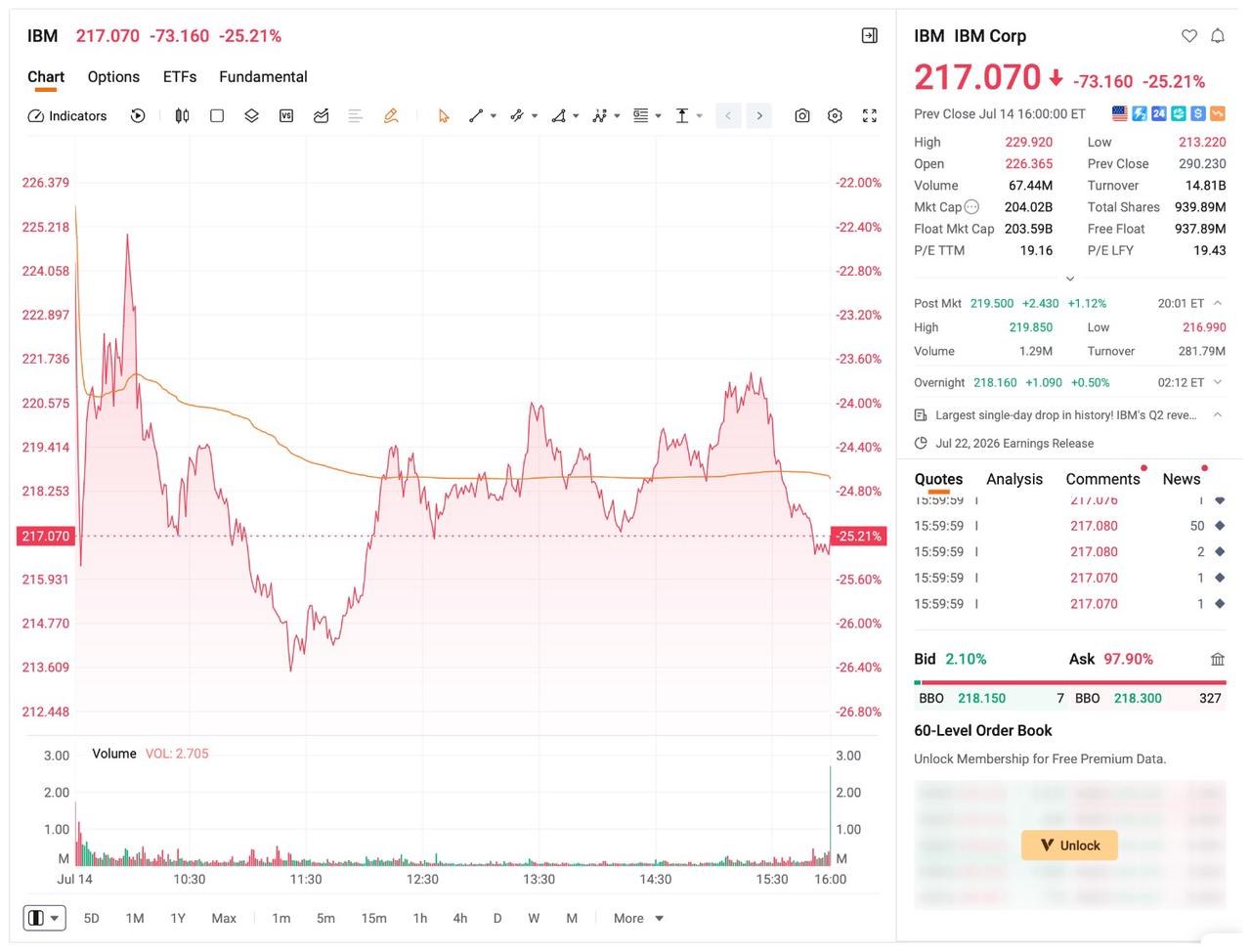
[Source: Futu]
IBM Chief Executive Arvind Krishna admitted in a letter to shareholders that in the final weeks of June, customers suddenly shifted their quarterly capital expenditures toward server, storage, and memory procurement to lock in tight supplies of AI infrastructure ahead of expected price increases. Although the company anticipated some supply chain impacts, it "failed to anticipate the magnitude of this capex reprioritization."
The underlying backdrop to this shift is a global shortage of memory chips. Samsung and SK Hynix ( SKHY) and Micron ( MU) have shifted their production capacity to AI-specific chips, with their 2026 capacity essentially sold out through long-term contracts, leading to persistent tight supplies of standard memory used in servers, PCs, and mobile phones. Anticipating further price increases, enterprise customers have been forced to prioritize hardware procurement and delay mainframe and software procurement contracts, with capital continuously flowing from the software and IT services sectors to hardware companies.
Goldman Sachs ( GS) subsequently issued a warning, stating that this IBM event "will fully validate the software bear case scenario" and predicting a widespread sell-off in the software and services sector. Barclays analysts pointed out that while IBM management had previously repeatedly emphasized that AI has an "additive" effect on software, this performance miss came precisely from the reality of customers shifting budgets to tight hardware, making this narrative unsustainable.
This structural adjustment in IT spending, triggered by AI hardware demand, quickly spread from the earnings warning of a single company, IBM, to the entire software and services sector. The decline in Japanese IT stocks is a direct reflection of this trend in the Asia-Pacific market.
This content was translated using AI and reviewed for clarity. It is for informational purposes only.
Recommended Articles








Comments (0)
Click the $ button, enter the symbol, and select to link a stock, ETF, or other ticker.