


NVIDIA (NVDA) Stock Forecast: White List Cuts Half of Asian Buyers; What It Means at $204



AI Podcast


NVIDIA (NVDA) faces minor distribution disruptions as it implements a "white list" for Southeast Asian clients to ensure U.S. export compliance. While this impacts smaller regional neo-cloud operators, the revenue risk is minimal, as Q2 FY2027 guidance of $91 billion excludes Chinese Data Center compute. Q1 performance remained robust with $81.62 billion in revenue, an 85% year-over-year increase, and $48.6 billion in free cash flow. Technically, the stock is testing a double-top resistance at $212.43. A decisive breakout could target $221, while failure to hold $201.66 support may lead to a retest of $191.25.
TradingKey - NVIDIA (NASDAQ: NVDA) is hovering around $204.59 on Tuesday, July 14, 2026, up from its Monday close of $203.53, which was a 3.52 percent drop. This movement follows a Financial Times piece noting that Nvidia had halved the number of Asian clients allowed to buy its AI chips, and then had a brand new “white list” of buyers. This applies to Singapore, Malaysia, and Japan, where the firm has beefed up compliance to stop AI chips from falling into the hands of China. The ones removed, largely smaller cloud customers in the region, can apply again once they show proof of ownership and evidence of how the chips are to be used.
From a charting perspective, on the 4H timeframe, Nvidia is holding above the $201.66-$198.98 demand area after it broke a lower trendline, and a double top is forming in the $212.43 region. With the RSI reading near 54, a decisive close above $212.43 would open the door to $221, while a break below $201.66 would see the stock revisit $191.25.
The White List and What It Does to Nvidia’s Revenue
The new white list effectively halves the pool of Asian companies that are able to legally purchase Nvidia GPUs. It's the Blackwell-generation chips that we're referring to here, as a result. The consequence in the near term is slowing down the pipeline through Southeast Asia and, in the case of those that have been removed, a pause while they reapply. The sector in question are neo-cloud customers: small regional customers that use chips for renting them out to end-users, instead of deploying the chips themselves. Such operators represent the highest risk for diversion, because the end-user of the compute is not necessarily the buyer of the chip.
The actual revenue impact is actually narrower than the numbers would seem to indicate. Southeast Asian neo-cloud operators account for only a sliver of Nvidia's entire order book: US hyperscalers (Microsoft, Google, Amazon, Meta) and sovereign AI programs in Europe and the Middle East, plus a handful of massive, large enterprises with direct deployments make up the lion's share. In fact, Nvidia's Q2 FY2027 guidance of $91 billion in revenue excludes any Data Center compute revenue from China, as it stands, suggesting the baseline already assumes Chinese-adjacent market demand.
The actual value of the white list is the regulatory compliance, not necessarily the revenue impact. It shows the company is working closely with Washington to ensure compliance, rather than simply sitting back and doing nothing while regulatory enforcement is carried out against it. That has more long-term strategic value than the immediate, minor disruption to distribution costs.
Q1 FY2027 in Numbers — The Quarter That Makes $204 Look Cheap
The numbers that justify the $204 valuation Nvidia trades at right now. The company delivered Q1 FY2027 results on May 20. Total revenue was $81.62 billion, an 85% year-over-year increase from $44.06 billion. Within Data Center, there was $75.2 billion total with $60.4 billion coming from compute (+77% YoY) and $14.8 billion from networking (+199% YoY). Non-GAAP gross margin came in at 75.0%, while the non-GAAP diluted EPS was $1.87, besting the consensus of $1.76.
GAAP net income reached $58.32 billion, boosted by a one-time tax benefit, and free cash flow was $48.6 billion after the firm spent only $1.8 billion in capital expenditure. This results in a 60% FCF margin. The board of directors authorized a new $80 billion buyback, and they also hiked the dividend from $0.01 to $0.25 per share.
Nvidia is trading at $204.59, with a trailing P/E of 31.17 times. This makes it cheaper than several consumer staples companies which grow revenue at 3-5% every year. The guidance for Q2 FY2027 calls for $91 billion, with the $0 data center compute component, suggesting a sequential increase of 11.5% from the Q1 total. If that guidance is met, the annualized revenue run rate into FY2028 will exceed $360 billion.
The 61-analyst consensus target price stands at $301.62, implying 48% upside. The key technical question remains, whether we get a 5-10% drop from the double-top in the $212.43 area, as they typically do, or does another earnings report in late August propel us above the $212.43 double-top to the $221 to $228 zone.
NVDA Technical Analysis: Double Top at $212.43, RSI 54, Key Levels for the Session
NVDA is bouncing off the $201.66 to $198.98 demand zone after breaking above the descending channel that has been capping the stock since May. RSI 54 can move anywhere. Above $212.43, close breaks the double top and aims for $221.12 then $228.77. Below $201.66, close is back to $191.25. 200-period EMA is $203.70, which is near-term support.
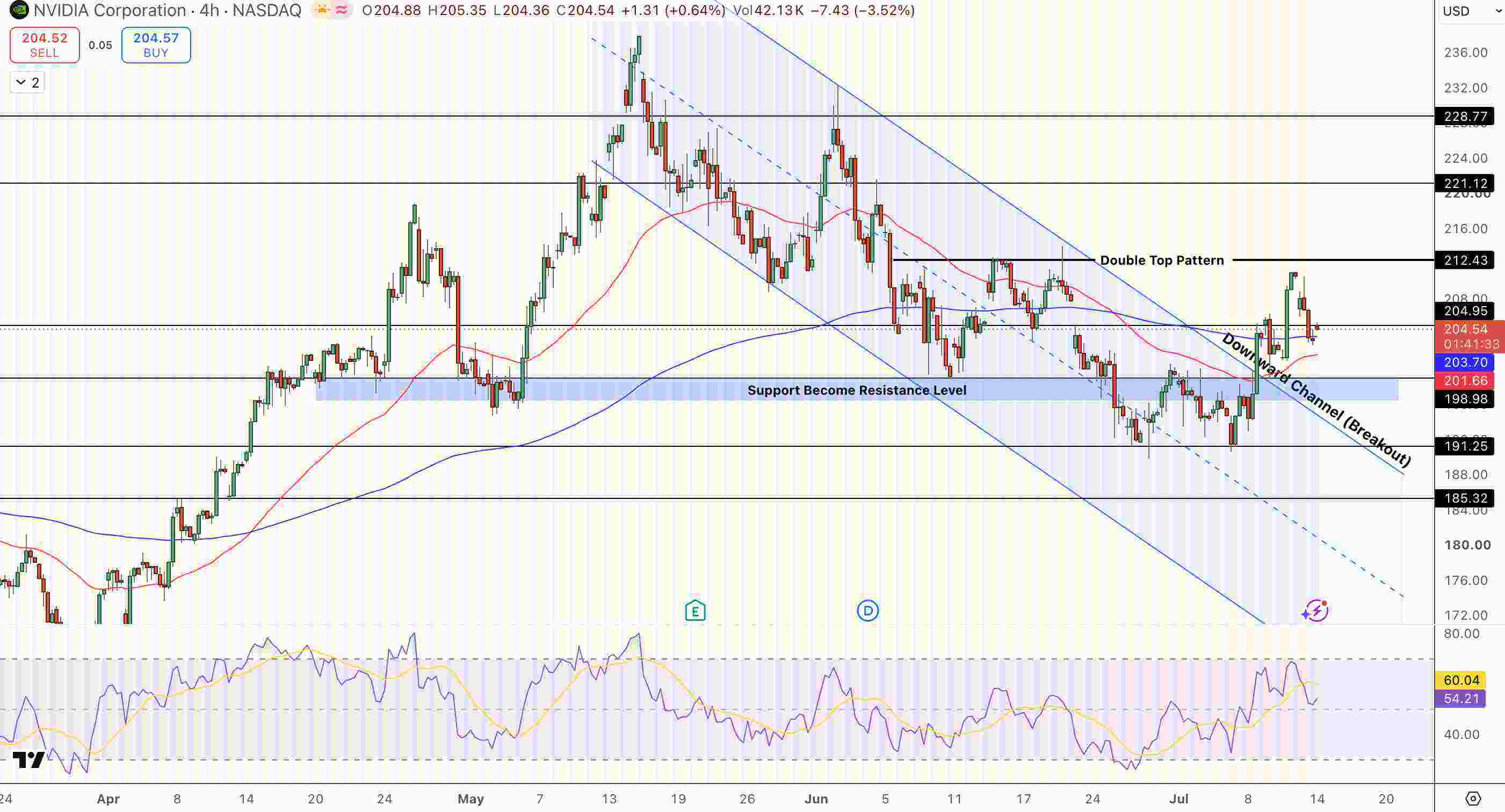
NVIDIA (NVDA) Stock Price Chart - Source: Tradingview
- Bull trigger: Close above $212.43: target $221.12 then $228.77.
- Bear trigger: Close below $201.66: back to $191.25.
- 200 EMA: $203.70, which is the near-term support level.
- White list effect: >50% of Asian buyers removed. Neo-cloud operators hit hardest. Reapply with paperwork.
- Q1 FY2027: $81.62B revenue (+85% YoY). Non-GAAP EPS $1.87 vs. $1.76. FCF: $48.6B.
- Q2 Guidance: $91B revenue (+11.5% seq). No China Data Center revenue assumed.
Why Did Nvidia Create a White List of Asian Chip Buyers?
NVIDIA established a whitelist of authorized Asian chip buyers in response to a Financial Times report stating that its previous approvals for more than half of its Southeast Asia clientele were revoked. The new program is designed to increase the effectiveness of US export compliance in Singapore, Malaysia, and Japan, which have been the primary marketplaces for acquiring chips in the first instance for China, where they were sold using shell companies.
Any company that has been removed from the whitelist may submit a new application, including ownership documents, end-user client agreements, and records of the physical layout of the data center for review and approval. With this strategy, NVIDIA is taking on the role of compliance in advance with the Biden administration's position in Washington, avoiding further US regulatory pressure in the event of a general trade embargo.
What Were Nvidia’s Q1 FY2027 Results?
In reporting its Q1 FY2027 results on May 20, 2026, which covers the quarter ending April 26, NVDA had revenue of $81.62 billion, up 85% year over year (YoY). Data Center sales were $75.2 billion, including networking sales of $14.8 billion, up 199% year over year. Non-GAAP gross margin was 75.0%.
Non-GAAP earnings per share were $1.87, above $1.76 expected. Free cash flow was $48.6 billion on capex of $1.8 billion. The Board of Directors approved a further $80 billion of share buyback and increased the quarterly dividend from $0.01 per share to $0.25. For Q2 FY2027, it was expected that the firm would earn $91 billion in revenue, which was expected to include no revenue for China Data Center compute.
What Is the Double-Top Pattern on NVDA’s Chart and What Does It Mean?
The double top is a price pattern in which a stock reaches resistance at a price point that it can't breach, thus revealing resistance from sellers at that level. On the NVIDIA 4H chart, the double top has now formed at $212.43. With an RSI of 54, the chart is neutral, and there's room for both a successful completion of the double top, or for the stock to break above resistance, thus invalidating the pattern. Above the pattern is $221 to $228. Below $201.66 the stock will once again see $191.25. The stock is now at resistance, having also been capped at the $212.43 level on July 7 and July 10 this year.
Bottom Line
NVIDIA dropped 3.52% on Monday as the Financial Times reported the firm would be eliminating more than half of its list of approved Asian chip buyers under its newly created whitelist, which it created to comply with US-China export regulations in Singapore, Malaysia, and Japan. The effect on revenue is small because even the Q2 guidance of $91 billion doesn't include China Data Center compute. Proactive compliance with regulators, and the benefit that will accrue from that, outweighs the short term disruption to distribution channels. NVDA has an expected multiple in the neighborhood of 31x trailing earnings at $204.59 for a quarter that produced $81.62 billion in revenue and $48.6 billion in free cash flow. The key resistance in the short term is the $212.43 double top; above $221. Below $201.66 there will be no problem in seeing $191.25 again.
Recommended Articles







Comments (0)
Click the $ button, enter the symbol, and select to link a stock, ETF, or other ticker.