


Premarket Plunge Over 20%, IBM Preliminary Revenue Miss, Why Is the Legacy Software Giant’s AI Transformation Falling Into a Maze?



IBM’s preliminary Q2 earnings missed expectations, with revenue of $17.2 billion falling below the $17.86 billion consensus. Infrastructure revenue declined 7%, driven by a shift in customer capital expenditure toward AI-centric hardware. CEO Arvind Krishna attributed the shortfall to execution delays and an unexpected realignment of client budgets. This performance has sparked broader concerns regarding the software industry as enterprises prioritize AI infrastructure over legacy products. The sharp pre-market share price decline underscores investor skepticism regarding IBM’s ongoing transformation into an AI-focused provider and highlights the risks traditional tech giants face in a rapidly evolving market.

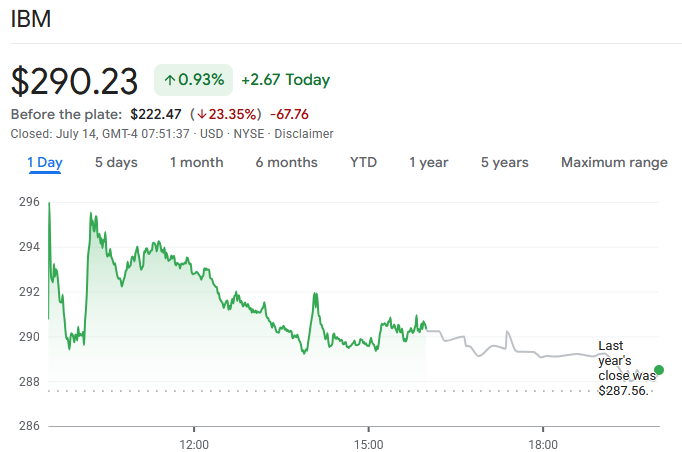
TradingKey - On Tuesday, IBM ( IBM )'s preliminary second-quarter results preview sent shockwaves through the market. The company's disclosed revenue of $17.2 billion was not only far below the Wall Street consensus estimate of $17.86 billion, but more concerningly, it highlighted the declining trend of its traditional business amid the AI infrastructure boom.
The news directly caused IBM's premarket stock price to plummet by over 20%. If this decline carries over into regular trading, it is poised to mark the largest single-day drop since 'Black Monday' in 1987.
Source: Google Finance
IBM Revenue and Profit Both Miss Estimates
According to consensus analyst estimates compiled by the London Stock Exchange Group, the market had expected IBM's second-quarter revenue to be $17.86 billion, whereas the company's preliminary estimate was only $17.2 billion. Adjusted earnings per share is expected to be $2.93, falling short of the market expectation of $3.02.
By segment, IBM's software revenue rose 5%, representing a decent performance, but infrastructure revenue fell 7% year-on-year, significantly weaker than the market's previous expectations of a low-single-digit decline for the full year.
IBM said it expects infrastructure revenue to decline by a single-digit percentage starting this quarter. The company attributed the revenue decline primarily to the performance of its Z series and an insufficient related software stack.
In addition, in the final weeks of June, customers shifted quarterly capital expenditure toward procurement of servers, storage, and memory to secure tight infrastructure supply ahead of expected price increases, a change that directly impacted IBM's legacy business.
IBM Chief Executive Arvind Krishna admitted in an open letter to investors that the company failed to quickly adapt to the constantly changing market environment this quarter, causing its business progress to lag, and multiple large deals failed to close as scheduled.
He said, "We had expected the supply chain to be affected, but we did not expect the reallocation of customer capital expenditure to be of this magnitude."
Traditional Giants Lost in the AI Era
Currently, global AI infrastructure development has entered a high-investment phase, with enterprises shifting more of their IT budgets from mature software products to computing equipment, storage, and supply chain resources. This trend is not only affecting traditional tech giants like IBM but is also sparking market concerns over the outlook of the entire software industry.
For a long time, software investors have worried that AI automation tools would replace traditional software functions, but IBM's latest disclosure reveals a new risk: even AI-centric hardware investments are squeezing software procurement budgets.
Chris Beauchamp, Chief Market Analyst at IG Group, noted: "This is the darkest hour for IBM and the entire software industry. What the market is most concerned about is how long the trend of enterprises shifting from software to infrastructure will last."
Over the past few years, IBM has been trying to shed its label as a traditional hardware and mainframe business, accelerating its transformation into an enterprise software and AI infrastructure service provider through acquisitions of companies such as Red Hat, HashiCorp, and Confluent.
The company previously emphasized that artificial intelligence would drive growth in customer demand for its infrastructure software, enabling enterprises to connect and manage different AI models more efficiently.
However, this earnings warning has reignited market doubts about IBM's transformation path. In February this year, IBM's stock price experienced significant volatility after AI startup Anthropic introduced a tool that helps modernize legacy programming languages on IBM mainframes. Furthermore, the second-quarter results missing expectations have further intensified market concerns that its traditional business is being squeezed by AI infrastructure investments.
This content was translated using AI and reviewed for clarity. It is for informational purposes only.
Recommended Articles










Comments (0)
Click the $ button, enter the symbol, and select to link a stock, ETF, or other ticker.