


Broadcom Shares Buck the Trend to Rise Over 6%. Signs Long-Term Deal With Apple Exceeding $30 Billion, JPMorgan Expects Its AI Revenue to Double Again by 2028.



AI Podcast


On July 8, Eastern Time, Broadcom shares rose over 6% following a multi-year partnership with Apple exceeding $30 billion. This agreement extends until 2031, shifting from traditional RF components to the joint development of custom AI ASIC chips, including the "Baltra" server processor slated for 2026. JPMorgan and BofA highlight this as a strategic shift for Broadcom, now commanding over 70% of the custom AI chip market alongside major tech clients. By integrating AI ASIC development with networking and optical systems, Broadcom reinforces its long-term growth trajectory, significantly boosting revenue certainty and its AI-focused valuation framework.

Tradingkey - On July 8, Eastern Time, Broadcom ( AVGO) bucked the trend to rise over 6%, closing at $393.25. It is reported that Apple ( AAPL) announced a multi-year partnership agreement with Broadcom today, worth over $30 billion. BofA Securities previously pointed out that Broadcom's newly added fifth AI ASIC customer "could be Apple."
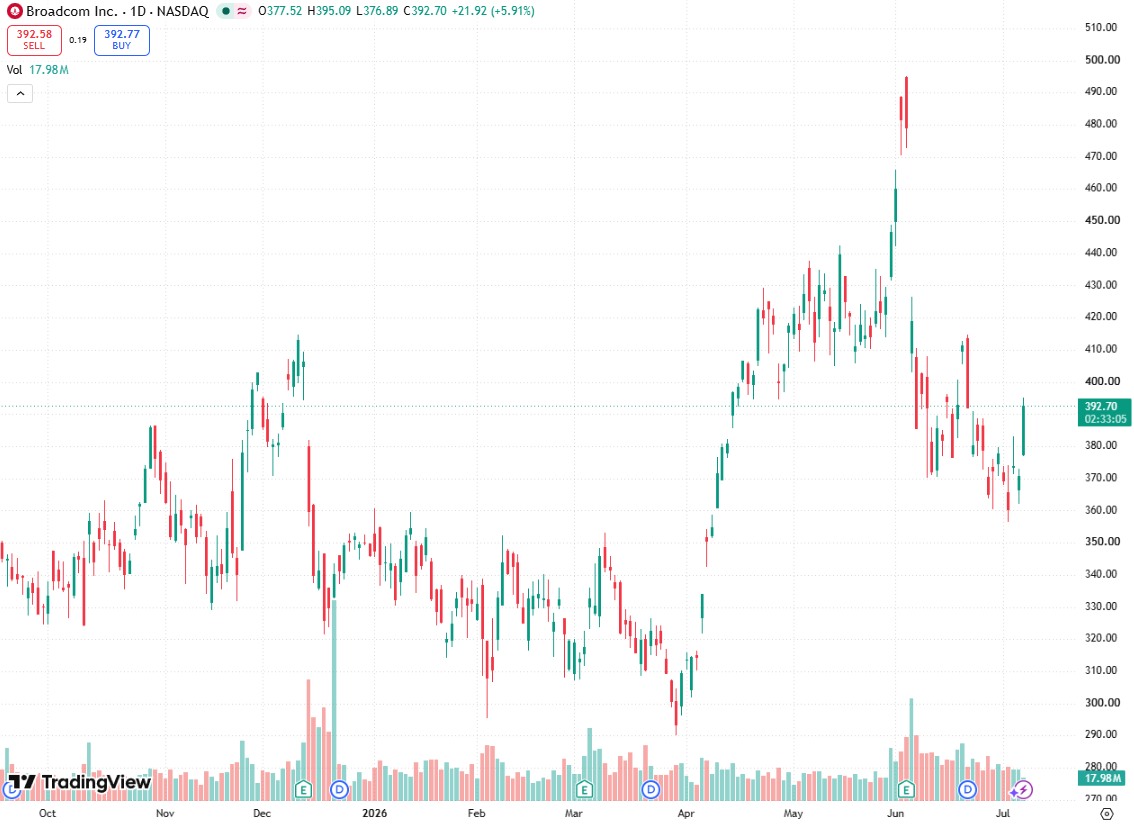
[Source: TradingView]
The collaboration between Broadcom and Apple has undergone a strategic upgrade, extending from traditional RF component supply to the joint development of custom ASIC chips.
Broadcom filed with the U.S. Securities and Exchange Commission (SEC) on Monday, disclosing that the technical cooperation between the two parties has been extended to 2031 to develop and supply a series of custom ASIC chips for multiple generations of Apple products. Apple further released the financial details of the agreement on Wednesday, with the total scale expected to exceed $30 billion. The AI server chip under the subsequent cooperation is code-named "Baltra," which is expected to enter mass production in 2026, primarily targeting the customized computing power requirements of Apple's internal AI workloads.
JPMorgan Chase significantly revised up its AI revenue forecast for Broadcom, predicting that AI-related revenue in 2027 will grow by 2 to 2.5 times compared to current levels, and will double again in 2028. Analysts from the firm stated that Broadcom's growth is driven by two major business lines. On the traditional business front, Apple contributes about 20% of its annual revenue, and this extension provides extremely strong revenue certainty for the RF and connectivity chip business. On the AI business front, growth is even more aggressive, with first-quarter AI-related revenue reaching $8.4 billion, a year-on-year increase of 106%, holding a share of over 70% in the custom AI chip market.
BofA Securities pointed out in its latest report that with the official addition of Apple, Broadcom's AI ASIC customer matrix now covers leading tech companies such as Google, Meta, ByteDance, and OpenAI, further consolidating its leading position. This also alleviates to some extent the market concerns previously raised by MediaTek entering Google's TPU supply chain.
It is understood that this cooperation is divided into two major technical directions. On the RF side, Broadcom will invest $1.5 billion to expand its Fort Collins plant in Colorado to produce advanced RF components such as FBAR filters. It will produce over 15 billion chips domestically in the U.S. in the future, which will be widely used across Apple's entire product line, including iPhones and iPads. On the AI chip side, the custom server processor jointly developed by both parties is expected to be manufactured using TSMC's N3P process, deeply optimized specifically for AI computing power scenarios in Apple's ecosystem.
Analysis suggests that this agreement marks Broadcom's upgrade from a traditional connectivity chip supplier to a platform-type AI computing infrastructure company of "AI ASIC custom chips + networking infrastructure + data center optical interconnect systems," strengthening both its long-term growth logic and valuation framework.
This content was translated using AI and reviewed for clarity. It is for informational purposes only.
Recommended Articles







Comments (0)
Click the $ button, enter the symbol, and select to link a stock, ETF, or other ticker.