


TSMC Stock Forecast: Texas Expansion and 2nm Ramp Put Record AI Demand in Focus



AI Podcast


TSMC exhibits strong fundamental momentum driven by surging AI demand, with High-Performance Computing dominating revenue and 2nm nodes initiating commercial contributions. Management raised 2026 capital expenditures to $60–$64 billion to expand advanced capacity, including potential U.S. fab investments in Texas. Despite robust operating leverage and robust year-over-year sales growth, risks include margin dilution from overseas expansion and steep 2nm ramps. Technically, the stock remains bullish above major support at $469.66, though an overbought RSI signals potential short-term consolidation ahead of upcoming Q3 earnings and September sales reports.
Taiwan Semiconductor Manufacturing Co. (NYSE: TSM) has reached new all-time highs in September, propelled by strong demand for AI chips and other products. TSM’s ADR closed at $485.80 on October 5, after touching a new intra-day high of $487.47. September sales are scheduled for release on October 8 and TSM is expected to report earnings on October 15.
What is interesting is how many components of the growth story are moving at the same time. 2nm has started generating revenue, HPC is the dominant segment on the platform, and management raised the 2026 capex guidance to fund further capacity. To add to all this, TSMC is considering adding further capacity in the US, in addition to their existing plans in Arizona. With all of this capacity coming online, the main concern shifts to how TSMC will be able to maintain the current margin structure while continuing to expand capacity.
Texas Could Become TSMC’s Second Major U.S. Manufacturing Hub
According to a report by Reuters on September 30, TSMC is also considering building a major semiconductor manufacturing hub in Texas. Discussions are still preliminary, and TSMC has not reached a final decision for the potential campus. Any new manufacturing investment in Texas would be in addition to the $265 billion the company previously committed to Arizona.
The Arizona buildout is already impressive. Reuters has reported that the current plan calls for 12 fabrication and advanced-packaging facilities plus an R&D center. Additional front-end and back-end fab facilities will be built over time. A Texas campus would definitely create a large U.S. manufacturing ecosystem, and not be a small satellite campus.
From a competitive strategy perspective, the more capacity TSMC builds in the U.S. the less focused its customer and geopolitical risks will be. Plus, the capacity will be considerably closer to TSMC’s largest AI and cloud customers. The trade-off will be less gross margin because it is more expensive to build and operate fabs overseas, and management has already warned about the dilutive effect of building and ramping overseas fab facilities.
August Sales Show AI Demand Is Still Accelerating
TSMC’s latest official monthly sales data for August are still very strong. August sales reached NT514.81billion,up10.1%fromJulyandup53.3%fromAugust2025.SalesforJanuarythroughAugustreachedNT3.387 trillion, up 39.3% from the same period last year.
September sales data have not yet been released. According to TSMC’s financial calendar, full September sales data will be released on October 8. So, any sales data released before that date should be considered an estimate.
In the third quarter, management expects sales to reach 44.6-45.8 billion. This would be an increase from the $40.2 billion in sales in the second quarter. Management expects third quarter gross margin to be in the range of 65% to 67% and an operating margin of 56% to 58%.
2nm Has Already Started Contributing Revenue
One of the major changes this year is the switch from 2nm being a probable future product to being a reported revenue product. In Q2, 2nm accounted for 3% of total wafer revenue. High volume production of the node started late last year. Management expects a ramp through the second half of 2026.
The rest of the technology mix continues to be extremely advanced. 3nm accounted for 30% of wafer revenue in Q2, 5nm for another 33% and 7nm for 11%. In total, 7nm and more advanced technologies accounted for 77% of total wafer revenue.
TSMC’s focus on the most advanced nodes gives it a lot of pricing flexibility. Customers building high-performance products such as AI processors, CPUs and mobile processors have a very limited set of options at the most advanced nodes. As TSMC continues to innovate into the 2nm node and beyond, it becomes more difficult and less attractive for customers to move their business to a competitor for the more advanced technologies.
The 2nm Ramp Will Pressure Margins Before It Helps Them
There are some short term positives to the 2nm ramp, but the steep ramp will pressure margins in the second half of 2026. Management has stated that the 2nm ramp will negatively impact gross margins by 3-4 percentage points in the second half of 2026. Overseas fabrication expansion will cause additional gross margin dilution of 2-3 percentage points, and later 3-4 percentage points, as additional capacity ramps up.
A key challenge will be visible as startup costs and overseas manufacturing impact gross margins. Management guided Q3 gross margin to 65% to 67% and said strong leading-edge demand and cost improvements should partially offset the 2nm ramp dilution. If TSMC is able to hold margins near the upper end of that range, it would likely mean the negative impact from AI growth would be less than expected.
AI Has Turned HPC Into the Dominant Platform
The client’s largest platform has been HPC. In Q2 HPC represented 66% of the clients revenue, up from 61% in Q1. Mobile represented 22% of revenue, and automotive only 4%.
That change illustrates the extent to which AI has transformed TSMC’s business. TSMC produces chips for Nvidia, AMD, Apple, and hyperscalers developing custom accelerators, and thus captures the demand for chips for various competing AI architectures. Therefore, with TSMC, investors don’t have to pick the chip designer to benefit from the compute cycle.
Management has estimated that AI-related semiconductor revenue would grow at a mid-to-high 50% CAGR for the next five years. In July, Wei said that customer demand is outpacing their expectations, thus reinforcing the viewpoint that AI-related customer demand is outpacing TSMC’s ability to meet that demand.
Q2 Earnings Show Extraordinary Operating Leverage
Revenue for the quarter came in at $40.20 billion, up 33.7% from the same quarter last year. Net income was NT$706.56 billion, up 77.4%, diluted earnings per share was NT$27.25, or $4.31 per ADR. Gross margin was 67.7%. Operating margin was 60.3% and net margin was 55.6%.
In my opinion, these margins are the best part of the investment case. Revenues are growing quickly, but so are profits. Given tight supply of leading-edge capacity and strong customer demand for these chips, TSMC is able to charge a premium for access to its leading edge capacity. This is why the company has strong operating leverage, and even while it ramps new technologies and builds new manufacturing capacities, it is able to give exceptional returns to its shareholders.
Another differentiating factor between TSMC and other AI infrastructure companies is the margins. TSMC isn't just benefiting from increased AI spending. It is converting that demand to exceptional returns by providing a platform that customers can't easily replace.
Capex Has Jumped Again as Customers Push for More Capacity
TSMC has increased its 2026 capital expenditure budget to $60 billion to $64 billion from $52 billion to $56 billion. In the second quarter, the company spent $15.7 billion on capex, bringing its first-half spending to $26.8 billion. Management said the main driver for the increase is that customer demand continues to rise and customers are asking the company to ramp up capacity more quickly.
About 70% to 80% of the $60 billion to $64 billion capex budget is estimated to be spent on advanced process technologies, about 10% on specialty technologies and about 10% to 20% on advanced packaging, testing, mask making and other processes. The breakdown shows that the AI bottleneck is wider than wafer fabrication.
As advanced packaging becomes more integrated with high bandwidth memory and other AI accelerators, the entire manufacturing chain must be considered, especially testing, rather than just adding more front end of line wafer capacity.
October 15 Could Set the Direction for the Next AI Cycle
Taiwan Semiconductor (TSMC) is expected to publish its September sales on October 8. The company is also expected to report its Q3 results on October 15. Both dates are confirmed in TSMC’s own calendar with the earnings conference set for 2:00 p.m. Taiwan time, 2:00 a.m. ET. September sales will complete the company’s Q3 revenue picture.
Looking past September sales, I will be focused on the Q4 revenue outlook, utilization of 2nm, advanced packaging, AI demand forecast for 2027, gross margin, and the progress on the U.S. fabs. I will also be focused on potential changes in management’s outlook on the scale and timing of overseas fab margin dilution.
The outlook remains strong. August sales were up over 50%, 2nm is reportedly contributing, HPC is the main driver, and capex has been increased due to customer demand. The main concerns are around execution, valuation and geopolitical risks.
Valuation Reflects Exceptional Expectations
TSMC closed at about $2.10 trillion in market cap on October 5. Stock Analysis shows a trailing P/E around 30, and a forward P/E around 20.7. All of these numbers are extremely high. However, if you look at TSMC's growth vs. a normal semiconductor cycle, the multiples are somewhat justifiable.
The valuation is more supportable if the demand for 2nm, advanced packaging and AI continues. The largest risk would be if the margins start to deteriorate due to an adverse cost structure. Other risks include overseas expansion and start up costs, or if the hyperscalers start to slow their orders.
What would support my view the most would be if a larger AI run rate would be built out, showing a quicker ramp to 2nm and/or a margin surprise to the upside. What would most adversely affect my views would be a slow down to leading edge orders, or a larger than expected cost of doing business overseas.
TSMC Technical Analysis: TSM Tests $487.49 as Breakout Momentum Turns Overbought
TSMC closed October 5 at $485.80, after an incredible breakout above $458.77 and $469.66. The thing that stands out to me is how quickly the price broke above $469.66 and is currently testing the $487.49 swing high. Additionally, the price is currently well above both the rising moving averages and the ascending trendline. The overall picture is clearly bullish.
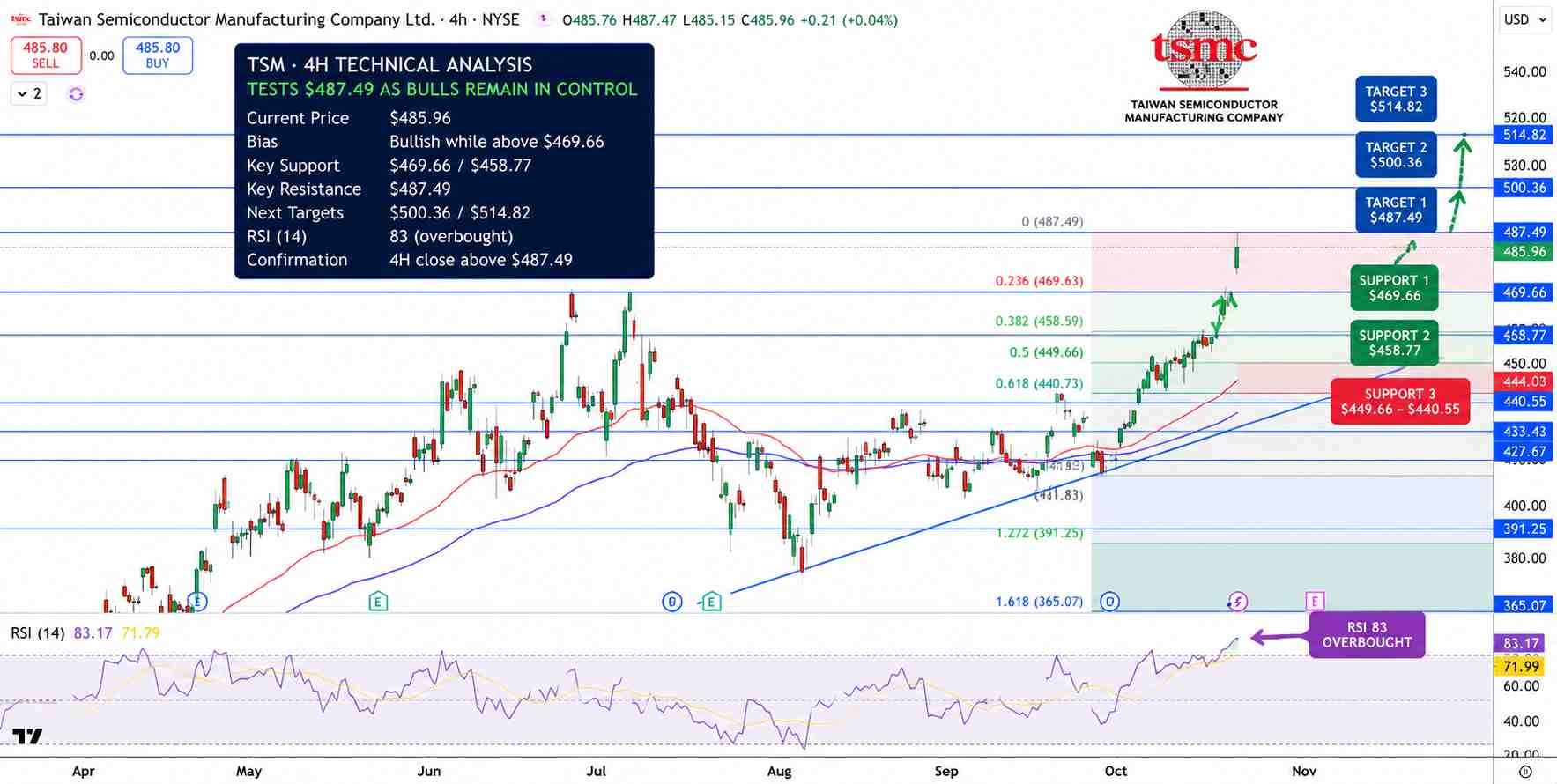
TSMC Stock Price Chart - Source: Tradingview
RSI is sitting around 83, and the signal line is at 72. The RSI line this close to 100 and the signal line this close to 70 suggests there is a good chance that the price consolidates or pulls back before continuing higher. The immediate resistance is at $487.49.
A close above $487.49, in the 4 hour time frame, would signal further upside potential, and a price target of $500.36. Further upside potential is likely at $514.82. The first good support is $469.66, then $458.77 and $449.66 to $440.55.
My base case is still bullish, as long as price is above $469.66. The overbought condition of RSI does suggest a pullback is likely.
Key Levels
• Latest completed close: $485.80
• Major support levels: $469.66, $458.77, then $449.66 to $440.55
• Major resistance levels: $487.49, $500.36, then $514.82
• RSI: approximately 83, overbought but bullish
• Breakout target: $500.36 (above a confirmed $487.49 break)
Why is TSMC stock in focus now?
TSMC is in focus because 2nm has started contributing revenue, August sales were up 53.3%, HPC now accounts for two-thirds of revenue, and management raised 2026 capex to $60-64 billion due to continuing demand for more leading-edge/advanced packaging capacity. Reuters also reported that in addition to their $265 billion Arizona build, TSMC is also considering a major investment in Texas.
What level confirms a stronger TSM breakout?
A 4-hour close above $487.49 would confirm an even stronger trend in the making and put $500.36 in focus, followed by $514.82. A break below $469.66 would reverse the near-term breakout and could expose $458.77.
Bottom Line
TSMC has the upper hand heading into October. With August revenues up and 2nm ramping, the company is well positioned for the AI buildout. TSMC’s platform mix is dominated by HPC and management is increasing capex because customers want additional capacity. The advantage for TSMC is that they are benefitting from multiple chip-design wins instead of having to guess the dominant AI accelerator.
The main risk is how well management executes. The steep 2nm ramp is expected to pressure gross margins in the second half of 2026 and expansion to other fabs overseas will also put pressure on gross margins. Technically, TSM is bullish above $469.66, but the overbought RSI suggests a pullback may be warranted. The next major fundamental test is if the September sales and the October 15th earnings show that the AI demand is strong enough to offset TSMC’s expansion.
Recommended Articles









Comments (0)
Click the $ button, enter the symbol, and select to link a stock, ETF, or other ticker.