


Japan, South Korea Stocks Rebound at Open; Kospi Rises 1.8%, Samsung, SK Hynix Gain Over 1%



AI Podcast


On October 16, Japanese and South Korean stock markets rebounded following a sharp sell-off on October 15 that triggered circuit breakers and the Nikkei’s largest drop since March. Major regional indices opened higher, supported by gains in semiconductor leaders like Samsung Electronics, SK Hynix, and SoftBank Group. This followed mixed U.S. market closes, where the Dow gained while the Philadelphia Semiconductor Index extended losses amid AI infrastructure funding concerns and persistent inflation pressures indicated by stronger September PPI and retail sales data.

TradingKey - On October 16, Japanese and South Korean stock markets rebounded in early trading, with both South Korean and Japanese equities opening slightly higher. The Korea Composite Stock Price Index (KOSPI) opened up 1.8% at 5,653.99 points and subsequently rose 1.77% to 5,652.51 points; Japan's Nikkei 225 Index opened 0.78% higher at 64,925.29 points, with gains later expanding to 0.94% to reach 65,029.45 points.
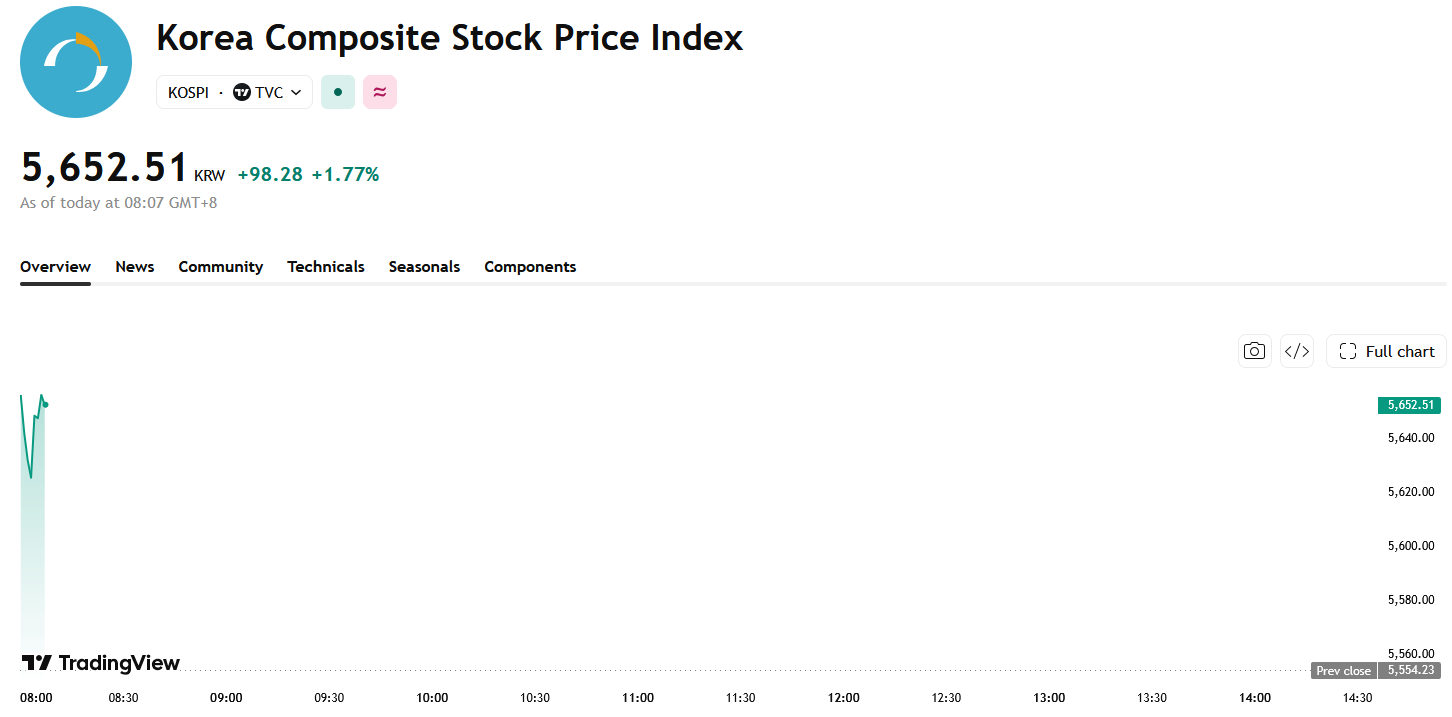
Source: TradingView
South Korean semiconductor leaders rebounded in tandem in early trading, with Samsung Electronics rising 1.67% to 213,500 won (about $159) and SK Hynix gaining 1.43% to 1.28 million won. In the Japanese market, Kioxia advanced 0.54% to 12,950 yen (about $82), while SoftBank Group rose 0.95% to 4,898 yen.
Overnight, the three major U.S. stock indices ended mixed. The Dow Jones Industrial Average rose 1.08% to 52,177.69 points, the S&P 500 Index gained 0.33% to 7,744.06 points, and the Nasdaq Composite Index added 0.08% to 26,713.03 points. However, the semiconductor sector remained under correction pressure, with the Philadelphia Semiconductor Index falling 0.88%, marking its seventh consecutive session of losses.
On the economic data front, the U.S. Producer Price Index (PPI) for September registered its largest increase in over four years, while retail sales data on the surface was also stronger than expected, signaling that price pressures are transmitting from the consumer end to the production end. Meanwhile, the scale of financing required for AI infrastructure buildout and potential returns remain a focal point for the market, with related concerns continuing to weigh on the semiconductor sector.
In the previous trading session, Asia-Pacific stock markets suffered a major sell-off. On October 15, the Nikkei 225 Index fell 4.90% to close at 64,425.95 points, marking its largest single-day drop since March this year. South Korean stocks also took a heavy blow, with both the KOSPI and Kosdaq indices triggering circuit breakers intraday.
This content was translated using AI and reviewed for clarity. It is for informational purposes only.
Recommended Articles










Comments (0)
Click the $ button, enter the symbol, and select to link a stock, ETF, or other ticker.