


Meta Unveils Open-Weight AI Model Muse Spark Open, Teams Up With Apple in Rare Move



AI Podcast


Meta and Apple have announced an AI collaboration allowing developers to run Meta’s Muse Spark Open model locally on Mac Studio devices powered by M5 Ultra chips. The 816-billion-parameter Mixture-of-Experts multimodal model is optimized for coding, agentic tasks, and complex reasoning. By eliminating cloud dependency, the partnership enhances data security and reduces costs while showcasing the high memory capacity of Apple silicon. Meta's stock edged up 0.55% following the announcement. While this alliance opens new application scenarios for both companies, the potential for further expansion remains uncertain.

TradingKey - Meta (META) and Apple (AAPL) have launched a rare AI collaboration. Meta announced Thursday that developers can run Meta's newly launched open-weights model, Muse Spark Open, locally on Mac Studio powered by the M5 Ultra chip. The partnership, months in the making, has enabled the two companies—whose relationship has been strained for years—to find new common ground.
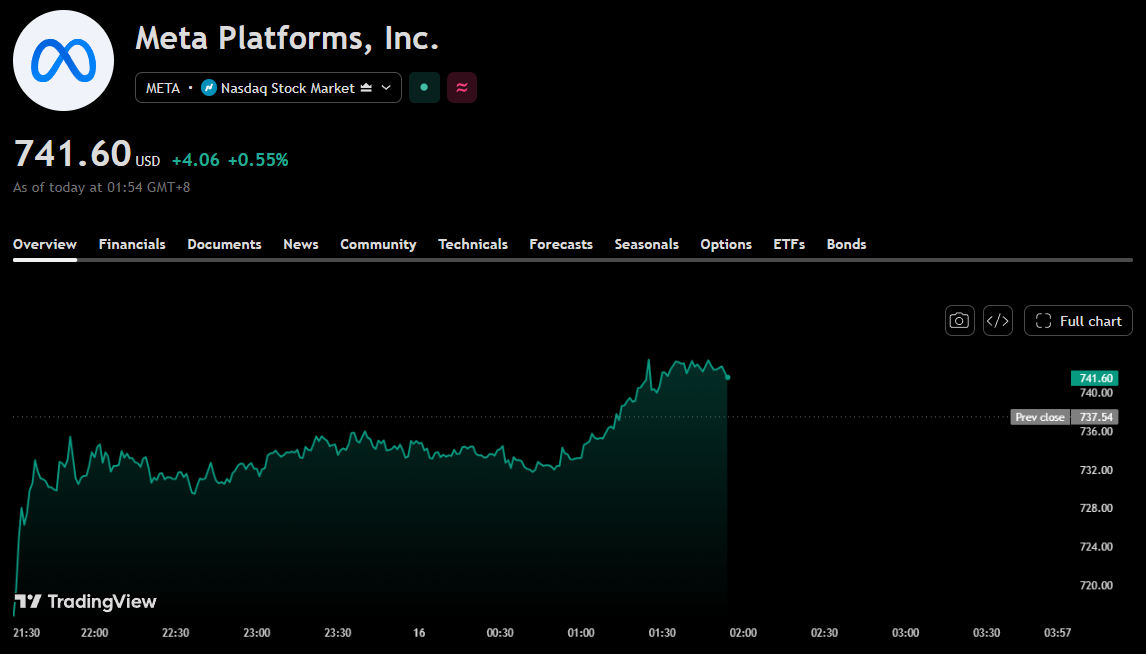
Following the announcement, Meta's stock price edged up, rising 0.55% to $741.60 as of press time.
Source: TradingView
According to Meta, Muse Spark Open utilizes a Mixture-of-Experts architecture with 816 billion total parameters, 42 billion active parameters, and support for a 1-million-token context window. This native multimodal model is mainly targeted at coding, complex software engineering, long-horizon agentic tasks, and multi-step reasoning. Meta called it the most capable US open-weights model to date.
Regarding deployment, Meta announced that two M5 Ultra Mac Studios are sufficient to run the model, while reports noted that setups of two to four devices can be used for coding, video analysis, and other agentic tasks. Both companies stated that running locally eliminates the need to offload tasks to the cloud, helping enhance data security and save costs.
Alexandr Wang, Head of Meta AI, stated that many high-performance open-weights models are too large for standard personal computers to handle, whereas the Mac Studio provides sufficient memory. The two companies also optimized the model for Apple silicon, enabling developers to directly download adapted versions. Concurrently, Apple released chip benchmarks and MLX technical documentation detailing how to split and run the model across multiple devices.
For Meta, the new model continues its open-weights route, although the company had previously shifted its focus toward developing proprietary models under Wang's leadership. Wang noted that Daniel Gross, an AI researcher and former Apple executive, was one of the factors facilitating the collaboration. As the two sides join forces on local AI deployment, Apple silicon and Meta models gain new application scenarios, though whether the partnership will expand further remains to be seen.
This content was translated using AI and reviewed for clarity. It is for informational purposes only.
Recommended Articles











Comments (0)
Click the $ button, enter the symbol, and select to link a stock, ETF, or other ticker.