


US Stocks Gain as Dow Rises Over 500 Points; Some Tech Shares Stabilize, Micron Reverses Losses to Rise Nearly 2%



AI Podcast


US stocks advanced as investors rotated into defensive sectors following September PPI data showing the largest monthly and annual gains since 2022. Defensive consumer and healthcare stocks led the market higher despite mixed tech performance. Nvidia CEO Jensen Huang expressed optimism regarding CoreWeave’s declining capital costs, dismissing the need for financial guarantees. Meanwhile, Meta released an open-weight AI model, Google achieved a quantum computing breakthrough reducing error rates, and JPMorgan indicated that recent pullbacks in memory chip stocks offer medium-term buying opportunities amid broader inflationary pressures.

TradingKey - PPI data recorded its largest monthly and annual gains since 2022, while US stocks rose as investors rotated from AI tech stocks into defensive sectors. Defensive sectors such as consumer and healthcare stocks led the gains, while some tech stocks rebounded.
At the close, the Dow Jones Industrial Average rose 1.08% to 52,177.69; the Nasdaq Composite Index gained 0.08% to 26,713.03; and the S&P 500 Index climbed 0.33% to 7,744.06.
Tech Stock Performance
CoreWeave (CRWV) reversed losses to rise 5.94% to $69.69, with an intraday swing of 15.58%.
Nvidia CEO Jensen Huang stated that the financial condition of data center operator CoreWeave is improving. Nvidia is a supplier of computing equipment for CoreWeave. Huang said at an event in Stockholm: "CoreWeave's strength is growing every day." He believes there is no need for Nvidia to provide financial guarantees for CoreWeave. "I am optimistic. In fact, their cost of capital is falling."
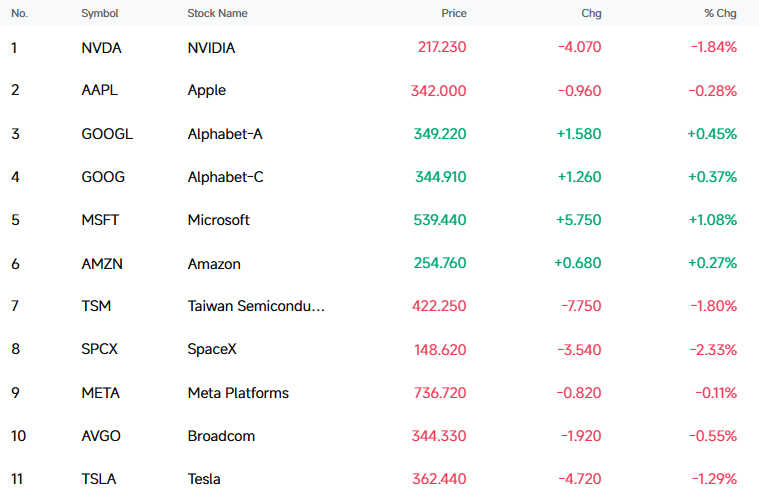
Among major tech stocks, Microsoft (MSFT) rose 1.08%, Google (GOOGL) gained 0.45%, and Amazon (AMZN) advanced 0.27%; on the downside, SpaceX (SPCX) fell 2.33%, Tesla (TSLA) slipped 1.29%, TSMC (TSM) dropped 1.80%, Nvidia (NVDA) declined 1.84%, Broadcom (AVGO) lost 0.55%, Apple (AAPL) dipped 0.28%, and Meta Platforms (META) fell 0.11%.
[Source: FutuBull]
The Philadelphia Semiconductor Index fell 0.88% to 11,581.22 points. Among its 30 constituents, 11 advanced and 19 declined.
Among memory stocks, Micron Technology (MU) rose 1.87%; on the downside, Seagate Technology (STX) fell 3.19%, Western Digital (WDC) dropped 2.10%, SK Hynix (SKHY) declined 0.98%, and SanDisk (SNDK) slipped 0.61%.
Company News
Meta Releases Open-Weight AI Model Muse Spark Open
According to reports by CNBC and The Wall Street Journal, Meta Platforms launched a new open-weight AI model, Muse Spark Open, primarily targeting programming and AI agent tasks, though it did not open-source its most powerful model. Meta Chief AI Officer Alexandr Wang stated that Muse Spark Open is not the most powerful model developed or released by the company. Muse Wonder, introduced by Meta earlier this week, remains closed-source. Meta also acknowledged that Chinese open-weight models still outperform Muse Spark Open in software development and certain other tasks.
Jensen Huang: CoreWeave's Financing Costs Are Falling, No Need for Nvidia Backstop
Jensen Huang expressed optimism about CoreWeave, noting that the company's "cost of capital is actually falling." Regarding market concerns over whether Nvidia would need to provide a financial backstop for CoreWeave, Huang explicitly stated that he does not believe it is necessary.
Google Achieves New Breakthrough in Quantum Computing
Google announced on October 15 that its Quantum AI team successfully demonstrated a new technology called "Magic State Cultivation" on the Willow quantum chip, reducing the error rate of specific quantum states by approximately 40 times and achieving a prepared quantum state accuracy of 99.99%. The research findings have been published in the journal Science. Google explained that quantum computers are susceptible to interference that causes errors. To perform complex calculations, special quantum states must be prepared in advance, but this process is highly computationally intensive. Some studies estimate that traditional methods can consume up to 95% of a quantum computer's computing power. By detecting and removing faulty quantum states, the new technology improves preparation efficiency and is expected to reduce resource consumption for error correction in future quantum computers. Google stated that this achievement is an important step toward practical quantum computing, though further verification is needed to determine whether it can be applied to larger-scale quantum computing systems.
Industry & Macro News
JPMorgan Says Recent Sharp Pullback in Memory Chip Stocks Creates Medium-Term Buying Opportunities
JPMorgan's Asia-Pacific Equity Research team believes South Korea's third-quarter earnings season will officially kick off in the week of October 19, and the recent sharp pullback in memory chip stocks is creating medium-term buying opportunities, with the tech and financial sectors expected to be the main performance drivers. Analyst Jay Kwon noted after visiting over 100 investors in Asia that memory stocks fell about 6% and 15% over the past month and three months, respectively, while the Philadelphia Semiconductor Index (SOX) rose about 10% and fell about 4% over the same periods. This divergence is providing a favorable risk-reward entry point for duration trades.
U.S. September PPI Surges 1.3% Month-on-Month, Marking Largest Single-Month Gain Since March 2022
The U.S. Bureau of Labor Statistics released the September Producer Price Index (PPI). The U.S. PPI rose sharply by 1.3% month-on-month in September, significantly higher than the market consensus expectation of around 0.6%, marking the largest single-month gain since March 2022. Year-on-year, it increased by 6.3%, also noticeably higher than August levels, indicating further rising price pressures on businesses. Data showed that final demand PPI rose 6.3% year-on-year in September, the largest year-on-year gain since December 2022. The month-on-month PPI gain for August was revised from the previously reported 0.4% to 0.5%. PPI excluding food, energy, and trade services rose 0.5% month-on-month, up from 0.3% in August, and climbed 5.0% year-on-year, indicating that price increases were not entirely driven by energy factors.
This content was translated using AI and reviewed for clarity. It is for informational purposes only.
Recommended Articles











Comments (0)
Click the $ button, enter the symbol, and select to link a stock, ETF, or other ticker.