


Kioxia Shares Rise Over 5% as $5 Billion Buyback Plan Offsets Earnings Miss



AI Podcast


On August 3, Kioxia shares rose 5.72% following a volatile session. While fiscal Q1 2027 results showed massive year-on-year growth driven by AI server demand, the figures missed analyst expectations and conservative guidance raised concerns over slowing flash memory price appreciation. Market sentiment stabilized due to a 3-for-1 stock split and a 800 billion yen share buyback program. Furthermore, Kioxia’s roadmap for next-generation NAND solutions, including PCIe 6.0 and UFS 5.0 standards, supports its long-term outlook. JPMorgan maintains an "Overweight" rating, emphasizing that robust enterprise SSD demand remains the critical performance indicator.
TradingKey - During the Asian trading session on August 3, shares of Japanese memory chip giant Kioxia Holdings staged a rollercoaster ride, tumbling over 4% in early trading before staging a V-shaped reversal to surge over 10% intraday, ultimately closing up 5.72% at 49,140 yen (approximately $313).
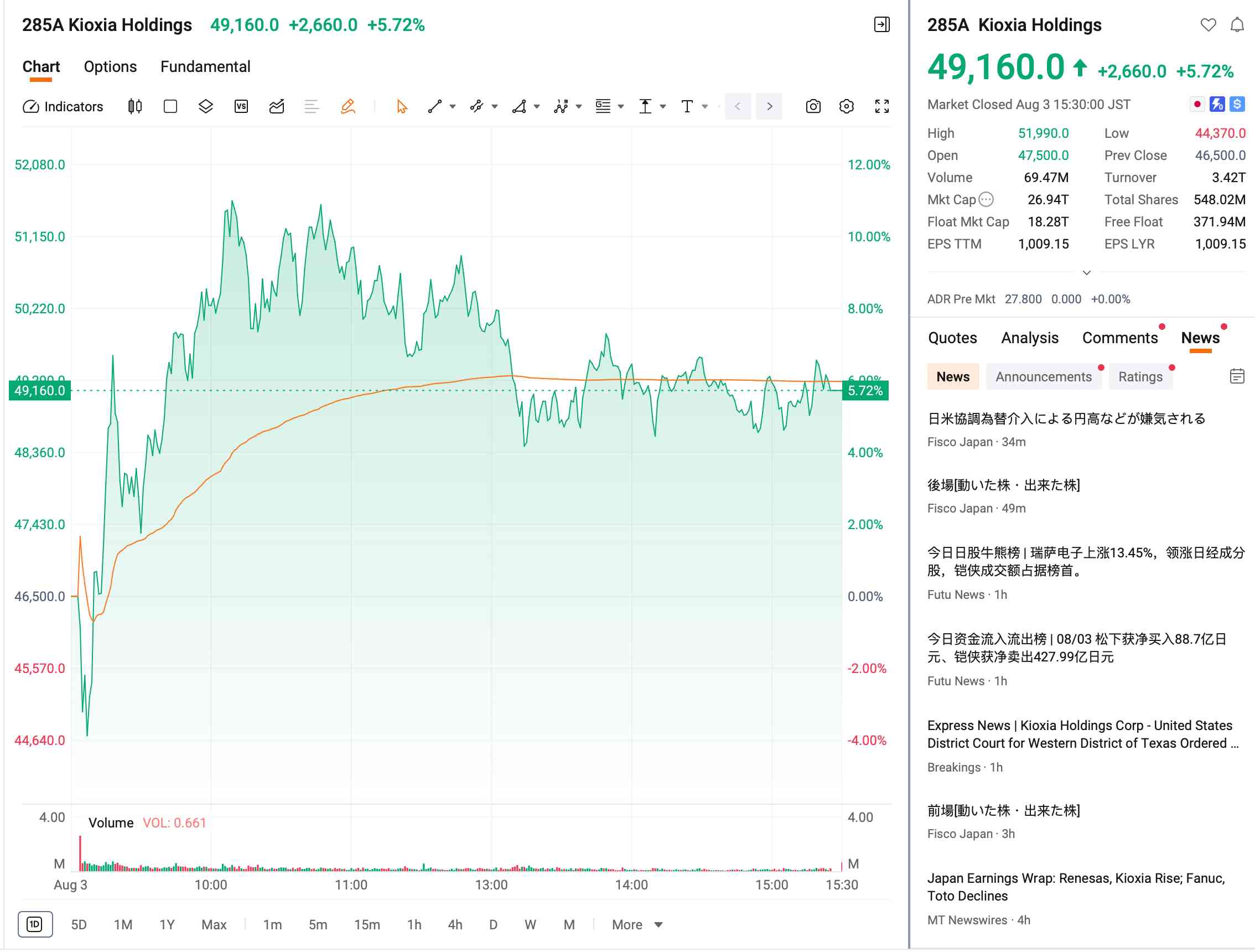
[Source: Futu]
This reversal stemmed from two heavyweight capital initiatives effective on the same day: a 3-for-1 stock split (effective October 1, 2026) and a share buyback program of up to 800 billion yen (approximately $5.11 billion) to repurchase up to 30 million shares, representing 5.5% of outstanding shares.
After the market closed on July 31, Kioxia released its financial results for the first quarter of fiscal year 2027 (April to June 2026). Data showed that, benefited from strong demand for high-performance memory from AI servers and data centers, Kioxia's revenue reached 1.77 trillion yen (approximately $11 billion), skyrocketing 415% year-on-year to hit a record high.
Non-GAAP operating profit reached 1.3262 trillion yen, up 2,833% year-on-year; GAAP operating profit was recorded at 1.27 trillion yen, up 2,728% year-on-year, with net profit surging 4,506% year-on-year to 842.17 billion yen. Among this, SSD and memory products contributed 1.1747 trillion yen in revenue, soaring approximately 440% year-on-year.
However, this scorecard still fell short of market expectations: operating profit fell short of the 1.37 trillion yen average analyst estimate, net profit missed the expected 973.81 billion yen, and the gross margin of 78% was also below the market expectation of 78.3%.
What worries investors even more is that the company expects second-quarter revenue of 2.39 trillion yen and Non-GAAP operating profit of approximately 1.9 trillion yen, which are also lower than market forecasts. Some analysts pointed out that the market is concerned that the rising trend of flash memory prices is slowing down.
Just as market sentiment was under pressure, Kioxia simultaneously released positive signals on the technical front. According to media reports on August 3, Japan's Kioxia is targeting the next-generation artificial intelligence (AI) NAND market, planning to mass-produce the latest standard NAND solutions this year, including "PCIe (PCI Express) 6.0" interface SSDs for data centers and enterprise servers, and the "UFS (Universal Flash Storage) 5.0" storage standard for terminal devices such as AI smartphones.
As the underlying technology support for the aforementioned products, Kioxia commenced the delivery of samples of its 10th-generation BiCS FLASH 3D flash memory chip in July. This chip features a 332-layer stacked architecture, boosting memory density by 59% and I/O interface speed by 33% compared to its predecessor.
JPMorgan ( JPM) pointed out in a June research report that scaling up enterprise SSD sales remains a more crucial observation point, and demand remains strong, maintaining an "Overweight" rating and a target price of 155,000 yen.
The rebound in the stock price on that day indicates that the $5.15 billion buyback program and the next-generation AI NAND technology roadmap are helping the market digest the pressure brought by short-term earnings guidance.
This content was translated using AI and reviewed for clarity. It is for informational purposes only.
Recommended Articles







Comments (0)
Click the $ button, enter the symbol, and select to link a stock, ETF, or other ticker.