


US Sept. PCE Preview: Inflation May Heat Up Again, How Will US Stocks, the Dollar, and Gold React?



AI Podcast


The US September Personal Consumption Expenditures (PCE) report, released after the Federal Reserve's October interest rate decision, will heavily influence market expectations for a December rate hike. Headline and core PCE are projected to rise, driven by recent consumer and producer inflation pressures. A higher-than-expected core PCE could drive up Treasury yields and the US dollar while pressuring equities and gold. Conversely, softer inflation data might ease rate-hike bets, supporting growth stocks, a dollar pullback, and a gold recovery. Persistent long-term inflation above the 2% target suggests the Fed will maintain a cautious, hawkish stance.

TradingKey - This Thursday (October 29), the US will release the September Personal Consumption Expenditures (PCE) price index. However, since the PCE report will be released after the Federal Reserve's October interest rate decision, this data will not affect the outcome of the October meeting, but it could serve as an important basis for the market to gauge whether the Fed will raise rates again in December.
Currently, the market expects the September PCE to show a renewed rise in US inflation pressure. Headline PCE is expected to rise 0.5% month-on-month, up from 0.3% in August, with the year-on-year growth rate projected to rise from 3.4% to 3.6%. Core PCE, which is more closely watched by the Fed, is expected to increase 0.3% month-on-month, higher than 0.2% in August, while its year-on-year rate may rise from 3.0% to 3.1%.
September PCE May Reaccelerate, December Rate Hike Expectations Remain in Focus
The recently released CPI and PPI have provided strong signals of a warming PCE. U.S. CPI in September rose 0.6% month-over-month and 3.7% year-over-year, with energy prices rising 5.2% in a single month and gasoline prices rising 9.1%; core CPI rose 0.3% month-over-month and 2.6% year-over-year.
Price pressures on the production side are even more evident. In September, PPI surged 1.3% month-over-month, marking the largest single-month gain since March 2022, and rose to 6.3% year-over-year; among this, final demand goods prices increased by 2.6%, while energy prices jumped 10.8%. This indicates that the rise in September inflation was not only reflected on the consumer end, but upstream cost pressures were equally pronounced.
For investors, the most noteworthy aspect of this PCE reading is whether core PCE reaches or even exceeds 0.3%. If core PCE rises to 0.4% month-over-month, or is significantly higher than 3.1% year-over-year, the market may view inflation as re-spreading to broader service and consumer items, further increasing the likelihood of another Federal Reserve rate hike in December. Conversely, if core PCE remains around 0.2%, it would suggest that the sharp increases in September's CPI and PPI were largely driven by energy prices, while underlying inflationary pressures remain relatively mild, potentially leading the market to lower its expectations for a December rate hike.
Currently, the market generally expects the Federal Reserve to keep the target rate range unchanged at 3.75%-4.00% at its October meeting, but maintains distinctly hawkish pricing regarding December policy. According to the CME FedWatch Tool, as of October 28, traders estimated an approximately 84% probability of a rate hike in December. Meanwhile, the 10-year U.S. Treasury yield has risen to around 5.01%, and the U.S. Dollar Index remains near 102.40.
From a longer-term perspective, the Federal Reserve's September economic projections forecast PCE inflation at 3.7% and core PCE at 3.4% for 2026, both significantly above the 2% long-term target. Therefore, even if September PCE largely aligns with market expectations, it is unlikely to prompt the Fed to pivot rapidly toward easing, and the market is more likely to reprice around 'whether to continue hiking rates in December'.
How PCE Will Impact Markets: Outlook for US Stocks, Dollar and Gold
In US equities, if September core PCE comes in higher than expected, particularly reaching 0.4% or higher month-over-month, the market may further raise the probability of a December rate hike, and US Treasury yields could climb again, putting pressure on high-valuation sectors such as the Nasdaq, AI, and semiconductors. Currently, the 10-year US Treasury yield is around 5%, and high interest rates are placing a noticeably stronger constraint on stock valuations. If core PCE comes in below 0.3%, it could ease market concerns over further rate hikes, and a decline in US Treasury yields would favor a recovery in tech and growth stocks. However, if the pickup in headline PCE is driven primarily by energy while core inflation meets expectations, the reaction in US equities may be relatively limited.
Regarding the US dollar, if PCE comes in higher than expected, especially if core inflation reaccelerates, it will reinforce expectations that US interest rates will remain high or even rise further, potentially supporting the US Dollar Index. The US dollar is currently near a two-week high, with the market's high probability pricing of a December rate hike serving as a key support factor. If core PCE comes in below expectations, lowering the probability of a December rate hike and causing US Treasury yields to pull back, it could trigger a phase of adjustment for the US dollar.
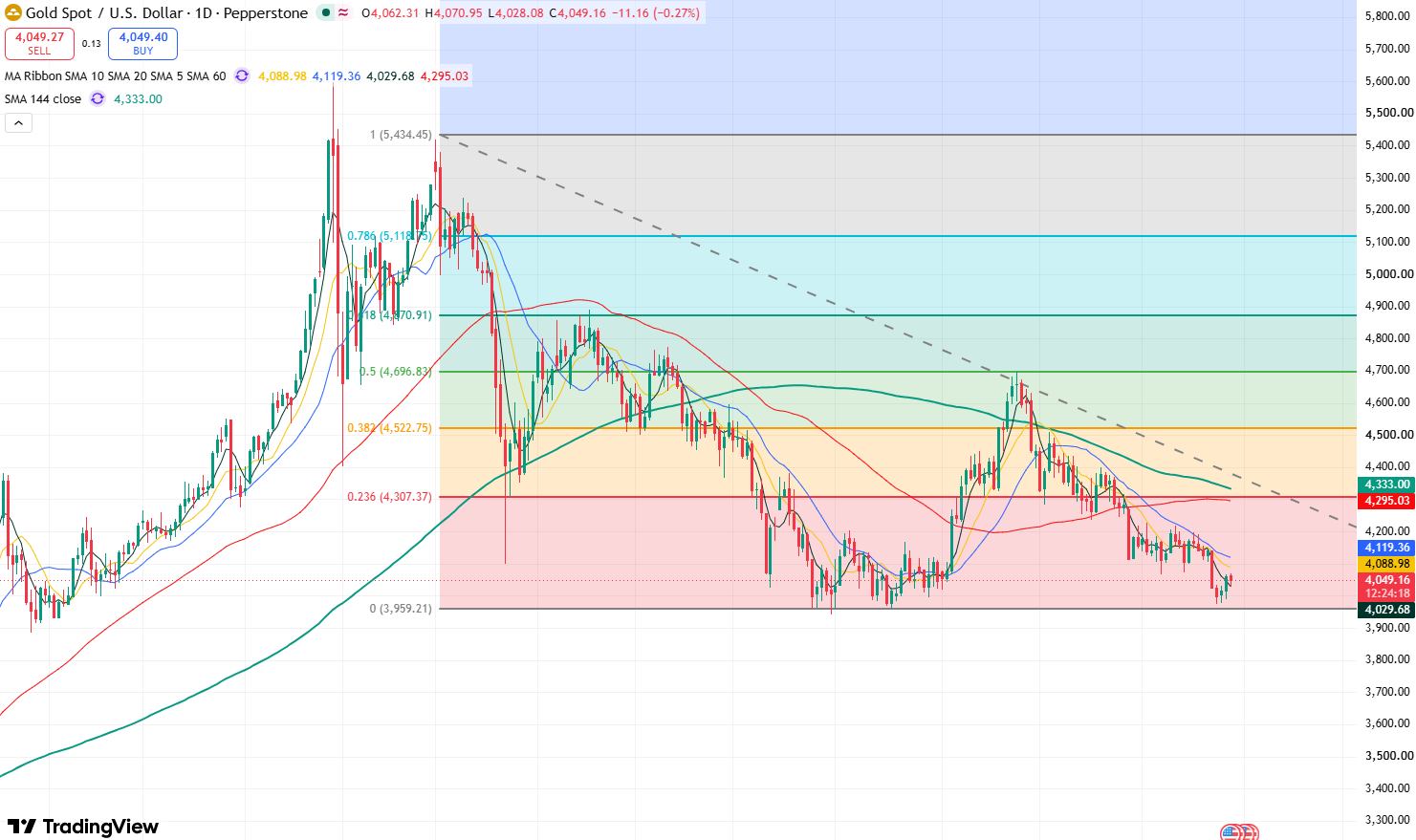
Gold price daily chart, Source: TradingView
As for gold (XAUUSD), on October 28, intraday gold prices fell to around $4,050, as high oil prices, a strong US dollar, and high interest rate expectations continued to limit gold's performance. If PCE exceeds expectations, a further rise in the US dollar and real interest rates could keep gold under pressure, with prices potentially falling below $4,000 to test the support level near $3,940; if core PCE comes in below expectations and the market scales back bets on a December rate hike, favoring a pull-back in the US dollar and US Treasury yields, gold could see a recovery rally, with the potential to test the $4,100 mark.
This content was translated using AI and reviewed for clarity. It is for informational purposes only.
Recommended Articles











Comments (0)
Click the $ button, enter the symbol, and select to link a stock, ETF, or other ticker.