


Intel Stock Price Prediction: Can INTC Hold $94 Before Q2 Earnings?



AI Podcast


Intel’s Q1 results showed revenue growth, driven by strong server and AI chip demand, alongside improved cost controls. However, the foundry business continues to incur significant losses, remaining a primary investment risk. Ahead of the July 23 Q2 earnings release, investors are focused on revenue beat potential, margin stability, and the ability to attract external foundry customers. Technically, the stock is testing a critical support zone at $94. A failure to hold this level may signal further downside, while a sustained recovery depends on proving manufacturing leadership and successful execution of the 18A process node.
TradingKey - Intel (NASDAQ: INTC) was trading near $96.98 on July 16 following a roughly 5.8% drop amid a broader chip industry sell-off. On the year, however, the stock is up dramatically after investors became encouraged by higher server chip demand, better expense control and a revived belief in Intel's manufacturing turnaround. The next big event is Intel's second-quarter earnings release on July 23 after the US stock market closes. For the time being, forecasts remain Intel's second-quarter revenue, earnings and margins.
Intel's Investor Calendar lists the earnings call for July 23 at 2:00 p.m. Pacific Time. The investment case for Intel is largely tied to whether its chief executive, Lip-Bu Tan, can boost revenue and profitability while shrinking the foundry's large losses.
Intel Revenue Grew in First Quarter
Intel posted first-quarter revenue of $13.6 billion, which is up 7% year-on-year from $12.7 billion. That makes the sixth consecutive quarter in which revenue exceeded management’s expectations. First-quarter adjusted earnings per share were 29 US cents, up from 13 cents a year earlier. Adjusted net income increased 156% to $1.5 billion. Operating profit margin also improved to 12.3% from 5.4%.
Adjusted research and development and administrative expenses were down 9%. That shows progress for restructuring efforts and cost controls. But Intel still had a GAAP net loss of $3.7 billion in the first quarter. That is a loss of 73 cents per share. The company had sizeable charges linked to restructuring.
Data Center And AI Revenue Drives Recovery
The Intel Data Center and AI Group's first-quarter revenue of $5.1 billion was up 22% year on year. The growth was driven by cloud and enterprise customers buying Intel's Xeon processors for their AI inference applications and for their networking, storage and traditional compute workloads. Intel says more AI use cases mean that CPU demand will rise, in addition to the demand for graphics processors. CPU still plays a key role in the pipeline and orchestration of the workload, managing memory, and running agentic AI applications.
The company won a number of significant deals. NVIDIA picked Intel's Xeon 6 as a host processor for its DGX Rubin NVL8 systems. Meanwhile, Google announced plans to increase using Intel's processors for cloud workloads, and work together to develop custom infrastructure processing chips. That adds to Intel's presence within AI data centres, although the company is still lagging behind rivals NVIDIA and AMD on its own AI chips.
PC Growth Slow
The client computing revenue for first quarter was $7.7 billion, up a slight 1% from the year earlier. Although Intel's biggest product business, it is still under pressure from competitors like AMD, processors designed by Apple and Arm-powered Windows notebooks. Intel is hoping for more sales based on its Core Ultra family of chips, and a potential PC upgrade cycle that comes on the back of artificial intelligence features. Panther Lake is the first Intel client platform built on the company's own Intel 18A process technology, and it goes to market as Core Ultra 3.
The challenge here is whether there are sufficient AI features to convince people to upgrade their PCs sooner than usual. Intel also needs to prove that its PC chips will provide productivity and performance gains and better battery life in order to drive a sustained upgrade cycle.
Q2 Guidance Sets a High Bar
Intel has laid out second-quarter revenue guidance of $13.8 billion to $14.8 billion, with a midpoint of $14.3 billion. Management also outlined expectations for adjusted earnings at $0.20 per share, adjusted gross margins of 39%, and GAAP gross margins of 37.5%.
This forecast signals robust demand for the company's servers and better availability of its products. Yet the real challenge is whether Intel can satisfy all that demand, which will come down to production volumes, yield rates and the company's ability to dodge any lingering supply restrictions.
So when it releases Q2 numbers on July 23, Wall Street will be looking for more than just a surprise beat on revenue. It will pay close attention to how Intel's margins are looking, whether it has the capacity it claims and how the company is navigating foundry losses. It's also important that Intel provides a clear outlook for what's ahead in the second half of the year.
Intel Foundry Remains the Main Risk
The business generated $5.4 billion in Q1 revenue, up 16% year over year, but most of the revenue was from manufacturing Intel products for its own divisions, not from external clients. The division reported an adjusted operating loss of about $2.44 billion, compared with a loss of approximately $2.32 billion in Q1 2025. The foundry arm remains a big financial concern for investors as it is expected to have a huge loss for the current cycle given the heavy capital expenditure to get up to speed on new fabs before revenues materialize and yields are acceptable.
Intel's 18A process node is being used for Panther Lake and the Clearwater Forest server platform. 18A includes RibbonFET transistors and PowerVia backside power delivery, both of which are a critical part of Intel's bid to regain manufacturing leadership.
But at the end of the day, it's still outside customer commitments that will serve as the real litmus test for the business. Even with all the deals and announcements that have happened with Intel foundry of late, investors still want to see that it is attracting external customers that have a high chance of generating a profit for Intel, not a commitment from the company to be competitive.
€5 Billion Ireland Expansion Adds Capacity
On July 13, Intel said that it was expanding its Leixlip, Ireland, manufacturing campus in a €5 billion ($5.7 billion) investment. The investment is meant to update its facilities, add new manufacturing capacity and improve productivity for its Xeon 6 and future Xeon series CPUs made on the Intel 3 process. The company said it would use existing clean room space as part of the program and did not need a completely new fab.
The investment comes as Intel's demand for its server chips is on the rise, but it comes as the company also faces continued investment costs even as its foundry business is in the red.
Intel Stock Technical Analysis: Double Bottom Tests $94
Intel is falling to a major double-bottom support zone in the $94 to $96 area on the daily time frame. Recent candle closed below the 50-day simple moving average at $109.68. The move also took the stock below a former resistance level of $107.21, which previously acted as support.
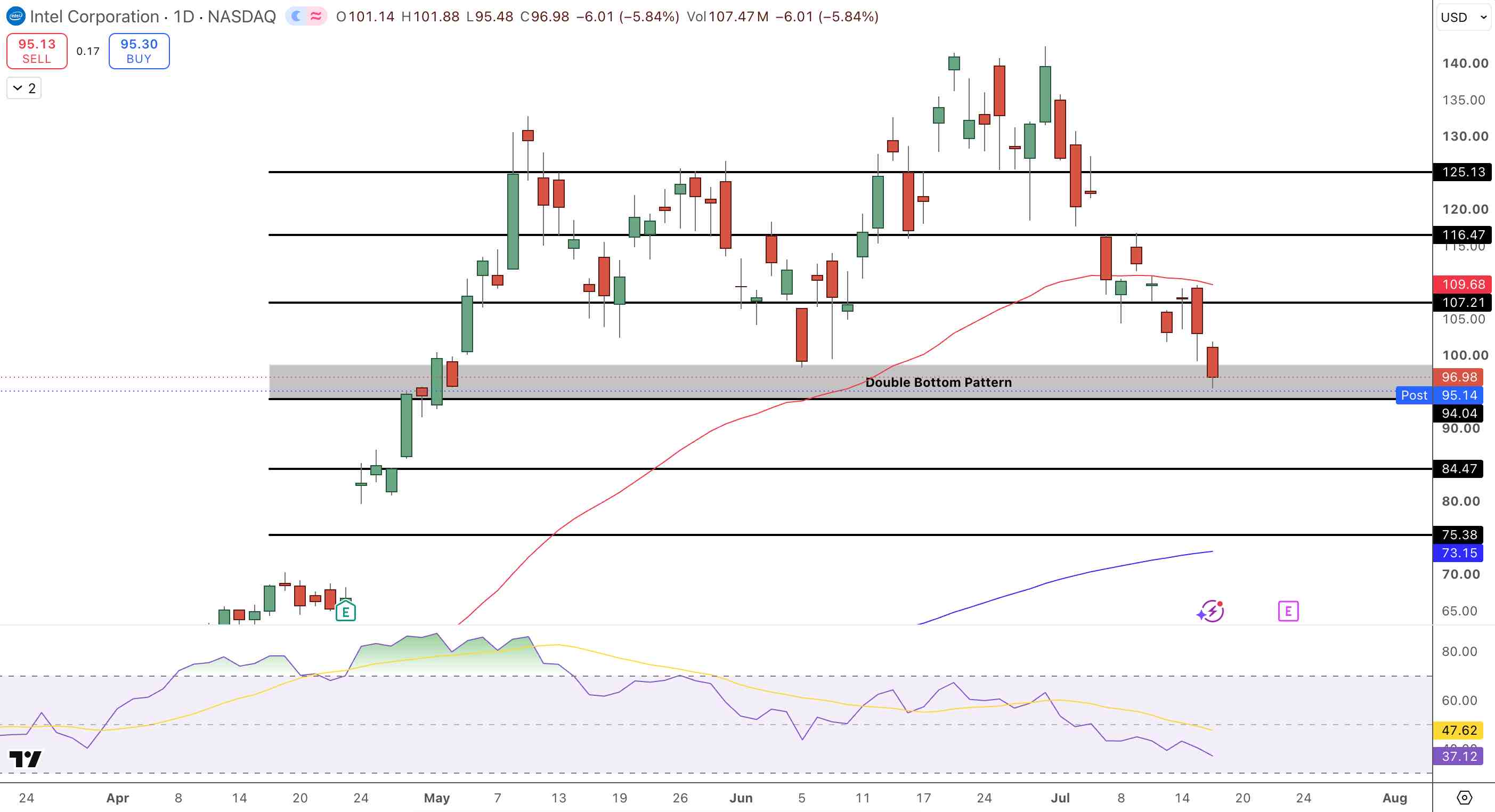
Intel Stock Price Chart - Source: Tradingview
Earlier, the $94 area saw a strong bullish reversal. If it holds, that could result in a rally to $107.20, followed by $116.50. However, a close below $94 would break the double-bottom pattern, and the next support zones are seen in the $84.50 and $75.40 area.
The relative strength index is at 37, showing strong downside momentum while approaching oversold conditions. However, there are no clear signs of a reversal in the current downtrend yet. Any bounce is likely to remain corrective, as the stock needs to close back above $107.20 and the 50-day moving average for bullish signs to be more pronounced.
Frequently Asked Questions
When will Intel report Q2 2026 earnings? Intel will release its Q2 2026 financial results after the market closes on July 23. The company has scheduled its conference call with investors and analysts on July 23 at 2:00 p.m. PT.
What is Intel's Q2 revenue guidance? Intel expects its Q2 revenue to be between $13.8 billion and $14.8 billion. The company has also set an adjusted earnings per share expectation of $0.20 and adjusted gross margins of around 39%.
Is $94 an important support level for Intel? Yes. The $94 to $96 region on the daily chart could serve as a support level and a potential double-bottom zone for the stock. A close above the $94 level would be bullish for a reversal toward $107.20; a decline below the level would likely lead to a further sell-off, with the next major support zones being seen in the $84.50 to $75.40 area.
Bottom Line
Intel's fundamentals are looking better in the second quarter as revenues from servers pick up pace, costs fall and guidance is higher. But the company still has foundry losses to deal with and faces significant investments ahead while the manufacturing side of the business remains shaky.
On July 23, when it reports its Q2 results, investors will want to see if Intel beats revenue guidance, maintains margins and gives evidence Intel 18A will be attracting meaningful demand from outside customers. Technically, $94 is an important level to hold; a sustained close below would leave it vulnerable to a continued fall.
Recommended Articles







Comments (0)
Click the $ button, enter the symbol, and select to link a stock, ETF, or other ticker.