


Brent Crude Plunges 10% Near $90 Level: What Caused the Rapid Drop in Oil Prices?



AI Podcast


On Wednesday, November 4, Eastern Time, crude oil prices dropped sharply over 9%, with Brent nearing $93 and WTI falling below $87. This decline followed the Democratic victory in the US midterm elections, which could constrain funding for military operations and reduce the geopolitical risk premium tied to potential supply disruptions. Analysts note that while diminished expectations for immediate escalation pressure prices, the new Congress takes office in January 2027, leaving room for near-term policy shifts. Ongoing military risks and potential threats to Strait of Hormuz shipping lanes continue to introduce supply volatility.
TradingKey - On Wednesday, November 4, Eastern Time, crude oil prices fell sharply, with Brent crude (UKOIL) approaching $93, down over 10% intraday; WTI crude (USOIL) fell below the $87 mark, down more than 9% intraday. Investors are reassessing the results of the US midterm elections and the impact of shifts in congressional power on the Trump administration's Iran policy.
The Democrats won control of both the Senate and the House of Representatives in the midterm elections, which could make it harder for Trump to obtain funding for overseas military operations. For the crude oil market, if expectations of a large-scale military escalation cool following the elections, the geopolitical risk premium reflected in oil prices accounting for potential supply disruptions could recede.
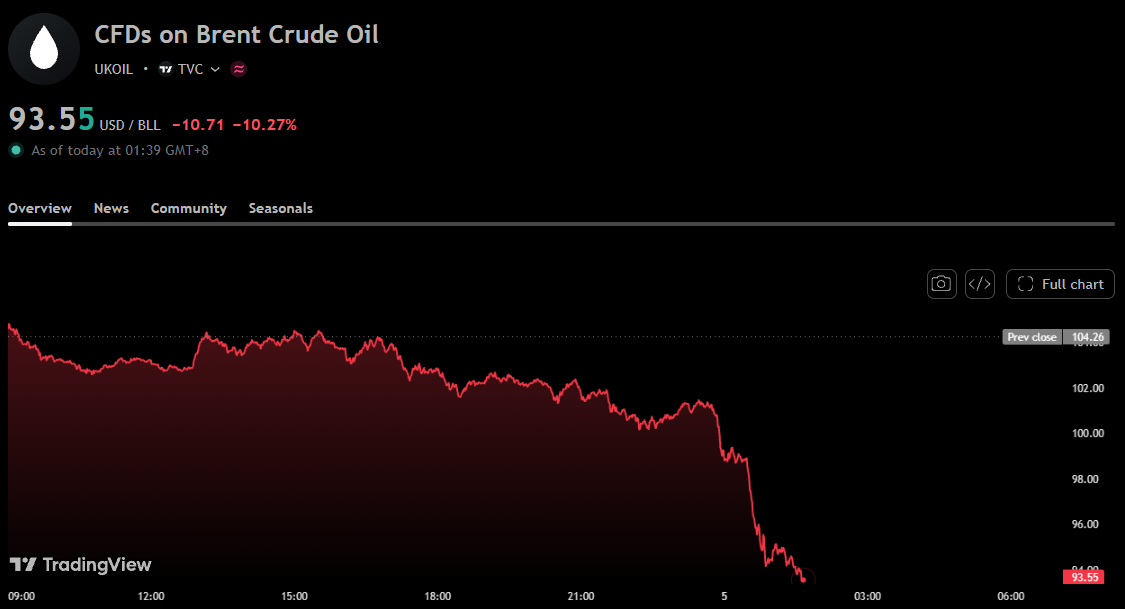
Daily chart of Brent crude oil prices, Source: TradingView
ING analysts Warren Patterson and Ewa Manthey noted that the market had previously increasingly priced in the possibility of further escalation in the US-Iran conflict. If there is neither a military escalation nor a diplomatic agreement after the election, traders will need to determine whether the existing risk premium can be sustained or will gradually fade.
However, a shift in congressional control takes time to translate into concrete policy. Michelle Brouhard, head of policy and geopolitical risk at Kpler, cautioned that the new Congress will not officially take office until January 3, 2027, and the Trump administration can still advance new diplomatic initiatives under the existing congressional structure over the next nearly two months.
Trump acknowledged that the war with Iran was a factor in the Republican loss, but said he did not regret launching the conflict. The previous US attack on Iran's Qeshm Island also showed that the risk of military escalation remains. If a larger-scale action breaks out, Iran could retaliate against regional infrastructure, further disrupting energy supplies and threatening shipping security in the Strait of Hormuz.
This content was translated using AI and reviewed for clarity. It is for informational purposes only.
Recommended Articles












Comments (0)
Click the $ button, enter the symbol, and select to link a stock, ETF, or other ticker.