


Tesla Stock Price Forecast: Democratic Victory Amplifies Musk Regulatory Risk, TSLA Falls Over 5% Pre-Market to Threaten $350 Level Again



AI Podcast


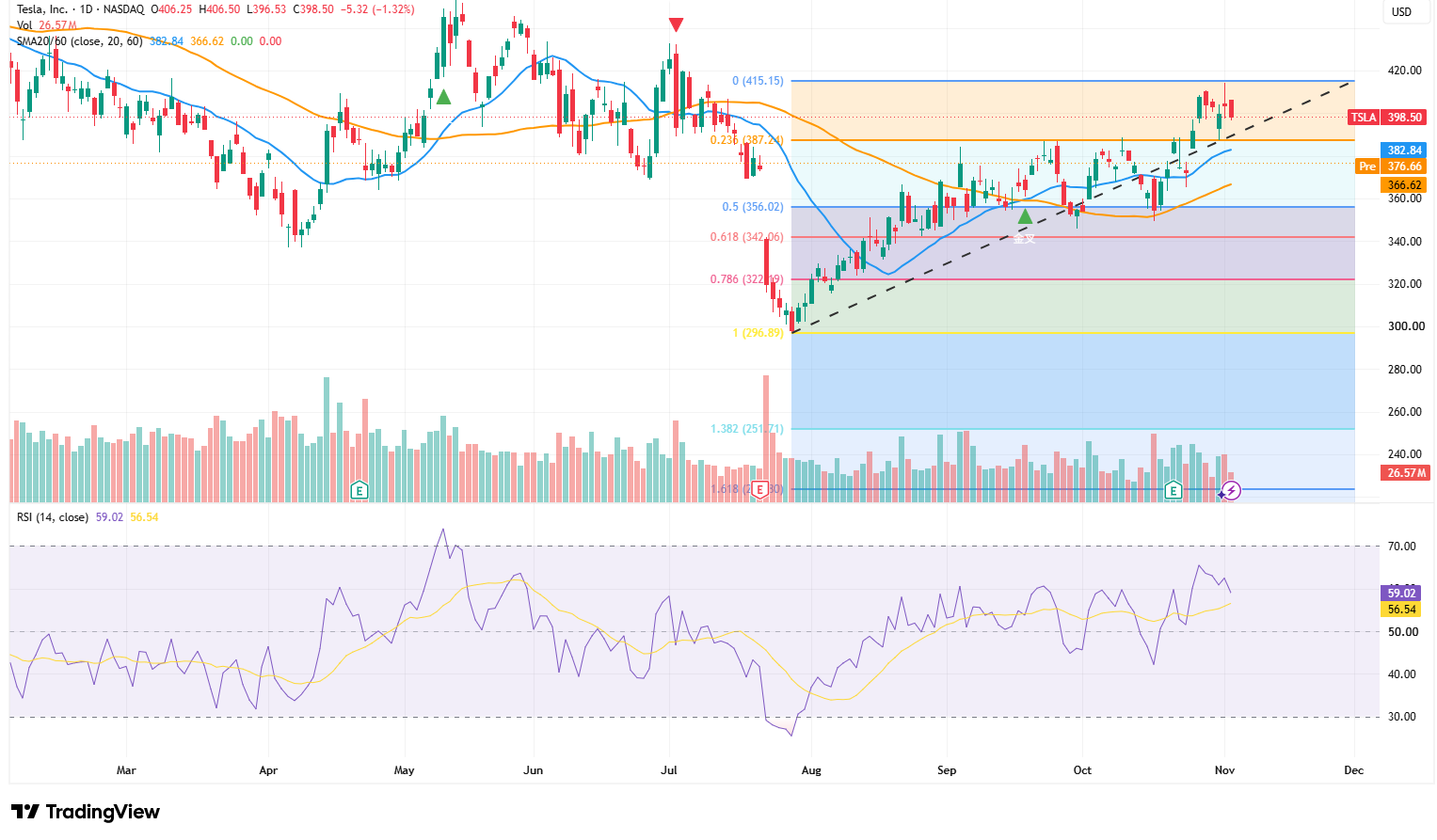
Following the Democratic victory in the U.S. midterm elections, Tesla shares fell over 5% pre-market amid concerns over heightened regulatory scrutiny on artificial intelligence, autonomous driving, and Elon Musk’s enterprises. While Democratic clean energy policies favor EV demand, Tesla’s valuation relies heavily on tech premiums and political dynamics, increasing its vulnerability. Technically, the pre-market drop broke the 20-day moving average and $387 support, weakening the short-term bullish structure. Initial resistance stands at $387, with downside support projected near $367, $356, and the psychological $350 mark. Reclaiming $383–$387 is required to revive upward momentum toward $400 and $415.

TradingKey - Following the results of the U.S. midterm elections, the Democratic Party won control of both the Senate and the House of Representatives, ending the Republican Party's unified control of the White House and Congress. Market concerns grew that the new Congress may step up regulatory scrutiny over artificial intelligence, autonomous driving, and Elon Musk's companies, causing Tesla (TSLA) to fall over 5% in pre-market trading on Wednesday.
Musk had previously poured large sums of money into the Republican Party and publicly endorsed several conservative candidates. With Democrats regaining control of Congress, they may step up scrutiny of autonomous driving, artificial intelligence, government contracts, and corporate governance through hearings, investigative powers, and budget negotiations.
Markets are particularly concerned that potential integration plans between Tesla and SpaceX could face stricter procedural oversight, while the contractual and regulatory relationships between Musk's companies and the U.S. government may also draw increased scrutiny.
However, a Democratic victory is not entirely negative for Tesla. Democrats are generally more supportive of clean energy, EV adoption, and emissions reduction policies, and may try to overturn certain measures that relaxed fuel vehicle emission requirements, which favors EV demand at the industry level.
The issue is that Tesla's current market valuation depends not only on vehicle sales, but also includes premiums driven by autonomous driving, Robotaxis, artificial intelligence, and Musk's personal influence. Therefore, compared with other new energy companies, Tesla is more vulnerable to changes in political relationships and rising regulatory expectations.
Source: TradingView
From a technical standpoint, Tesla had previously rebounded continuously from a low of around $297 in late July, forming a relatively clear uptrend. However, the pre-market drop has pushed the stock price below the Fibonacci retracement level near $387 and below the 20-day moving average around $383, noticeably weakening the short-term bullish structure. The $387 level has turned from support into initial resistance; if the stock fails to quickly reclaim this level, selling pressure may continue toward the 60-day moving average around $367.
If $366 gives way, the focus below will be on the 50% Fibonacci retracement level at $356.02 and the psychological $350 mark in turn. Since $356–$350 is also close to the previous consolidation platform, it serves as a relatively clear support zone; calculated from pre-market prices, a further decline to $350 represents a potential drop of about 7%. If $350 also fails to hold, the next target could shift lower to around $342.
The daily RSI currently sits at 59.02, above the signal line of 56.54, but the indicator has not yet factored in the pre-market drop and is expected to fall noticeably after the market open. On the upside, the stock first needs to reclaim the $383–$387 area before retesting the previous highs of $400 and $415. Until it stands back above $387, TSLA will remain focused short-term on defending support at $366 and $350.
This content was translated using AI and reviewed for clarity. It is for informational purposes only.
Recommended Articles











Comments (0)
Click the $ button, enter the symbol, and select to link a stock, ETF, or other ticker.