


Global Oil Prices Fall Sharply as Brent Slumps Over 13% and WTI Drops More Than 8%



AI Podcast


On July 27, international crude oil prices experienced a sharp decline, with Brent and WTI falling over 13% and 8% respectively, as Middle East risk premiums evaporated. The pullback followed a temporary de-escalation between the U.S. and Iran, easing concerns over supply disruptions in the Strait of Hormuz. While lower energy costs provide a tailwind for global inflation and equity markets, the reprieve remains fragile. With no formal peace agreement and persistent Houthi threats in the Red Sea, oil prices face potential volatility. Future price movements remain highly contingent on the stability of ongoing diplomatic negotiations.

TradingKey - On July 27, international crude oil prices fell sharply, ending a strong rally previously driven by supply risks in the Middle East. As of the European session, Brent crude ( UKOIL) fell over 13%, trading around $85.23 per barrel; WTI crude ( USOIL) fell over 8%, trading around $83.08.
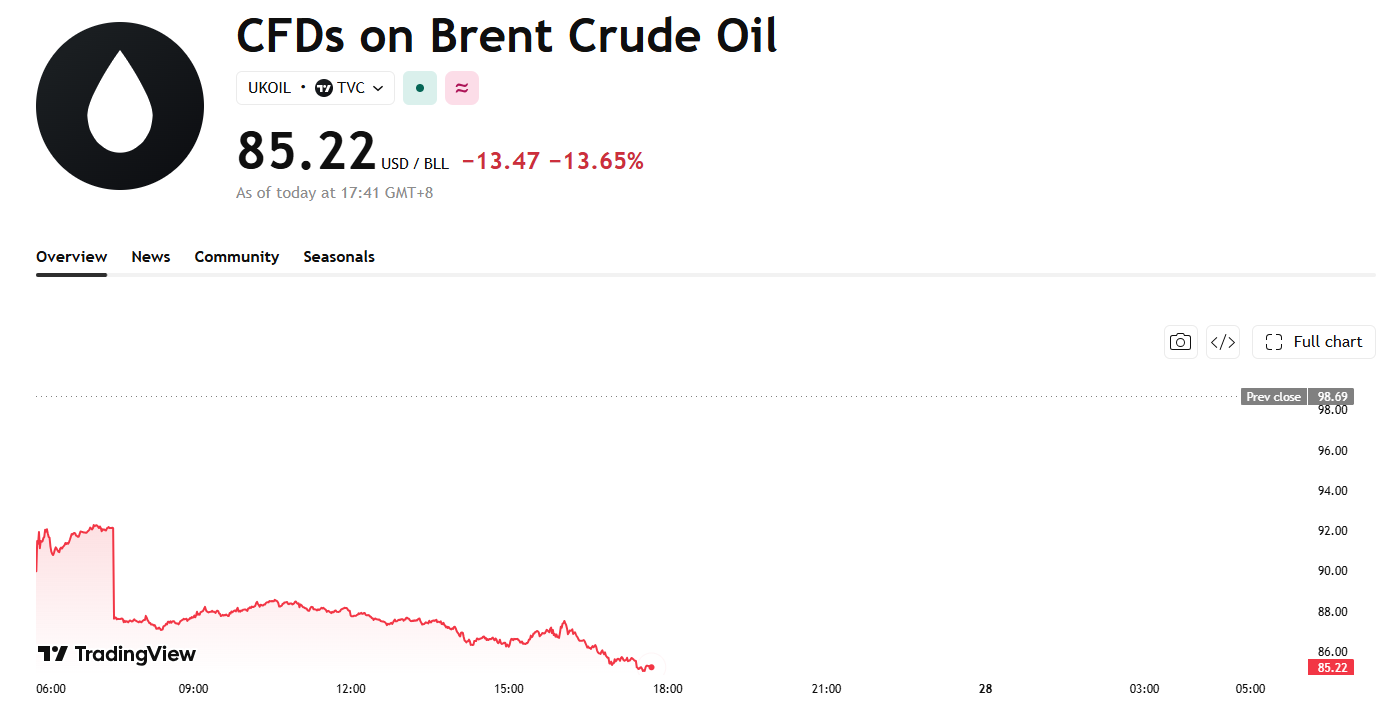
Brent crude oil price trend, Source: TradingView
This round of oil price decline was mainly driven by a temporary de-escalation of tensions between the US and Iran. The US suspended its new round of military strikes against Iran, and Iran also stated that it would suspend retaliatory actions if the US ceased its attacks. Meanwhile, China pushed for the US and Iran to resume talks, raising market expectations that both sides would re-contain the conflict through diplomatic means, which caused the Middle East risk premium in crude oil prices to drop rapidly.
Investors are particularly focused on transit through the Strait of Hormuz. Previously, the escalation of the US-Iran conflict led to a significant reduction in the number of tankers passing through the strait. Coupled with Houthi attacks on Saudi oil tankers, the market feared that two vital shipping routes—the Strait of Hormuz and the Red Sea—would be disrupted simultaneously, driving oil prices continuously higher. As the US and Iran paused hostilities, the market began to bet on a gradual recovery of crude oil transportation, and the risk of supply disruption eased.
The pullback in oil prices helps ease global inflation and pressure on major central banks to hike rates, while lowering energy costs for aviation, shipping, chemical, and manufacturing companies. Consequently, US stock index futures and Asian stock markets generally rose, although oil producers and energy stocks may face short-term correction pressure.
However, the US-Iran conflict is currently only a temporary ceasefire, with no formal peace agreement established, and the Houthi threat to Red Sea shipping has not yet been eliminated. If negotiations make progress, Brent and WTI crude may continue to give back their previous gains; if military actions escalate again, oil prices could still rebound rapidly.
This content was translated using AI and reviewed for clarity. It is for informational purposes only.
Recommended Articles











Comments (0)
Click the $ button, enter the symbol, and select to link a stock, ETF, or other ticker.