


Gold Price Forecast: Falling Oil Prices Boost Gold, Central Bank Rate Hike Risks Remain Key



AI Podcast


On October 12, spot gold held above $4,200/oz, supported by lower oil prices and falling U.S. Treasury yields that eased interest rate pressures. However, persistent Middle East geopolitical risks and potential inflation shocks threaten to revive rate-hike expectations, capping upside potential. Long-term support remains resilient, bolstered by record ETF inflows and sustained central bank reserve accumulation. Technically, gold trades below key moving averages with an RSI of 47.25, signaling a corrective bounce rather than a trend reversal. Initial resistance stands at $4,228 and $4,293, while immediate support rests between $4,180 and $4,200.

TradingKey - On October 12, gold (XAUUSD) prices rose slightly, continuing to hold above $4,200/oz. In the preceding week, gold gained a cumulative 1.3%. Lower oil prices and falling long-term U.S. Treasury yields eased some market concerns over further interest rate hikes, offering support to gold. However, tensions in the Middle East remain high, and with uncertainties surrounding energy supplies and the inflation outlook, gold's subsequent price trend faces impact from multiple factors.
Recent declines in oil prices were mainly influenced by U.S. President Trump's statements regarding an energy ceasefire between Russia and Ukraine. The market hopes that if such arrangements are implemented, pressure on global energy supplies could ease, thereby reducing the risk of further inflation increases. Lower energy prices may also lighten central banks' pressure to tighten monetary policy, favoring a recovery in gold prices.
Meanwhile, long-term U.S. Treasury yields pulled back from recent highs, also improving the market environment for gold. OCBC strategist Christopher Wong noted that the decline in 30-year U.S. Treasury yields, combined with lower oil prices, provided a degree of support for gold. Because gold itself pays no interest, rising bond yields typically increase the opportunity cost of holding gold, whereas pulling-back yields may relieve this pressure.
However, hopes for a de-escalation between Russia and Ukraine have not eliminated risks in the Middle East. Recently, Saudi Arabia suffered a new round of attacks, refocusing attention on the security of energy facilities and transportation hubs. If regional conflicts expand further, crude oil supplies could be affected, and oil prices might rally again. Once energy costs climb higher again, inflationary pressure could intensify, prompting central banks to maintain higher interest rates or even tighten policy further, thereby capping gold's upside potential.
Since the outbreak of the war in the Middle East at the end of February this year, gold prices have dropped by a cumulative total of approximately 20%. This trend reflects that although geopolitical risks typically favor safe-haven gold, if conflicts drive up energy prices and trigger rate-hike expectations, interest rate factors may outweigh some safe-haven demand, weighing on gold prices.
In the long run, investment demand and central bank gold purchases continue to provide support for gold. ANZ analysts pointed out that gold investment demand has increased recently. According to Bloomberg data, inflows into gold-backed exchange-traded funds (ETFs) reached a four-year high. Concerns over growing government debt, fiscal strain, and shifts in currency purchasing power have led some investors to continue including gold as part of their asset allocation.
In addition, the People's Bank of China added 740,000 ounces of gold to its reserves in September, extending its consecutive streak of increases to 23 months. Compared with short-term trading capital, central bank gold buying generally focuses more on long-term reserve allocation, helping to support medium- to long-term demand for gold.
However, ANZ also warned that if inflationary pressures persist, the Federal Reserve might reconsider rate hikes, limiting gold's upside. Keeping interest rates elevated or raising them further increases the opportunity cost of holding non-yielding gold, potentially pushing some capital toward yield-bearing assets.
Source: TradingView
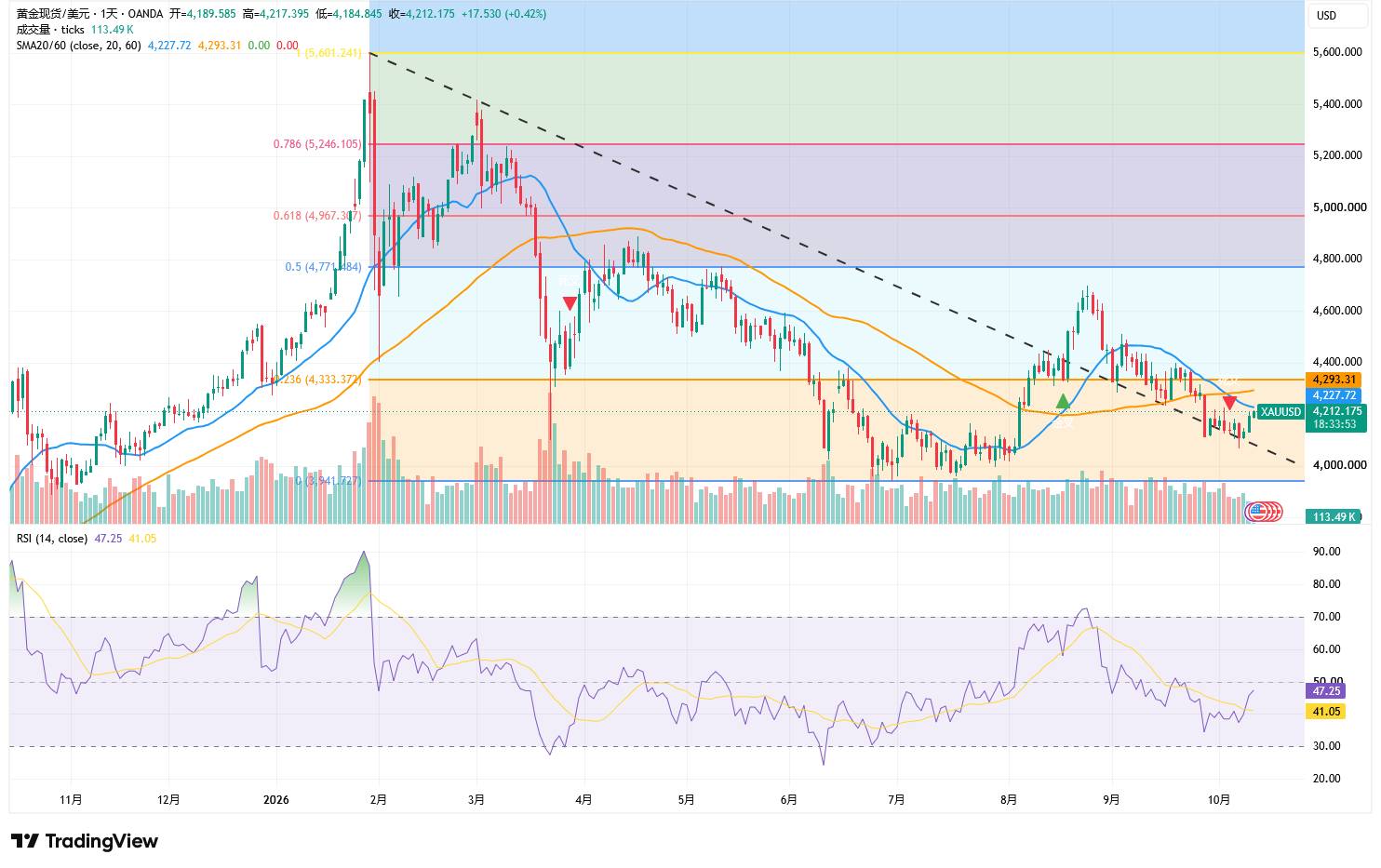
Looking at the daily chart, spot gold was last trading at $4,212, rebounding from recent lows but remaining below the 20-day moving average of $4,227.72 and the 60-day moving average of $4,293.31, indicating that short-term downside pressure has not been fully relieved. Currently, gold prices are repeatedly testing near the descending trendline, and whether they can firmly regain the moving averages will determine whether the rebound can continue.
The RSI rebounded from low levels to 47.25, moving above its signal line at 41.05, which indicates that downside momentum is weakening. However, since the RSI has not yet climbed above 50, the current move can only be viewed as a bounce after stabilizing, which is insufficient to confirm a trend reversal. On the upside, initial focus is on the 20-day moving average at $4,228, with further resistance at the 60-day moving average of $4,293 and the 23.6% Fibonacci level at $4,333. If the daily close breaks above $4,333, gold prices are expected to rebound further toward $4,400–$4,450.
On the downside, initial support is focused on $4,180–$4,200, a loss of which could lead to a retest of the $4,100–$4,050 zone. If the daily chart further breaks below $4,000, the previous low of $3,944 will serve as the next key line of defense.
This content was translated using AI and reviewed for clarity. It is for informational purposes only.
Recommended Articles










Comments (0)
Click the $ button, enter the symbol, and select to link a stock, ETF, or other ticker.