


Apple Stock Price Forecast: Two Rounds of New Product Launches Imminent in October; Can Touchscreen MacBooks and Smart Home Unlock Growth?



AI Podcast


Apple is entering an intensive product cycle, featuring a smart home hub, an OLED iPad mini, and a potential touchscreen OLED MacBook Pro. While these innovations expand ecosystem boundaries and support high-end pricing, software adaptation and third-party integration remain critical demand drivers. Technically, the stock maintains a medium-term bullish structure trading above its 20-day and 60-day moving averages at $336.64. However, it faces resistance at $340–$343. A high-volume breakout above $345 targets $350 and $360, whereas failure to hold the $330 support risks extending the pullback toward the 60-day moving average.
TradingKey - Apple Inc. (AAPL) is set to enter an intensive new product launch cycle in October. Following the release of its next-generation iPhone lineup in September, Apple also plans to hold a smart home-themed event on October 13, and is reportedly set to launch a touchscreen MacBook Pro, an OLED iPad mini, as well as MacBook Pros and iMacs powered by the M6 chip around October 27.
Unlike previous routine upgrades focused on the iPhone, iPad, and Mac, this product lineup simultaneously spans personal computers, tablets, and smart home devices, reflecting Apple's exploration of new hardware interaction methods and further expanding the application scenarios of its ecosystem.
Touchscreen MacBook May Drive High-End Product Upgrades
The most watched product in this cycle is Apple's first touchscreen-equipped MacBook Pro. The models are reportedly codenamed K114 and K116 internally and are expected to feature OLED displays, a lightweight chassis, and a display design similar to the iPhone's Dynamic Island.
Apple has long insisted on operating the Mac via keyboard and trackpad, reserving the touch experience for the iPad. The introduction of a touchscreen MacBook indicates that the company is realigning the boundary between these two product lines and could mark the most significant form-factor change for the Mac in recent years.
For professional users, a touchscreen offers new ways to interact when editing video, processing images, producing music, and annotating documents. Meanwhile, OLED technology will help improve contrast, color, and display quality, providing justification for Apple to raise prices on high-end MacBooks.
However, whether touch functionality translates into real demand still hinges on software adaptation by macOS and third parties. If the system simply adds screen tapping without redesigning menus, windows, and professional applications for touch, the feature may remain largely a marketing gimmick.
Apple is also reportedly set to introduce a 14-inch MacBook Pro and an iMac that retain their current design but upgrade to the M6 chip. In other words, the company may offer two product categories concurrently: one maintaining the regular upgrade cycle through chip refreshes, and the other testing higher-end market demand with touchscreens, OLED displays, and fresh designs.
OLED iPad Mini and Smart Home Expand Product Boundaries
The new iPad mini is expected to feature an OLED display, move the front-facing camera to the landscape border, and redesign the speaker system. These upgrades will help improve the landscape video, gaming, and calling experience.
Compared to the Mac and iPad upgrades, the smart home launch event on October 13 may hold greater long-term strategic significance. Apple is expected to unveil a home hub equipped with an approximately 6-inch screen, featuring Siri AI as the core portal to support smart home device control, video calls, music, security camera feeds, and schedule management.
Such products will directly compete with Amazon's (AMZN) Echo Show and Google parent company Alphabet's (GOOGL) Nest Hub. Apple is entering the market late, but it can leverage device synergies across the iPhone, Apple Watch, HomePod, and HomeKit, creating a competitive advantage through privacy protection and its user account ecosystem.
Apple may also collaborate with partners such as LG and Schneider Electric to expand its accessory lineup, addressing the shortage of its own smart home hardware. If third-party devices can be seamlessly integrated, Apple has the opportunity to develop the home hub into a new ecosystem portal, rather than just another smart speaker.
However, the smart home business is unlikely to reach the revenue scale of the iPhone or Mac in the short term. Product compatibility, Siri's reliability, and the interdevice experience across different brands will all determine whether consumers are willing to adopt Apple devices as their home control hub.
Apple Stock Technical Analysis
Source: TradingView
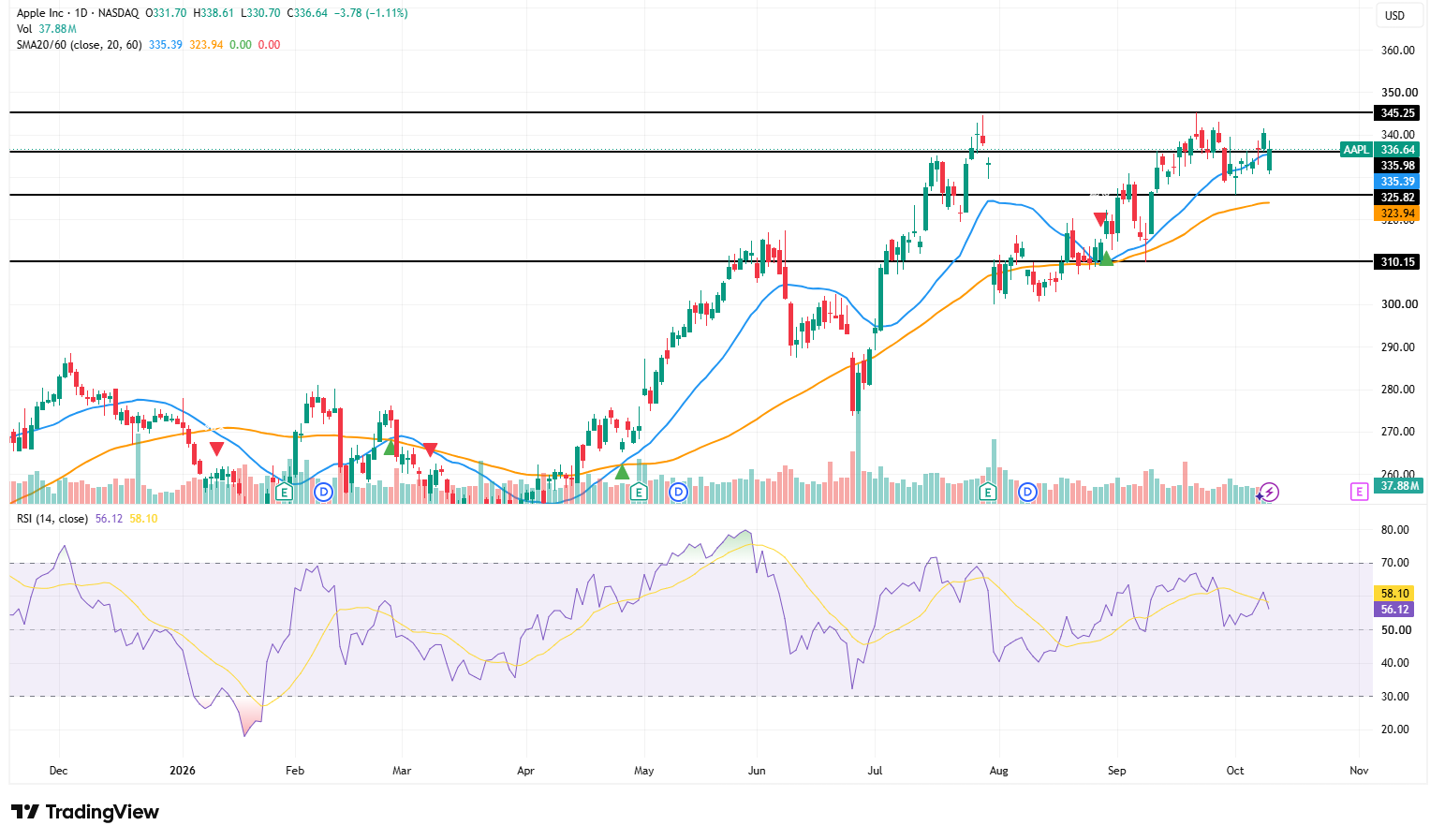
From the daily chart, Apple's stock price last traded at $336.64, remaining above its 20-day moving average of $335.39 and 60-day moving average of $323.94. With the 20-day moving average remaining above the 60-day moving average, the medium-term bullish structure remains intact. However, the stock price has repeatedly encountered resistance above $340 recently and has entered a high-level consolidation phase.
In the short term, $340–$343 forms the initial resistance zone, with a more critical previous high sitting at $344–$345. If the new product launch drives a high-volume breakout above $345 confirmed by the daily closing price, further upside targets to watch are $350 and $360. If it is merely an intraday breakout followed by a pullback, investors should still guard against selling pressure driven by profit-taking on good news.
On the downside, initial support to watch is around the 20-day moving average at $334–$335, followed by the recent consolidation floor at $330–$331. If it falls below $330, the pullback could extend to the 60-day moving average at $323–$324; if this level fails to hold, the bullish structure will weaken significantly, with the next support target near $310–$312.
The RSI currently stands at 56.12, remaining above 50 but below its smoothed signal line of 58.10, indicating that bulls still hold the advantage, though upward momentum has cooled somewhat. Trading volume has not expanded continuously of late, so a breakout above $345 still requires confirmation from significant incremental capital.
This content was translated using AI and reviewed for clarity. It is for informational purposes only.
Recommended Articles







Comments (0)
Click the $ button, enter the symbol, and select to link a stock, ETF, or other ticker.