AUD/USD Price Forecast: At make or a break near 0.6900



- AUD/USD consolidates near 0.6925 as focus shifts to the US CPI data for October.
- The US CPI is expected to have a limited impact on Fed’s interest rate expectations, unless there is a significant deviation.
- Financial markets are confident that the Fed will hike interest rates next month.
The Australian Dollar (AUD) trades flat at around 0.6925 against the US Dollar (USD) during the European trading session on Tuesday. The Aussie pair ranges as investors shift their focus to the United States (US) Consumer Price Index (CPI) data for October, which will be published at 13:30 GMT.
The US headline CPI on Wednesday is expected to arrive at 3.9% Year-on-Year (YoY), higher than the previous reading of 3.7%. The core CPI – which excludes volatile food and energy items – is also seen higher, arriving at 2.8% against the prior release of 2.6%.
The impact of the US CPI data is expected to be limited on expectations for the Federal Reserve’s (Fed) monetary policy outlook, unless there is a sharp deviation, as global inflation expectations have de-anchored due to falling oil prices.
According to the CME FedWatch tool, traders are confident that the Fed will hike interest rates by 25 basis points (bps) to the 4.00%-4.25% range in the December meeting. The tool shows that hawkish Fed expectations for the December meeting have increased to 84.2% from 77.4% seen a week ago.
Traders raised hawkish Fed bets after strong US Nonfarm Payrolls (NFP) data for October. On Friday, the data showed that the economy created 165K fresh jobs, significantly higher than 65K estimates and the prior reading of 60K.
On the Aussie front, investors await Consumer Inflation Expectations data for November, which is scheduled for Thursday. The data will likely have a significant impact on Reserve Bank of Australia’s (RBA) monetary policy expectations as latest remarks from policymakers have signaled that they are highly concerned about elevated inflation.
“Inflation is too high, whichever measure you use,” RBA Deputy Governor Andrew Hauser said last week.
AUD/USD Technical Analysis
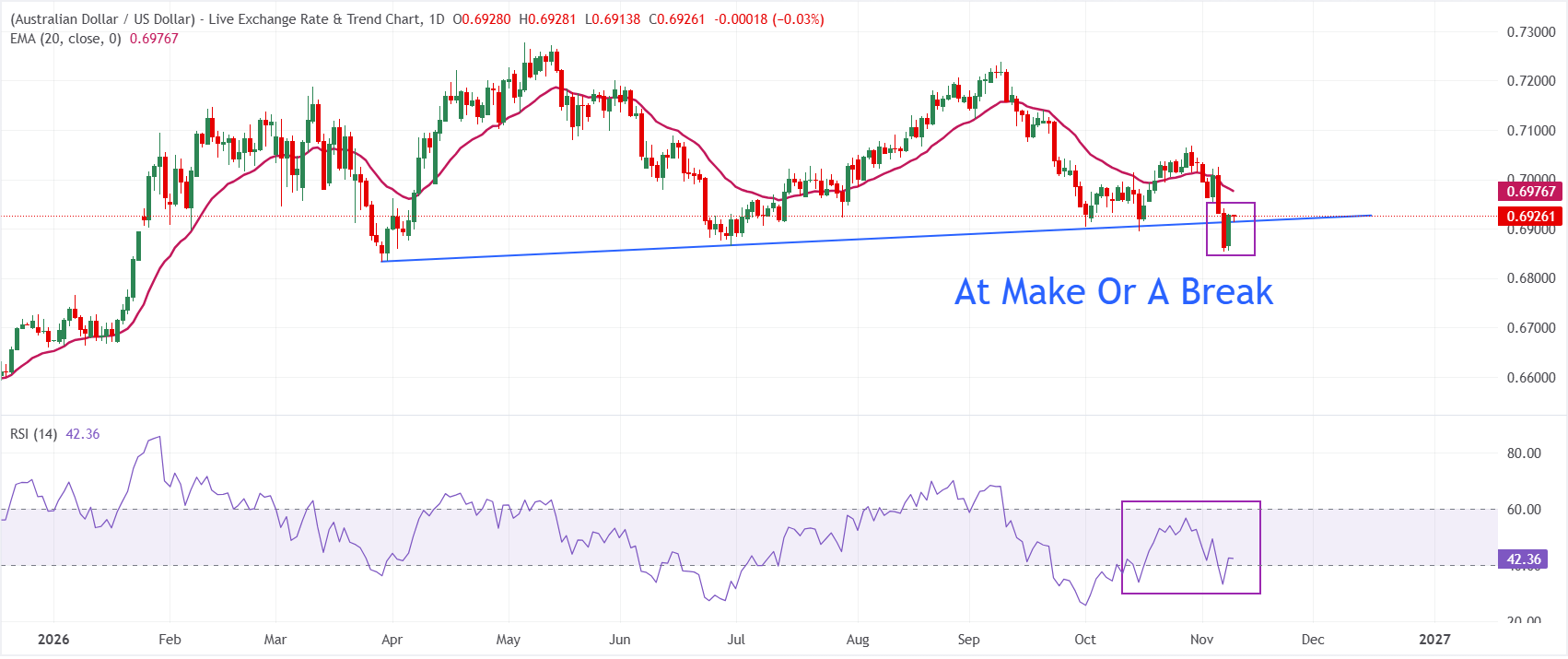
In the daily chart, AUD/USD trades at 0.6926. The pair holds just above the former uptrend support line around 0.6914, but remains capped by the 20-day Exponential Moving Average (EMA) near 0.6977, keeping the near-term bias tilted to the downside while price stays below this dynamic barrier. The Relative Strength Index (14) hovers in the low-40s, suggesting subdued momentum and hinting that recovery attempts could struggle beneath the overhead average.
On the topside, initial resistance is aligned with the 20-day EMA at 0.6977, and a daily close above this level would be needed to ease immediate bearish pressure. On the downside, the nearby trend-line area around 0.6914 offers first support; a clear break below that zone would expose lower levels and reinforce the current soft tone in AUD/USD.
(The technical analysis of this story was written with the help of an AI tool. Know more.)
US Dollar FAQs
The US Dollar (USD) is the official currency of the United States of America, and the ‘de facto’ currency of a significant number of other countries where it is found in circulation alongside local notes. It is the most heavily traded currency in the world, accounting for over 88% of all global foreign exchange turnover, or an average of $6.6 trillion in transactions per day, according to data from 2022. Following the second world war, the USD took over from the British Pound as the world’s reserve currency. For most of its history, the US Dollar was backed by Gold, until the Bretton Woods Agreement in 1971 when the Gold Standard went away.
The most important single factor impacting on the value of the US Dollar is monetary policy, which is shaped by the Federal Reserve (Fed). The Fed has two mandates: to achieve price stability (control inflation) and foster full employment. Its primary tool to achieve these two goals is by adjusting interest rates. When prices are rising too quickly and inflation is above the Fed’s 2% target, the Fed will raise rates, which helps the USD value. When inflation falls below 2% or the Unemployment Rate is too high, the Fed may lower interest rates, which weighs on the Greenback.
In extreme situations, the Federal Reserve can also print more Dollars and enact quantitative easing (QE). QE is the process by which the Fed substantially increases the flow of credit in a stuck financial system. It is a non-standard policy measure used when credit has dried up because banks will not lend to each other (out of the fear of counterparty default). It is a last resort when simply lowering interest rates is unlikely to achieve the necessary result. It was the Fed’s weapon of choice to combat the credit crunch that occurred during the Great Financial Crisis in 2008. It involves the Fed printing more Dollars and using them to buy US government bonds predominantly from financial institutions. QE usually leads to a weaker US Dollar.
Quantitative tightening (QT) is the reverse process whereby the Federal Reserve stops buying bonds from financial institutions and does not reinvest the principal from the bonds it holds maturing in new purchases. It is usually positive for the US Dollar.