


COHR: Market cap halved — was the optical‑module 'all‑rounder' oversold?


The optical comms duo: one is Lumentum, the other is Coherent. Their businesses are similar but not identical: Lumentum mainly sells laser chips externally, while Coherent, though it mass-produces laser chips, largely uses them in-house and ships finished optical modules to customers, having pursued vertical integration earlier and more fully. $Coherent Corp.(COHR.US)
So where does module-selling Coherent have an edge? This note focuses on its optical module biz. It answers four questions:
1) How are optical comms giants forged?
2) What products does Coherent cover?
3) Selling chips vs. selling modules: what differs?
4) What alpha does Coherent have in modules?
Below is the body text:
1) How are optical comms giants forged?
1. From a materials company to a comms giant
Coherent (hereafter COHR) has a complex lineage. Lumentum (hereafter LITE) was spun out of JDSU, the optical networking star, inheriting optical components for telecom and data centers, i.e., a pure-play comms background.
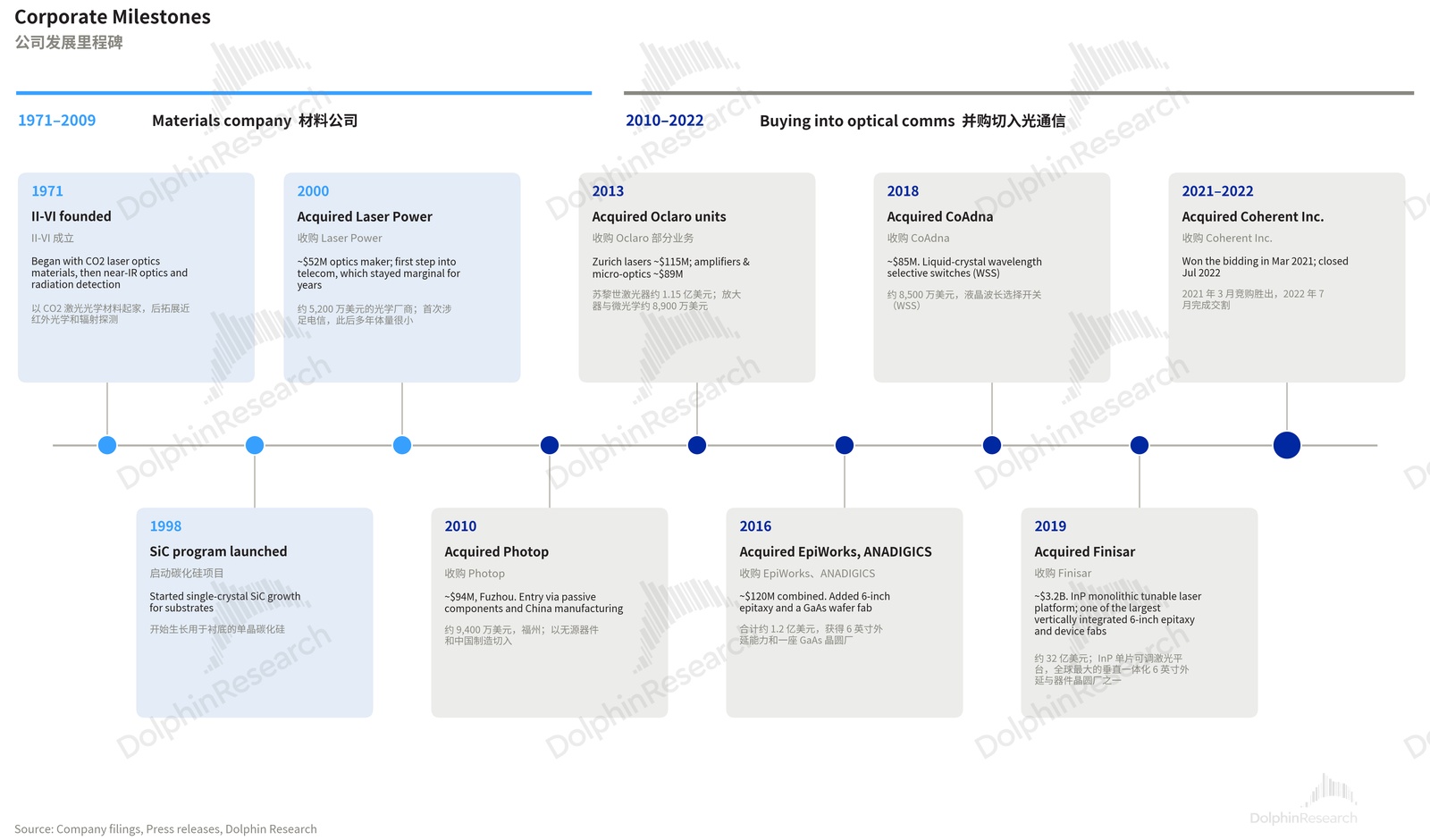
By contrast, COHR’s core originated from II-VI, a company founded in optical materials. It acquired Finisar (optical modules) in 2019 and Coherent (lasers) in 2022, then adopted the Coherent name and ticker.
How did II-VI, born in optical materials, step by step become a comms giant?
The company’s evolution can be divided into two phases:
a. 1971–2009: Staying in its lane
II-VI’s core business was consistently optical materials and adjacencies. It started with CO2 laser optics, launched single-crystal SiC growth, and acquired peer Laser Power to expand laser optics and defense IR. It also touched some telecom components during this period, but telecom remained peripheral.
b. From 2010: Pivot to optical comms, filling the stack via M&A
The legacy industrial laser optics market was small and cyclical. II-VI pivoted to optical comms through intensive M&A, where core capabilities (crystal growth, compound semis) were transferable and the market was far larger.
Over the following decade, II-VI acquired Photop, Oclaro’s laser/amplifier units, CoAdna, Finisar and others (see chart), covering the full stack from materials and wafers to devices, modules and subsystems.
In theory, after buying Finisar, II-VI had largely completed its optical comms integration. Why then proceed to buy Coherent, which focused on industrial lasers?
2. Competing with Lumentum to acquire Coherent
The goal was to diversify cycles. As noted in our LITE coverage, traditional optical components are cyclical with balanced supply-demand, intense competition, and declining pricing. Coherent, focused on lasers, appealed to both II-VI and Lumentum for different reasons.
- LITE wanted a second growth curve beyond optical comms by entering lasers, hedging its traditional comms cycle. - II-VI aimed to extend vertically, boosting competitiveness across laser product lines in materials/display processing and instruments, while using Coherent’s service network as a channel for II-VI’s higher-margin aftermarket consumables.
II-VI won in 2021, acquiring Coherent for $7bn.
2) What products does Coherent cover?
1. Biz mix: comms roughly 80%
After a string of deals, COHR now focuses on network connectivity, industrial materials and lasers. In FY2026 it reorganized segments into a) Data Center & Comms and b) Industrial.
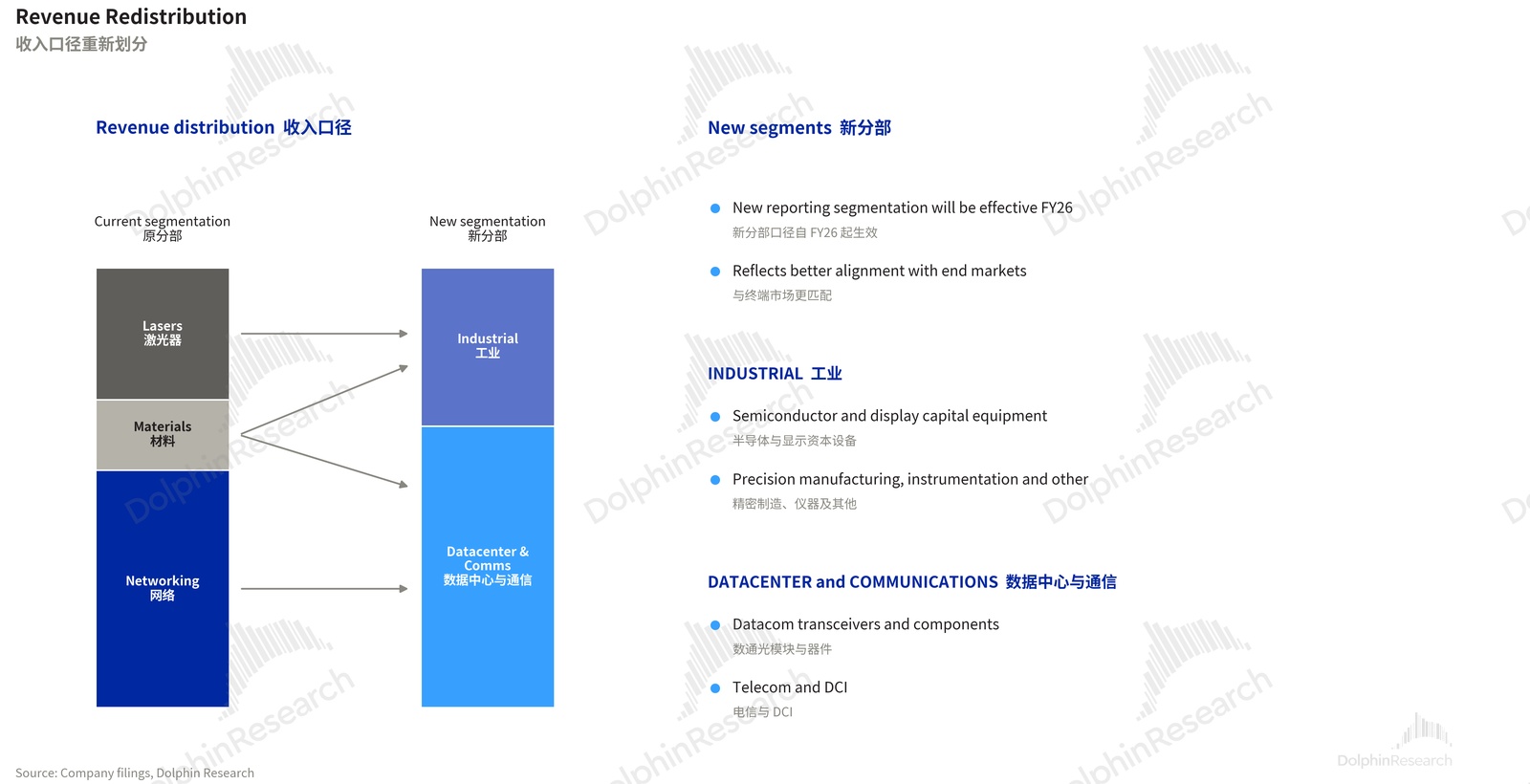
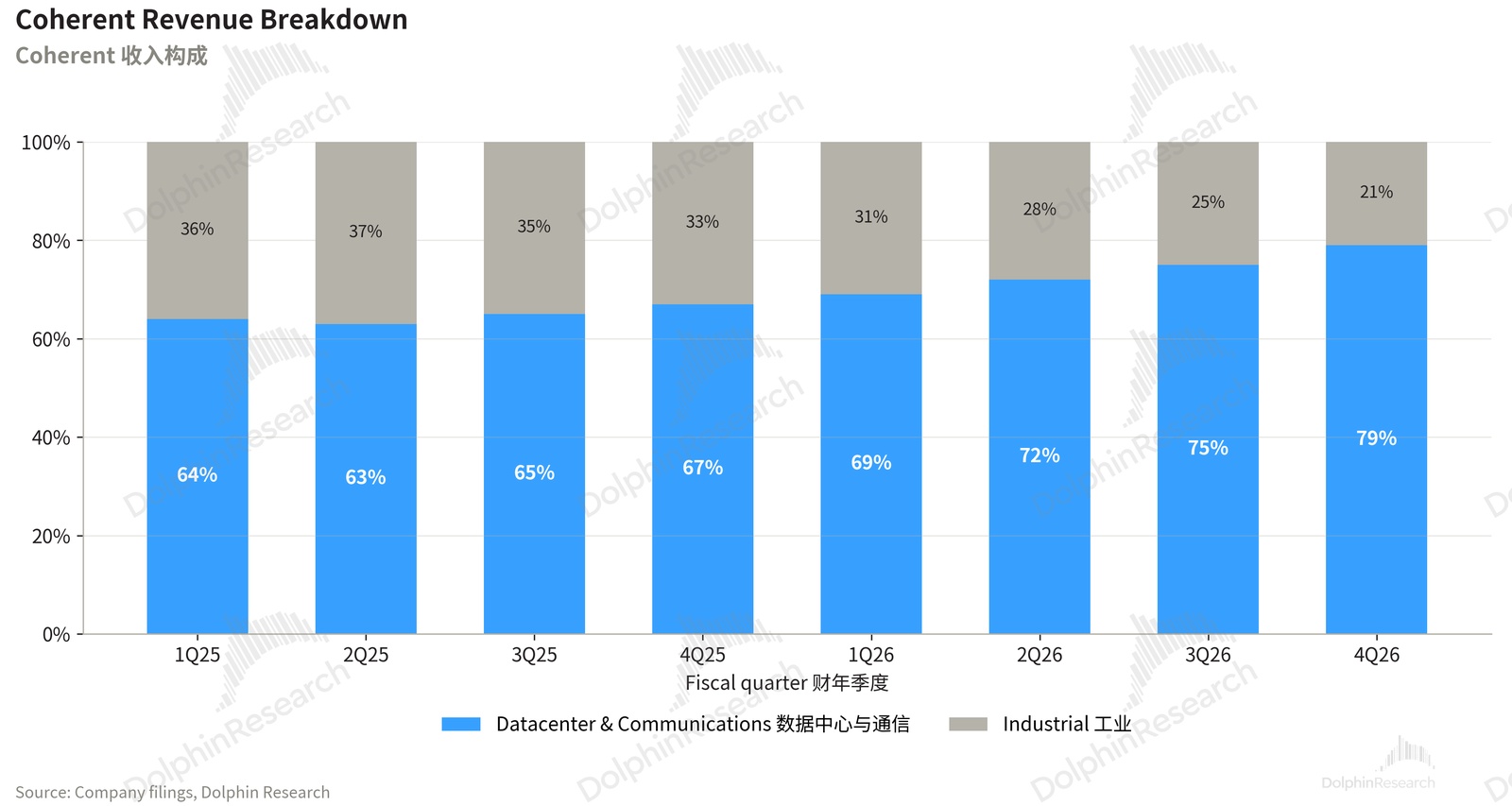
Under the new structure, Data Center & Comms is the main revenue driver, ~80% in FY26 Q4. On a comparable basis by our estimate, LITE’s comms exposure is ~95%, making it a purer optical comms play.
On industrial, the company is pruning and divesting non-comms assets. Aerospace & defense (optics and laser systems) and the Munich unit (laser processing equipment) were sold in Sep 2025 and Jan 2026, respectively. Industrial is not the focus of this note.
2. Comms: four core product areas
Within Data Center & Comms, core revenue contributors are, in order: optical modules; comms/DCI-related (ROADM/WSS/tunable modules); OCS optical circuit switches; and CPO (see tech and supply chain primers).
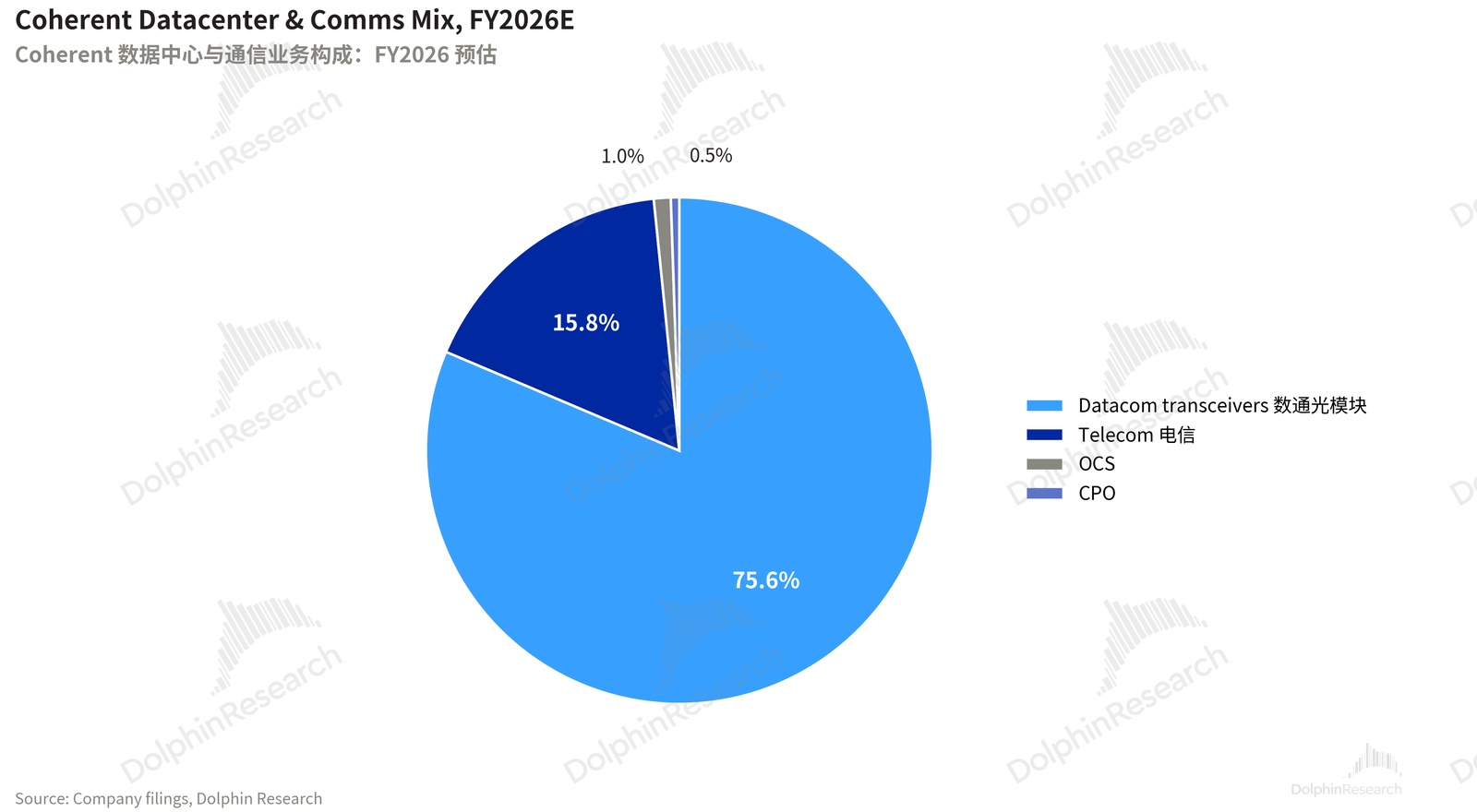
We now focus on optical modules, where COHR differs most from LITE:
3) Selling chips vs. selling modules: what differs?
Versus LITE, the key difference is: Coherent can mass-produce laser chips, but instead of primarily selling high-speed laser chips (InP) externally, it consumes most internally and ships modules directly to end customers. How should we think about chips vs. modules?
In short, chips sit closer to constrained upstream capacity and have epitaxy/manufacturing barriers, enabling higher GPM but a smaller revenue pool. Modules have a larger pool but lower GPM; leaders’ margin comes from control of upstream/downstream, not assembly per se.
1. Financials: accept lower GPM to address a bigger pool
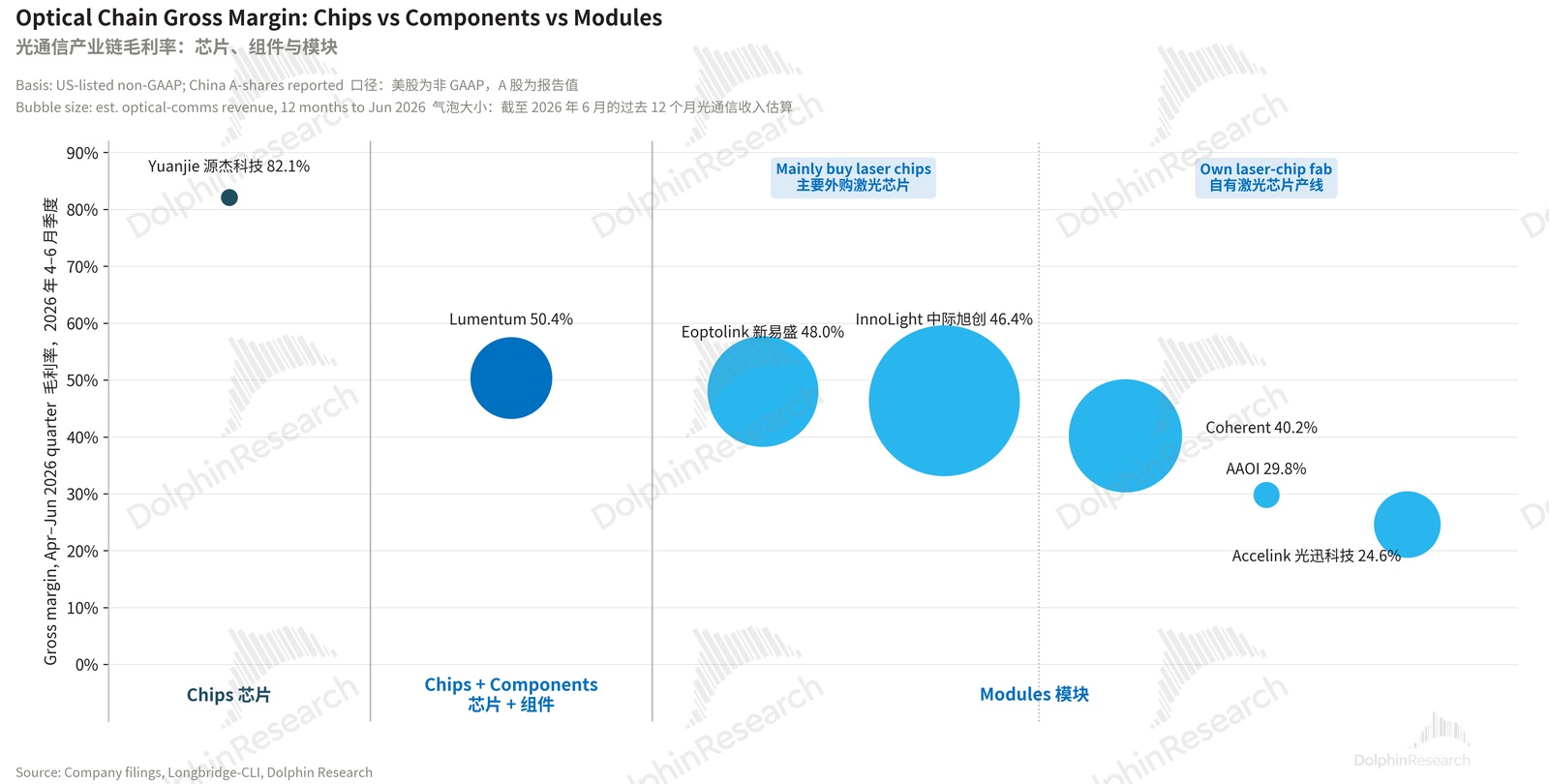
Optical players can be grouped into chip sellers, chip+component sellers, and module sellers. Because laser chips are inputs into modules, module revenue scale should be larger, reflected by bigger bubbles in the chart.
On margin, pure-chip businesses carry high GPM. The market generally expects LITE’s EML chip GPM at 60%+, while module GPM is lower. Where does the gap come from?
2. Supply chain: higher upstream, more concentrated
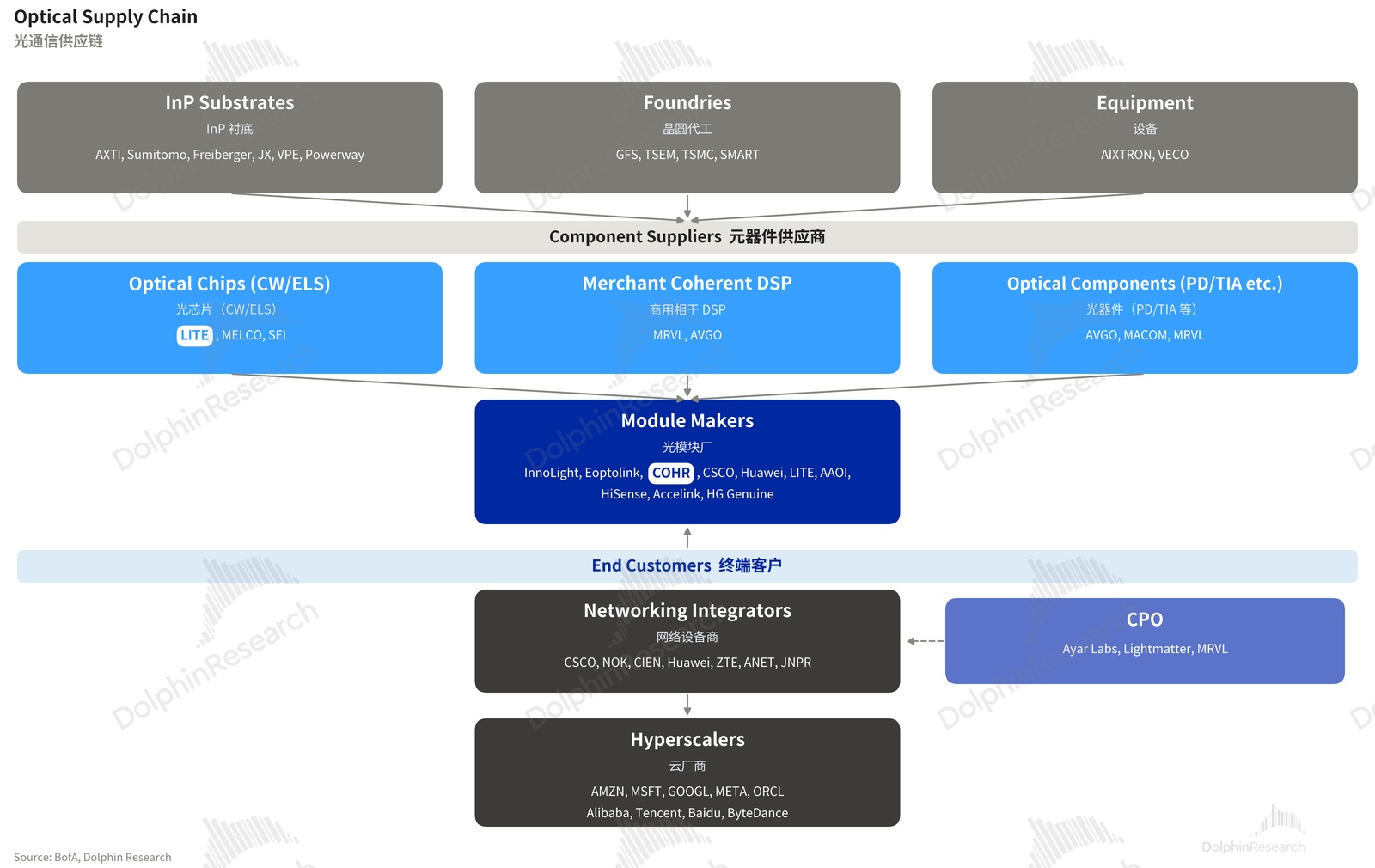
For pluggable modules, the chain spans upstream substrates/wafers, foundry and tools; then components such as laser chips, DSPs and optical parts; downstream are NEs and CSPs. Upstream is concentrated, while midstream module vendors are numerous and competitive.
InP laser chips: close to constrained upstream with process barriers, thus high GPM
For a laser-chip vendor like LITE, this link is in an upcycle and commands premiums for two reasons. First, under the EML route, second epitaxy has process barriers (see our Lumentum deep dive).
Second, they sit closer to the constrained upstream, and module makers’ demand far exceeds supply. On the demand side, deployments are shifting from 800G (8×100G) to 1.6T (8×200G), so with upstream tight, meeting 200G per lane is the top priority regardless of route, and downstream will broadly accept whatever can ship.
On supply, the bottleneck remains InP substrates. We believe tightness will be hard to resolve before 2028.
Thus, for laser-chip vendors, competition hinges on: a) meeting downstream specs; and b) secured substrate/wafer capacity.
3. Modules: limited barriers in assembly; value lies up- and downstream
For module vendors, spanning more upstream links and being closer to end users mean fierce competition. They need upstream sourcing/integration capability and strong delivery/validation with customers, functionally similar to an ‘assembler.’
1) How much value does assembly itself add?
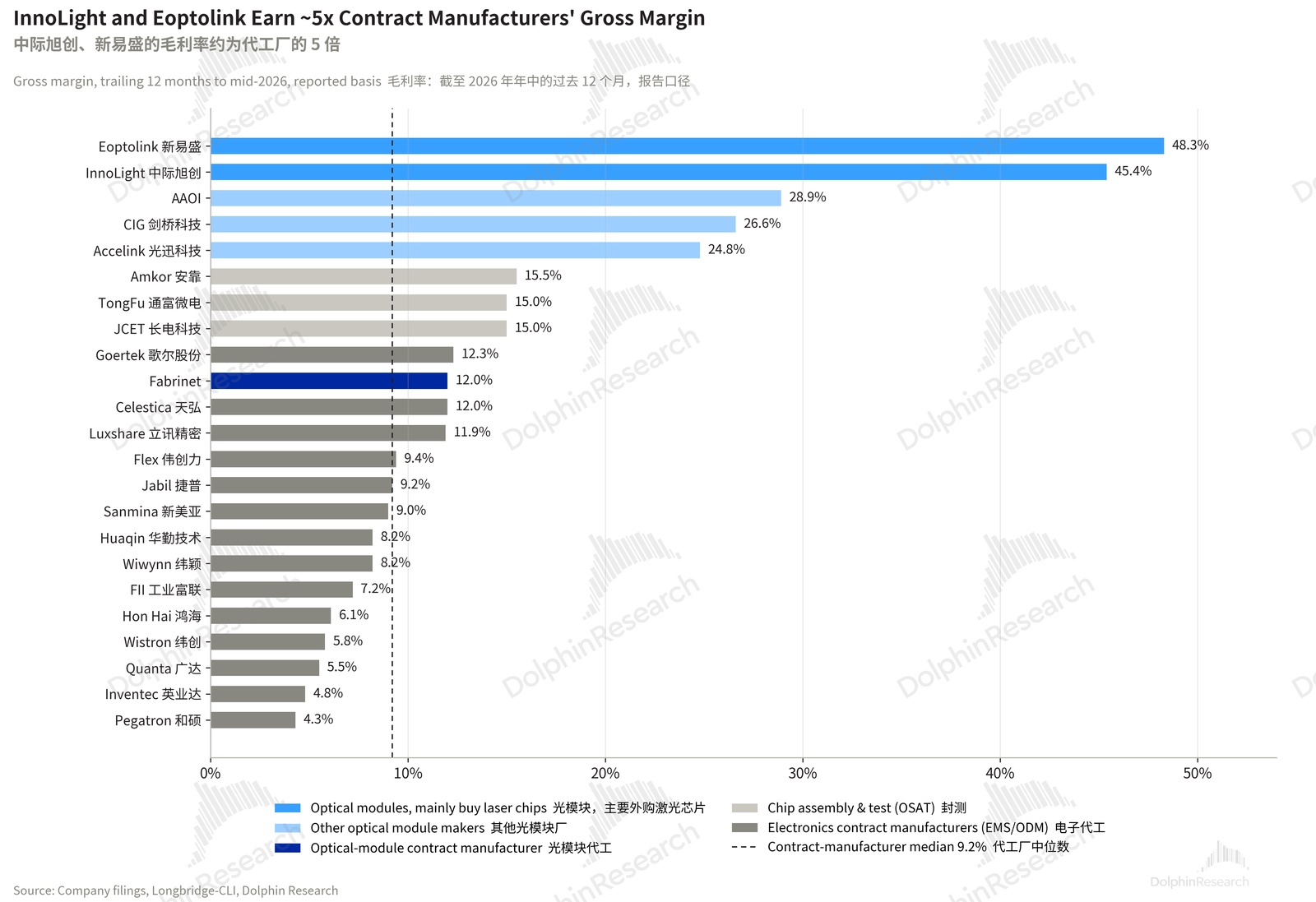
Assembly steps in manufacturing often capture thin margins, typically 5%–20%. Fabrinet, largely an EMS for modules, runs ~12% GPM.
Yet leaders such as Innolight and Eoptolink run 45%+ GPM. What value is created here? Our take: although assembly has difficult steps, it does not rise to the barrier level of second epitaxy for EML chips, and likely cannot justify leaders’ high GPMs by itself.
How do module vendors assemble upstream parts into pluggables? For a 1.6T EML solution, once components are in-house, they proceed through four stages: SMT/wire bonding, optical coupling, final assembly, and test/ship, as below.
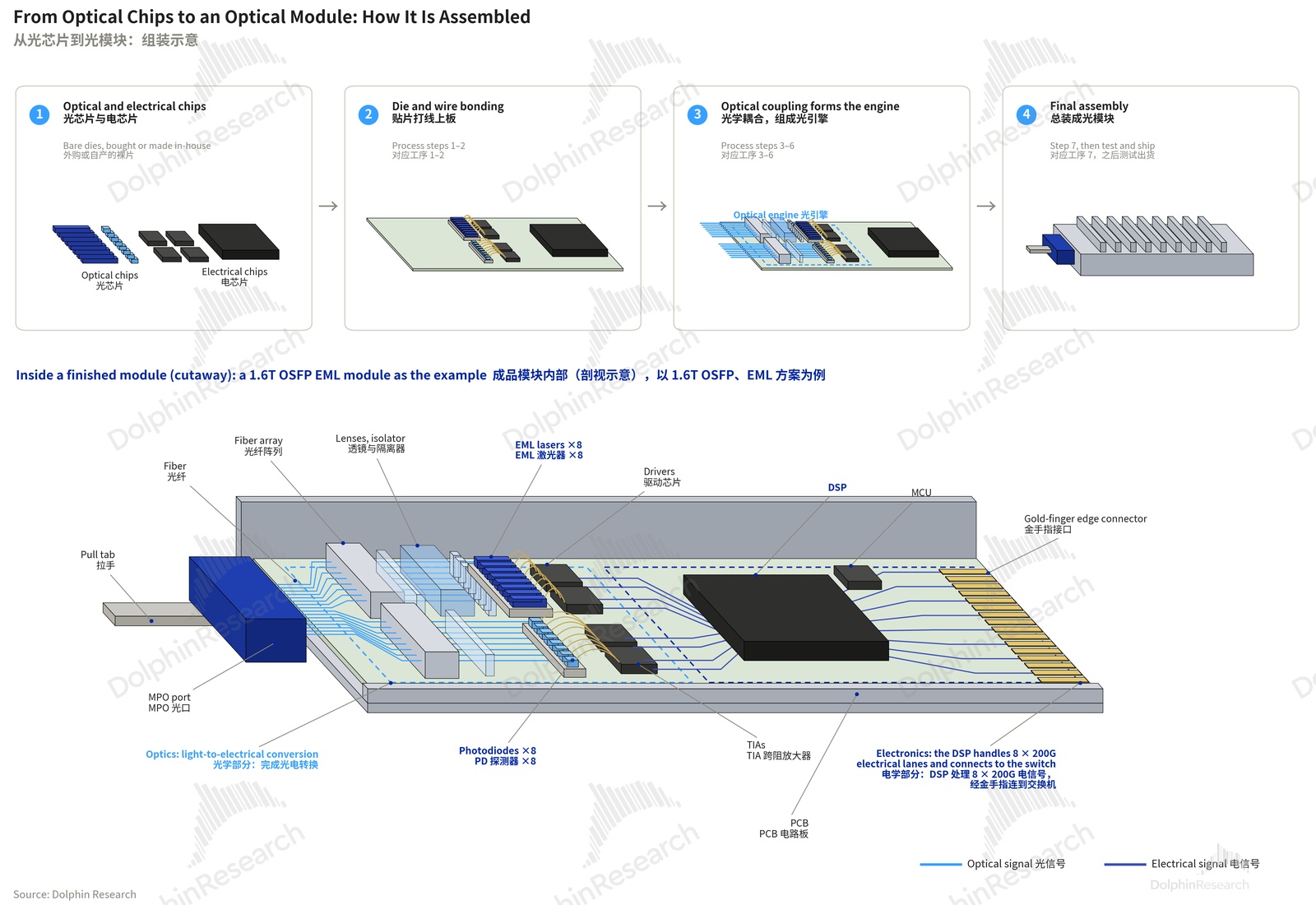
On the Tx path, electrical signals from the switch enter the DSP via the edge connector, are amplified by the driver to light the EML, then light passes lenses and an isolator into the fiber array, exiting via the MPO port.
The Rx path reverses: PD converts light back to electrical, TIA amplifies, DSP processes, and signals return to the switch.
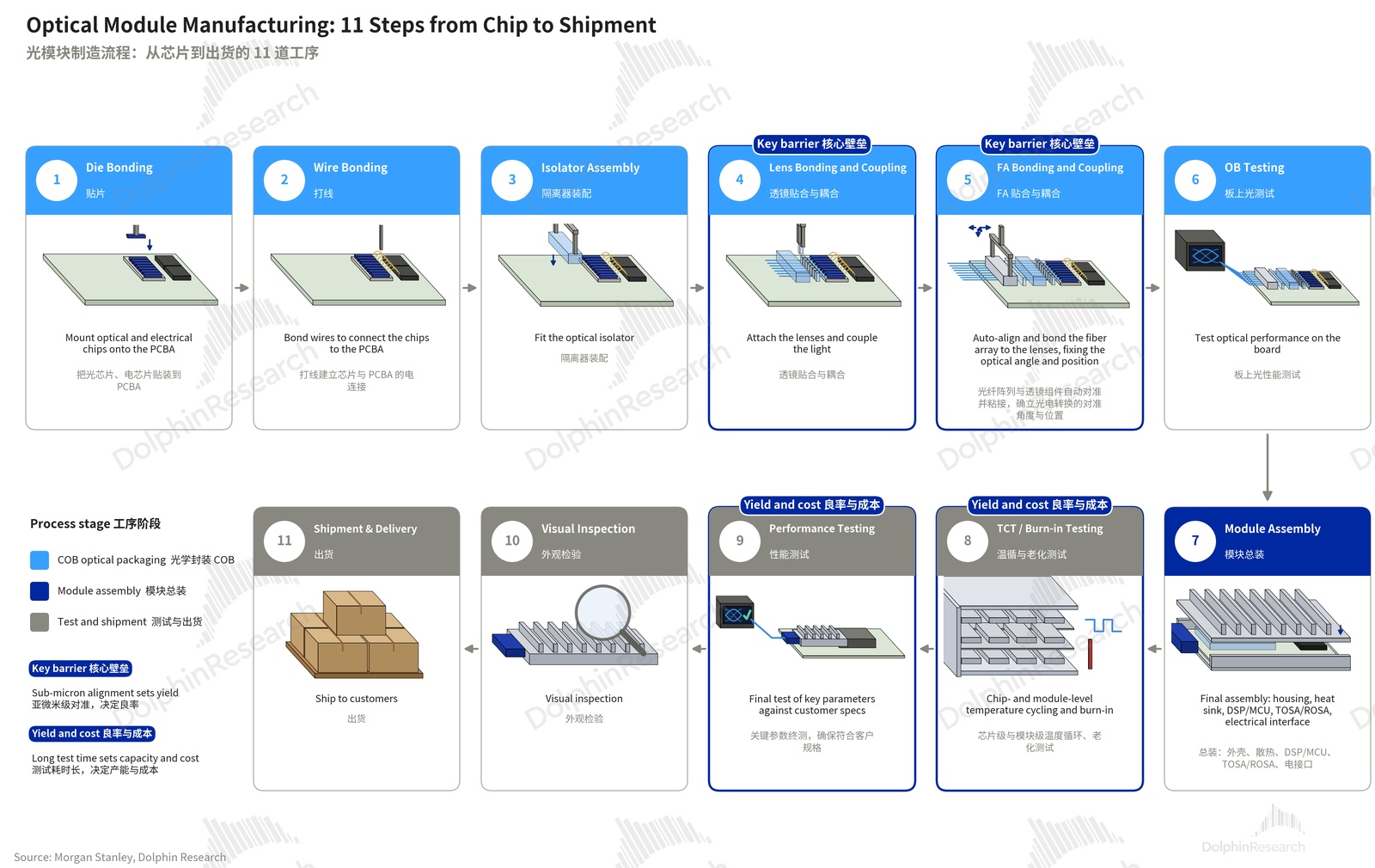
Under the EML route, the critical steps are lens attach/coupling and FA alignment/bonding (steps 4 and 5), collectively ‘optical coupling.’
Because laser output is narrow and divergent, and fibers only accept appropriately collimated light, coupling uses lenses to shape the beam and inject it precisely into the core. Industry generally views optical coupling as the most time-consuming and yield-limiting step.
Process specifics:
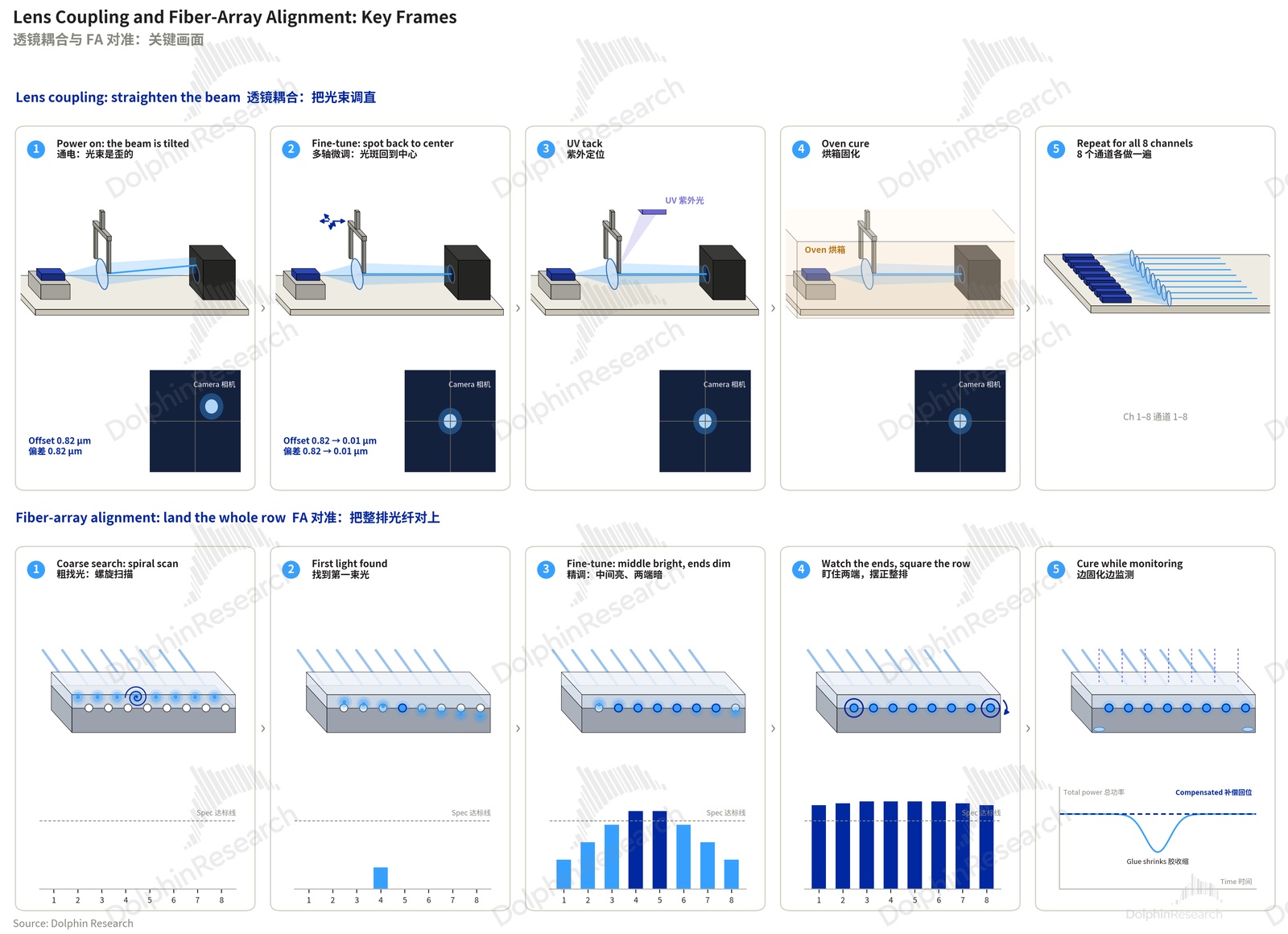
Lens coupling (top row): shapes divergent laser light into parallel light. A sub-micron lens placement error deflects the beam, seen as spot offset in the camera (①). In production, the laser is powered on; grippers micro-adjust lens position on a precision stage until the spot centers (②).
UV exposure then fixes preliminarily (③), followed by oven cure (④). The 8 channels repeat the process sequentially (⑤).
FA alignment (bottom row): simultaneously couples 8 beams into 8 fibers. Since in-fiber light is not directly visible, alignment relies on measured in-coupled power per channel, with higher power indicating higher coupling efficiency.
The process spiral-scans for initial signal (①②), then fine-tunes to maximize power (③). The row often still tilts, yielding stronger middle channels and weaker ends, so angle is adjusted to bring all 8 into spec (④).
During cure, in-coupled power is monitored to compensate for glue shrinkage in real time (⑤). Once cured, rework is impossible, so first-pass yield is critical.
More channels and higher speeds tighten yield requirements, as channel yields multiply.
Still, despite difficult assembly steps, we do not think they alone justify leaders’ high margins. Fabrinet also mass-produces 1.6T modules for NVIDIA, proving sufficient process capability for top customers, yet its GPM is ~12%.
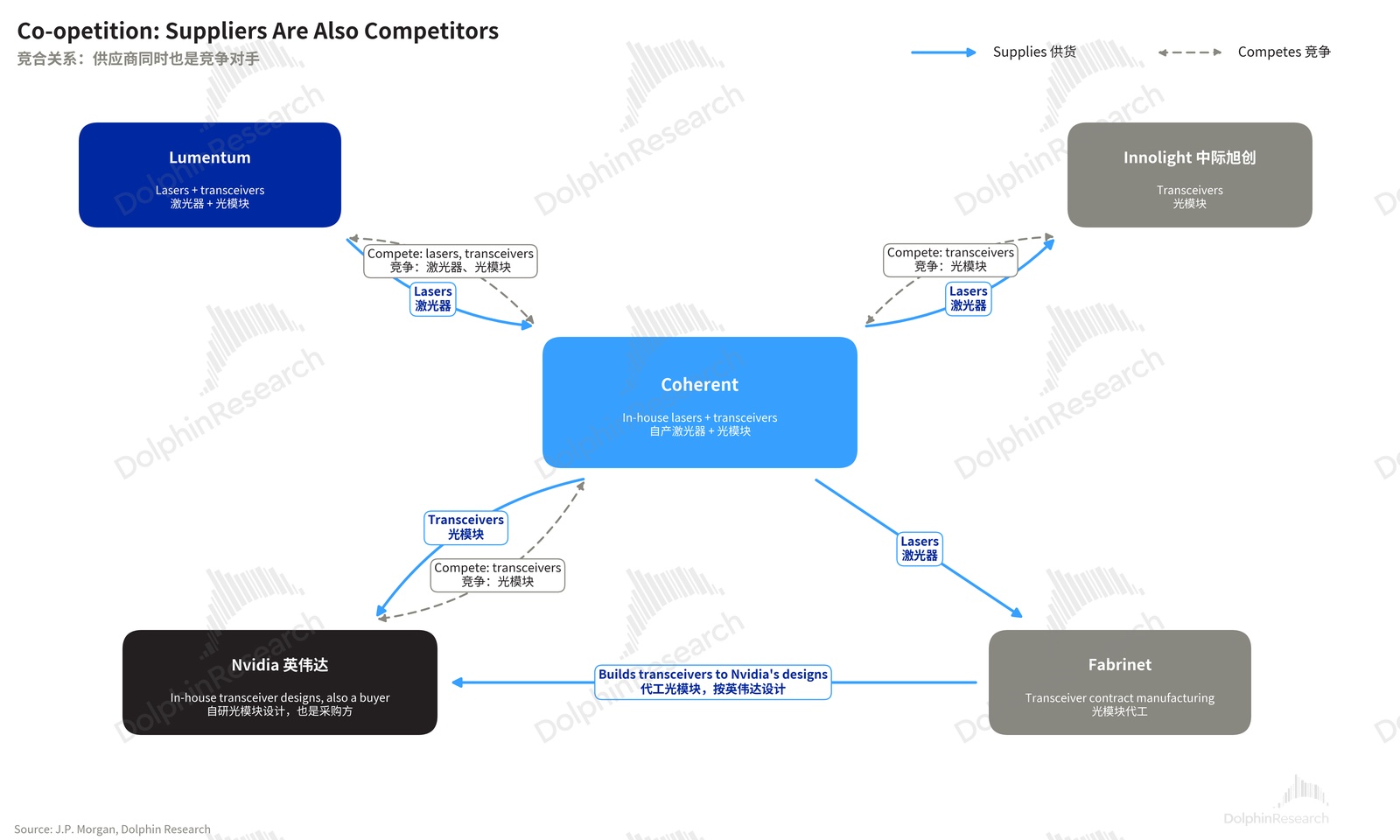
In reality, firms in the optical chain are both partners and competitors. Competition at the module layer is therefore highly intense.
So where do leaders’ margins come from? We look up- and downstream for answers.
2) Upstream: laser/PD chips and DSPs are the choke points
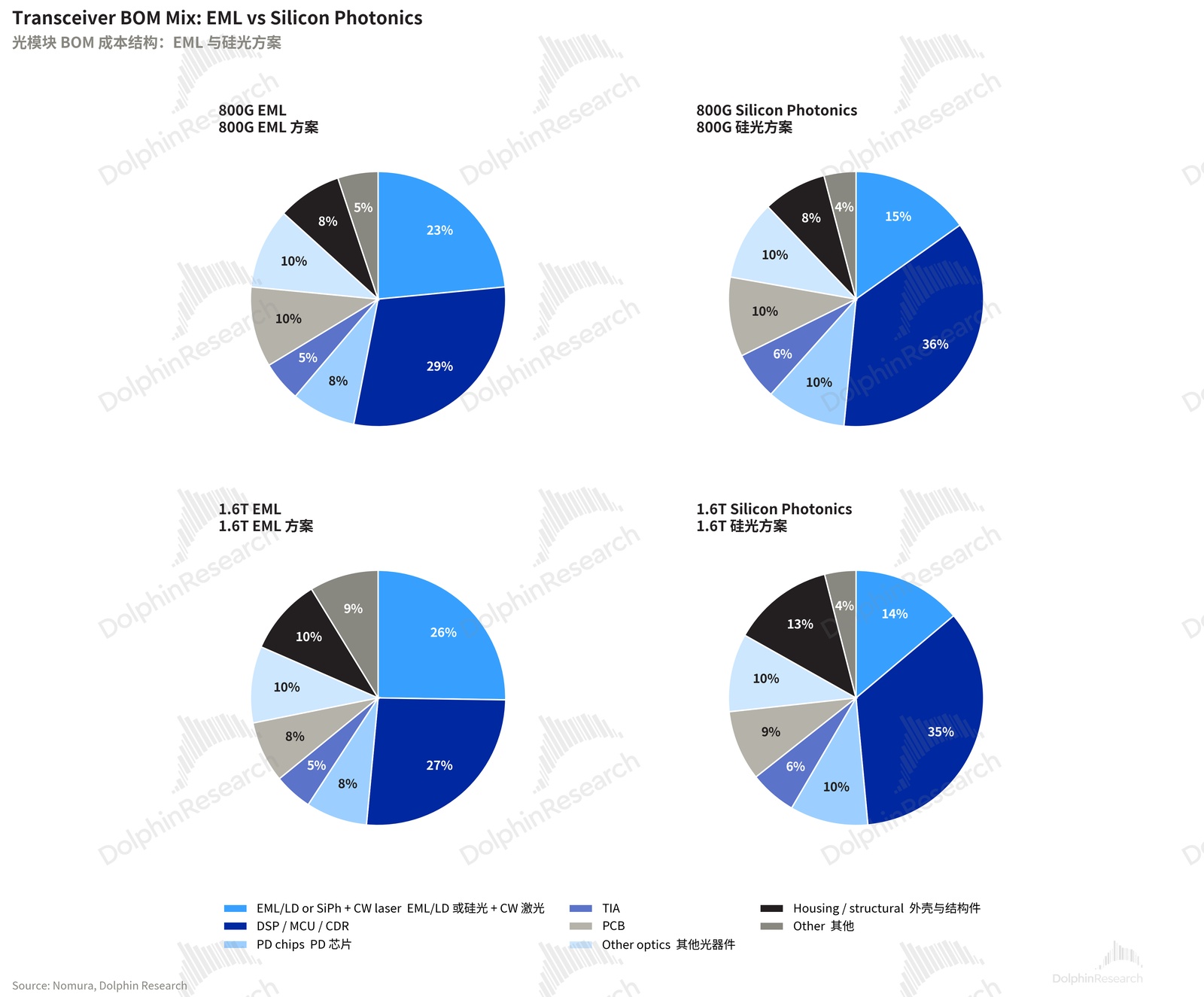
In 800G & 1.6T modules, across integrated EML and discrete CW+SiPh routes, BOM shows laser chips and DSPs dominate cost, together near 50% of value. They are the two cores in a module.
Each upstream link affects delivery. Beyond laser chips (constrained by substrates), we assess tightness of other parts below, with more '★' indicating higher bottleneck risk.
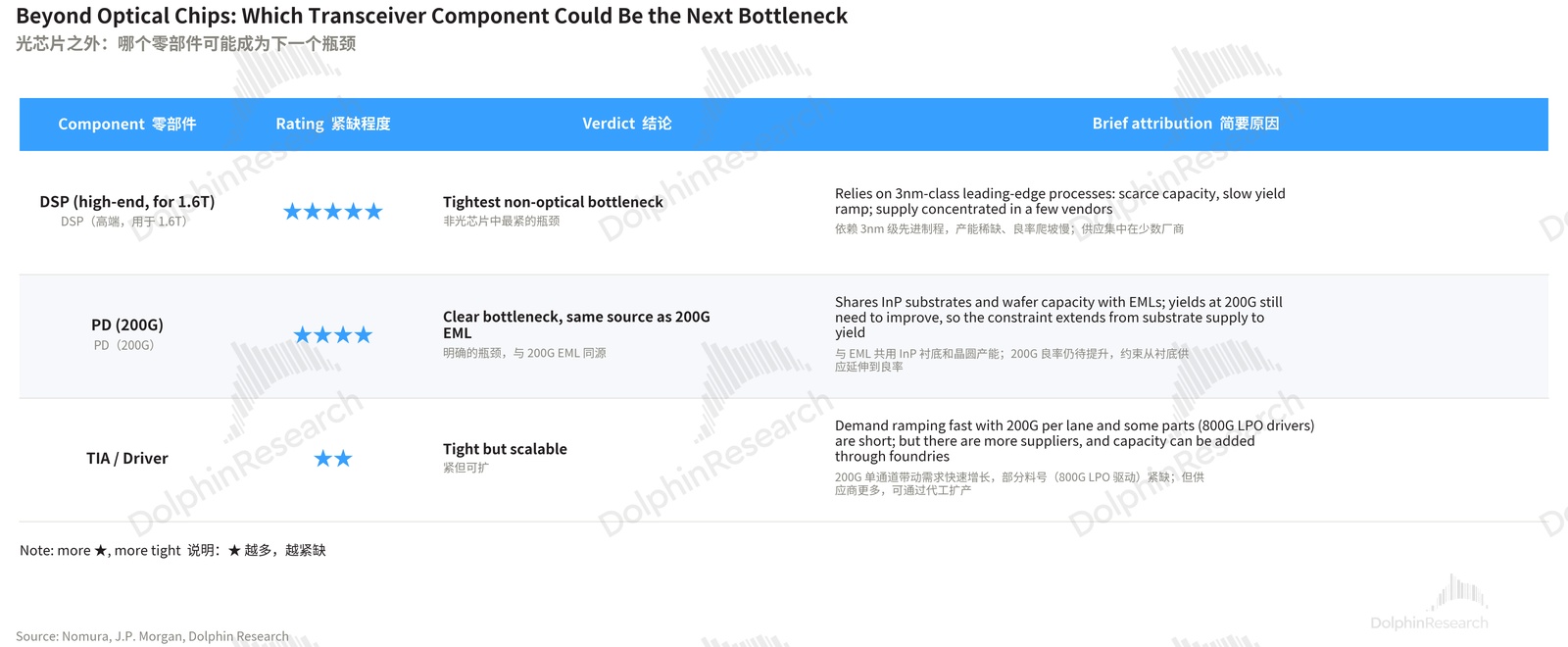
- DSPs carry high value, but their process and supply chain are far from optics.
Module vendors generally do not design DSPs in-house, relying mainly on Marvell and Broadcom, which together hold 90%+ of the high-end DSP market. Current 3nm yields pose risk of shortages.
In short, DSPs are a shared bottleneck for all module vendors. No one is self-sufficient; the difference is who secures more allocation.
- Another uncontrollable is substrates. InP substrates have high barriers and concentrated supply: Sumitomo (40%), JX Metals (10%) and AXT (30%). Supply is scarce.
Even laser-chip leaders must buy substrates and then do their own epitaxy and chips. Epitaxy know-how underpins EML barriers.
Therefore, high-value optical chips (laser and PD) constrained by substrates become core bottlenecks for module makers.
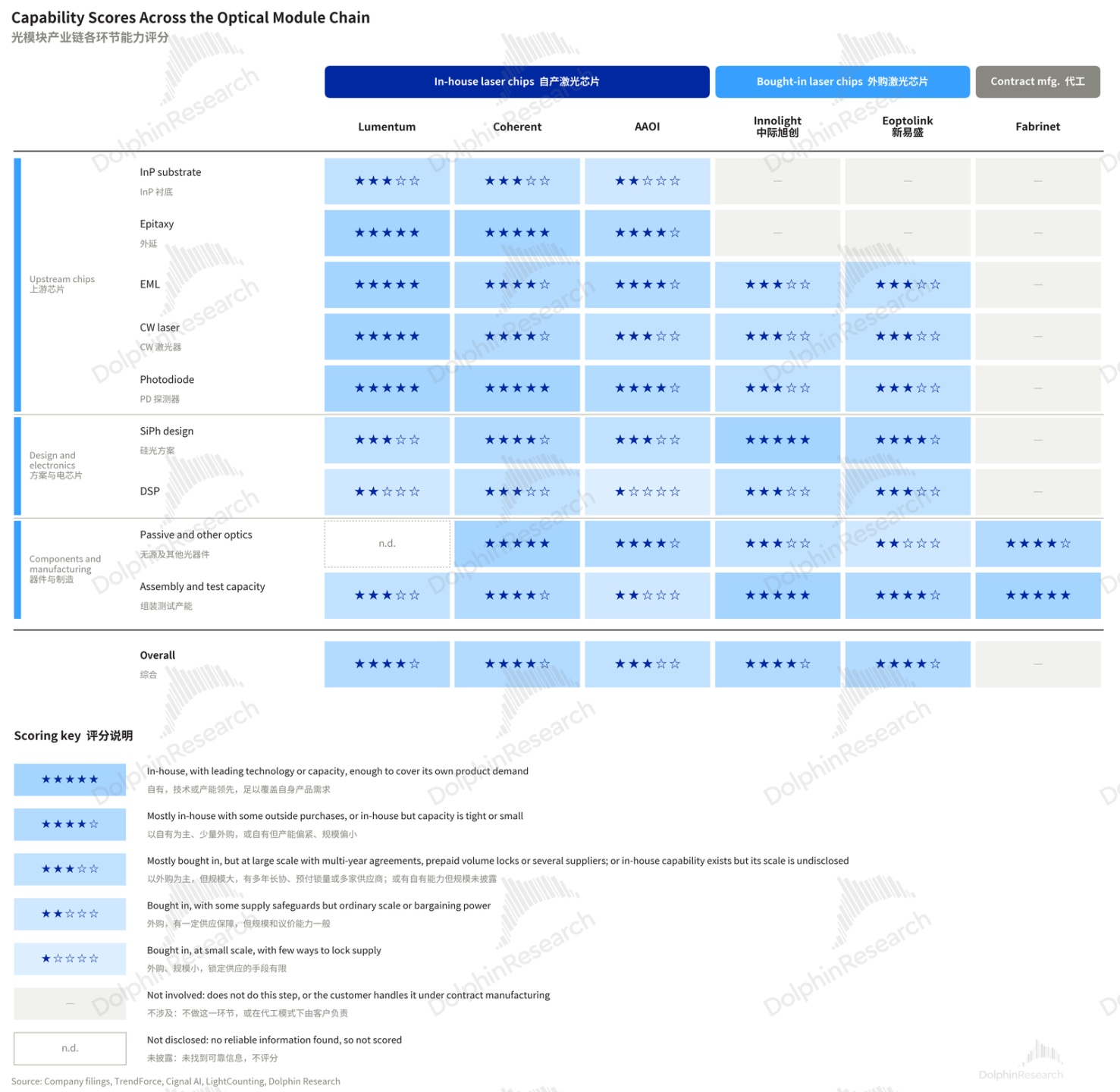
Vendors with stronger supply-chain management and internal capacity are better hedged. We rate several module makers’ supply-chain capabilities below. In tight cycles, vendors with assured delivery gain share and pricing power, a key source of leaders’ higher margins.
3) Downstream: engage early and scale up
Buyers are concentrated among tech giants such as NVIDIA, Google and Amazon.
Customers’ core need is broad SKU coverage. As shown, choices and timing differ across rates (800G/1.6T/3.2T), form factors (pluggable/LPO/NPO/CPO), and network designs. Combined with reaches (DR/FR) and light-source routes (EML/SiPh), SKU counts are large.
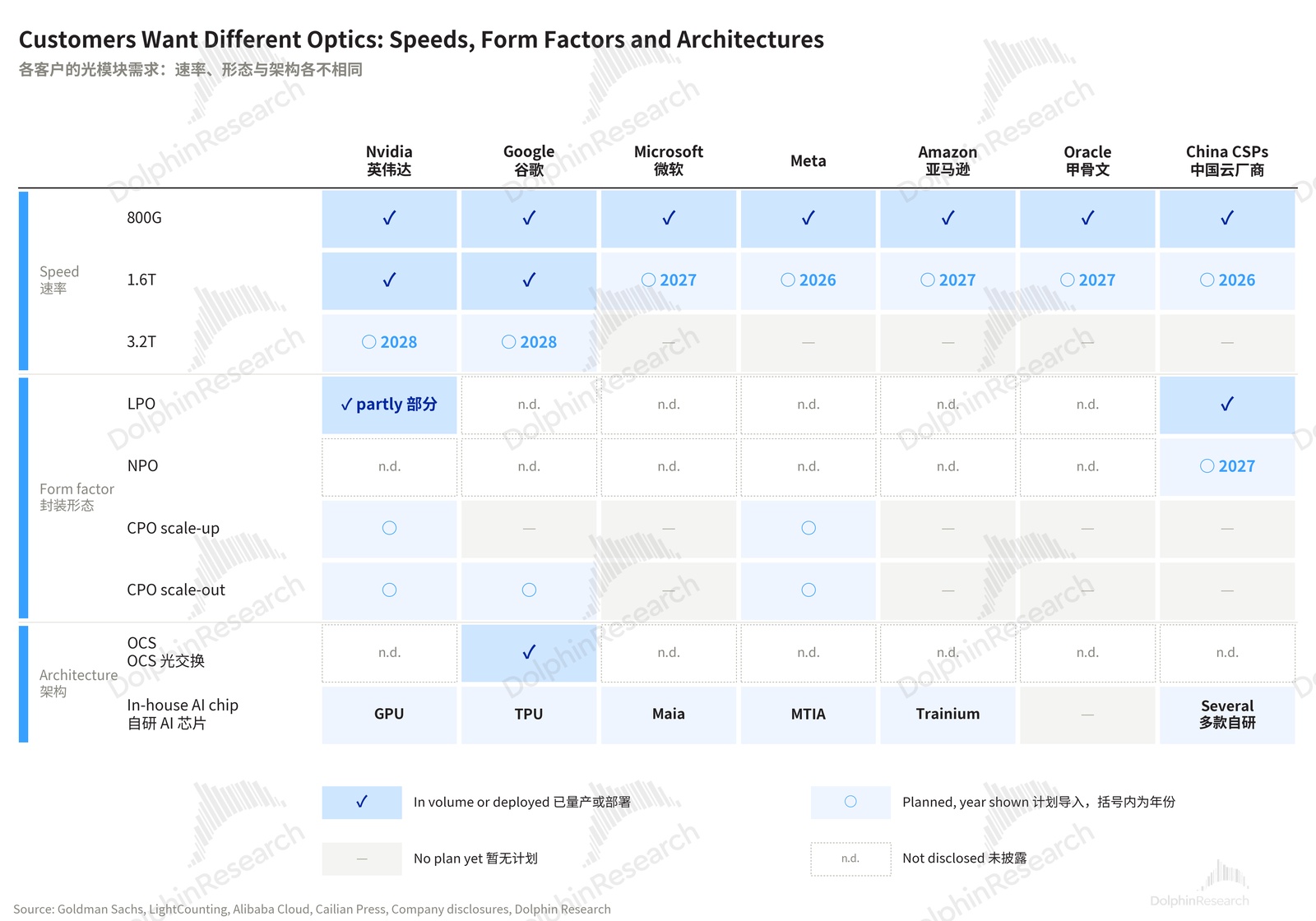
How are so many SKUs delivered? In short, customers pick not just a supplier but a partner that co-defines specs and ships volume on time.
We believe this is the second driver of higher margins for leaders (Innolight, Eoptolink) versus pure EMS assembly.
a) How do leading module vendors work with end customers?
The core difference vs. EMS (see flow below) is that module leaders engage at product introduction to co-develop next-gen or even next-next-gen products with customers.
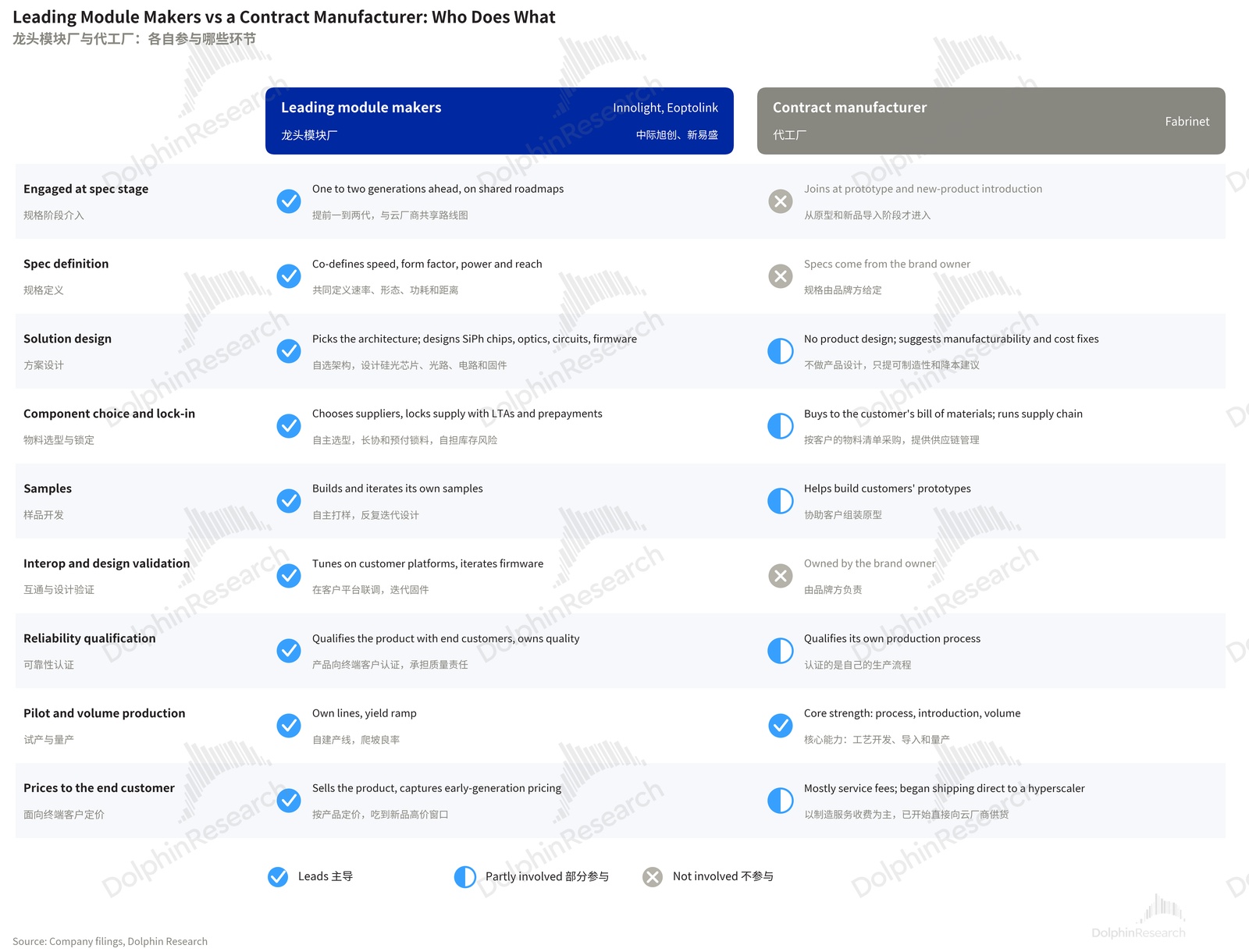
This brings key advantages: they can internalize cost-down via route shifts (e.g., SiPh vs. EML), sell directly at higher early-cycle prices, and lock in customers through long-term collaboration.
Per Innolight, orders cover all of 2026, some extend into 2027, and certain key customers have already indicated 2028 product plans. EMS only earns a manufacturing fee and does not bear design, inventory or price risk.
We think those who first co-define next-gen specs and pass customer quals earn a premium, widening the gap versus pure EMS.
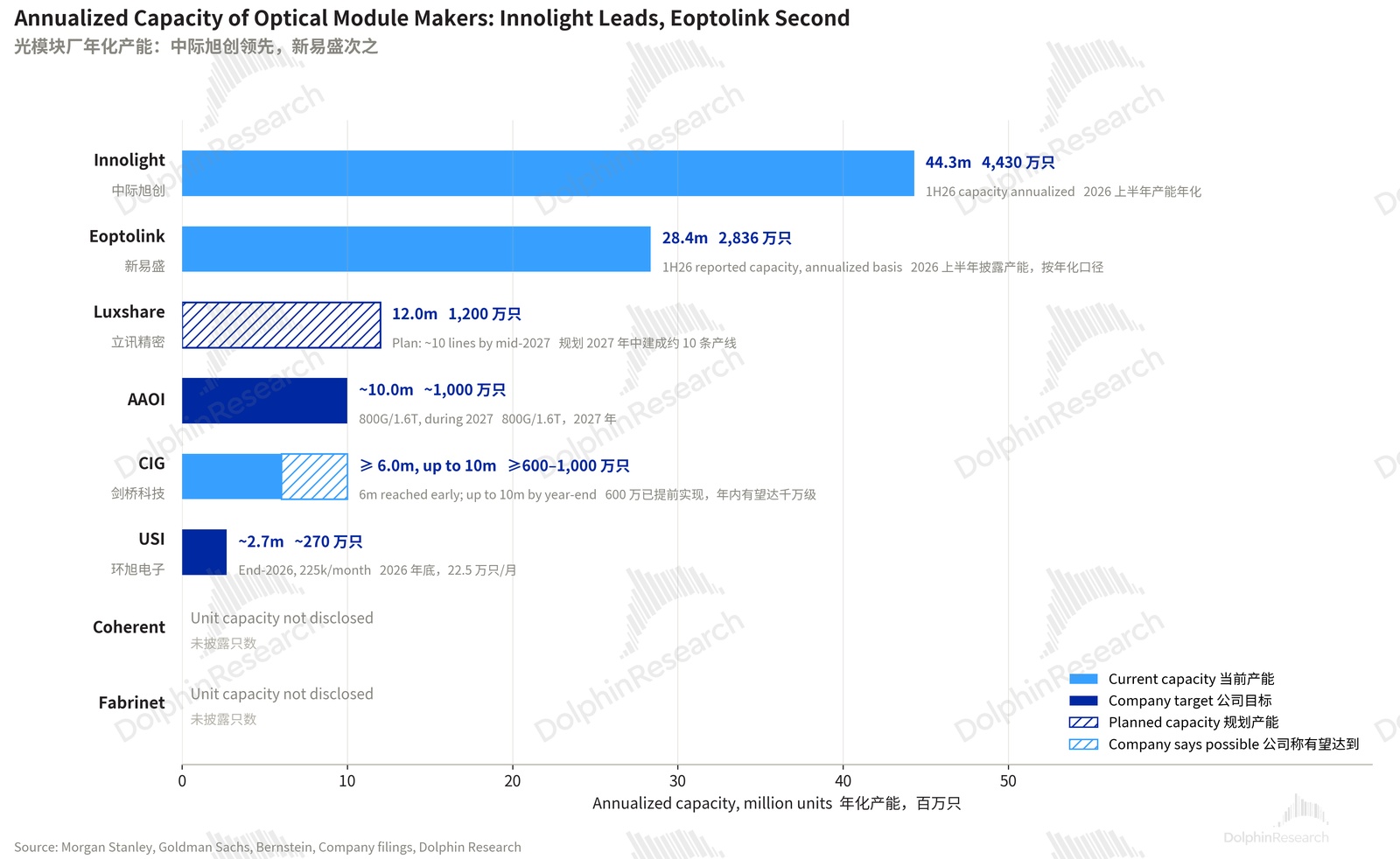
b) Large-scale capacity ensures delivery certainty
Many SKUs plus large volumes favor those with scale. On an annualized basis, Innolight has ~44.3mn units of capacity, and Eoptolink disclosed 28.36mn in its interim report.
Others with public data are mostly ~10mn or below. Scale advantages for leaders are clear.
4) Takeaways: high margins for chips/modules may not be durable; the industry likely trends to vertical integration
Laser-chip vendors sit closest to constrained upstream, and EML has high process barriers via second epitaxy, yielding very high margins. Module vendors’ higher margins do not come from ‘assembly’ itself but from leverage up- and downstream.
Upstream, leaders prepay and lock in constrained laser chips and DSPs to ensure delivery in tight markets. Downstream, they co-define specs one to two generations early and use large capacity to catch multi-SKU, high-volume orders, earning a premium.
In our view, near term, supply tightness underpins margin expansion for both groups, but fast route shifts inject uncertainty, so durability is in question.
Laser-chip vendors: Technically, 1.6T is shifting to CW+SiPh, lowering source barriers and enabling new domestic entrants. For 3.2T/6.4T, routes remain debated, and it is unclear if EML’s barrier extends.
On supply, leaders are expanding and upstream materials are seeking alternatives. As chip supply loosens, costs fall, and cheaper light sources actually help module vendors.
Module vendors: Longer term, since manufacturing steps are not the bottleneck, the worry is that under CPO, the light engine sits on the switch substrate and module vendors’ value reduces to assembly.
We will analyze how route evolution impacts chip/module value in our next note.
In industries with modest structural barriers, vertical integration tends to dominate. Optical comms shows this clearly:
a) Chip vendors move downstream into modules, e.g., Lumentum buying Cloud Light to add revenue and prepare for NPO/CPO validation downstream.
b) Module vendors move upstream into chips, mostly SiPh, while laser chips are still largely sourced externally, e.g., Innolight’s in-house SiPh and Eoptolink acquiring Alpine.
c) Electro-optical convergence: Marvell acquiring LITE reflects vertical integration in optics and further convergence of electrical and optical.
4) What alpha does Coherent have in modules?
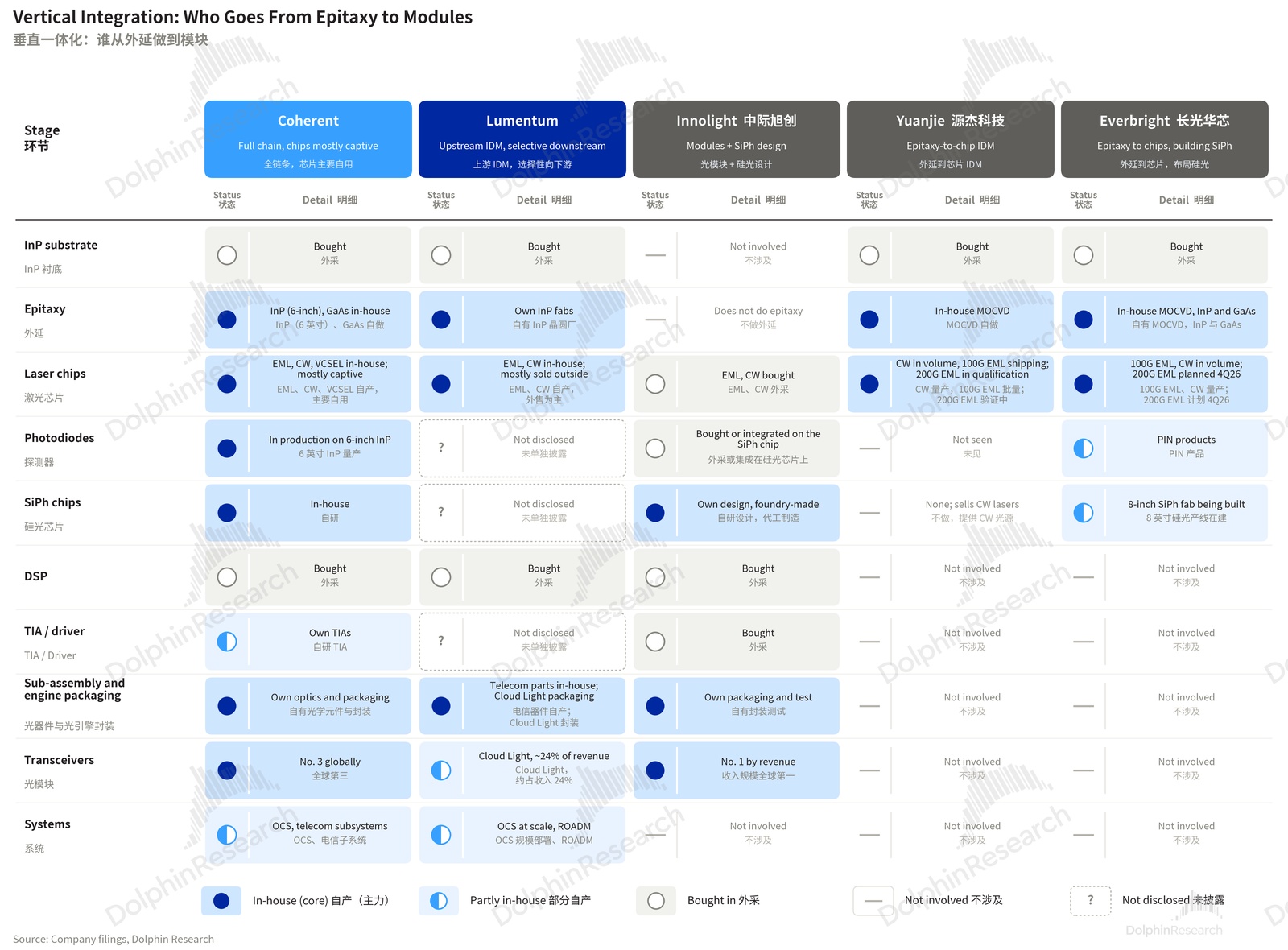
The chart shows Coherent currently has the deepest vertical stack, spanning epitaxy, chips, components, modules and systems. This extends its materials-first strategy by integrating downstream earlier and more fully.
Lumentum is also entering modules from upstream with deep integration. Chinese peers show clearer up/down specialization and are less integrated overall.
With limited intrinsic route barriers in modules, vertical integration helps scale first, fill technical and hardware gaps, and lower the risk of being bottlenecked or marginalized at any single link.
Longer term, as supply-demand gaps normalize, deeper integration provides operating leverage to drive cost-down.
1. Technology: multi-route coverage with deep reserves
Lasers carry real barriers, making top-down integration smoother: epitaxy (especially second epitaxy for EML) and laser-chip processes are the hardest capabilities to build, requiring years of know-how, yield ramps and customer quals.
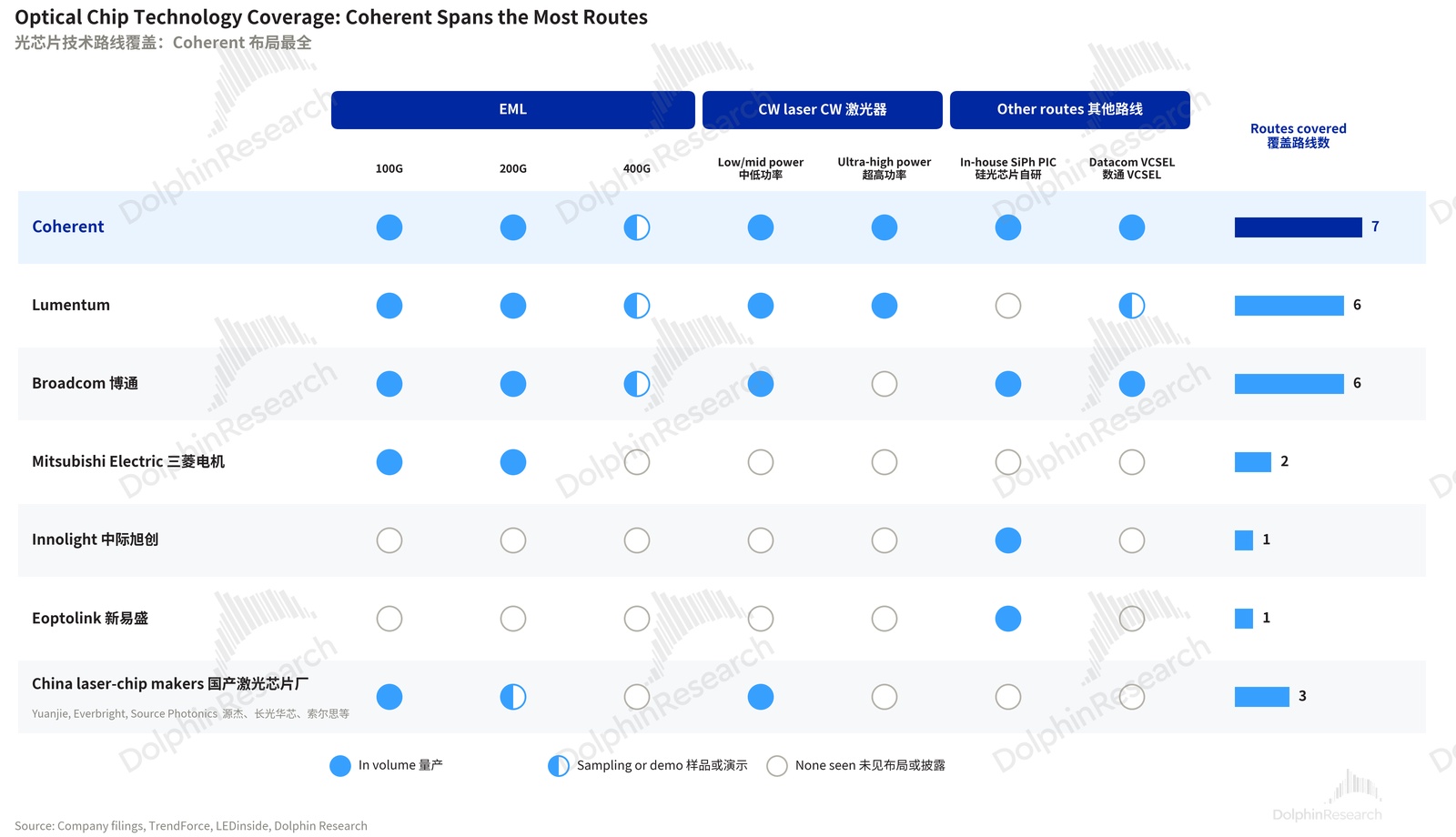
Coherent has second-epitaxy capability, has invested in in-house laser chips for years, and covers nearly all mainstream routes with strong reserves:
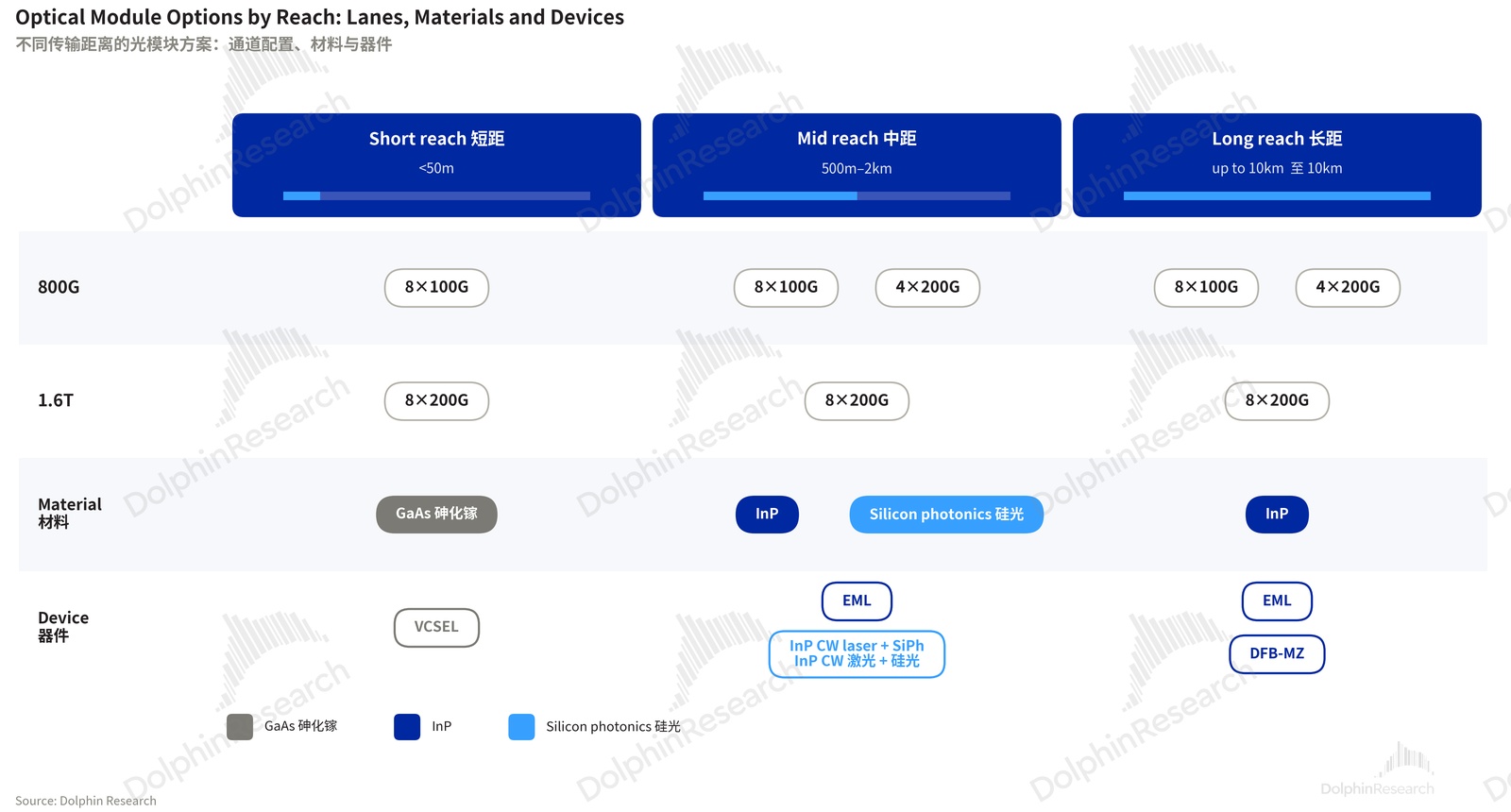
EML: As we noted in LITE coverage, EML is more challenging, and domestic vendors are constrained by second epitaxy. While 100G EML has broken through, 200G EML self-sufficiency remains below 5%.
Coherent launched 200G EML back in Sep 2022, and 400G EML is also in the pipeline.
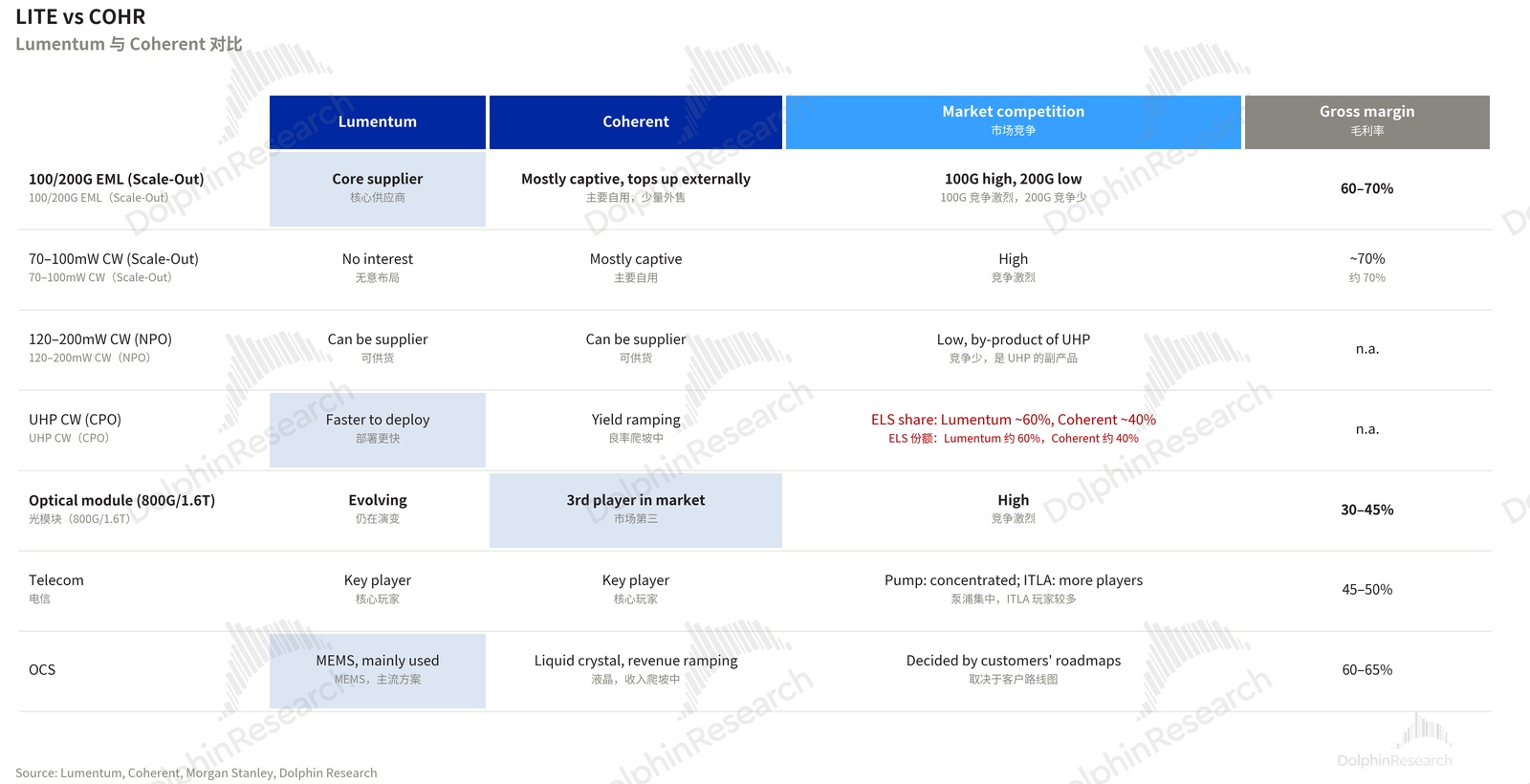
CW: In ultra-high-power CW (UHP CW) for ELS in CPO, the market is effectively a duopoly of LITE (~60%) and Coherent (~40%).
At OFC 2026, Coherent showcased a 400mW CW laser for both CPO and SiPh pluggables. Even if CPO reduces module vendors’ value, Coherent, as one of two major external light-source suppliers, remains a key beneficiary, its core differentiation vs. pure module vendors.
Other routes: The company also pursues SiPh ICs and 200G GaAs VCSELs in parallel. Management guides that 1.6T initial ramps will be led by EML and SiPh, with the VCSEL version ramping in 2H26.
That said, in today’s tight market, supply trumps route. If lane-rate targets are met, downstream largely takes whatever ships; the value of tech reserves shows more in next-gen competition.
We view tech leadership as a calling card to end customers. AIDC’s need for higher interconnect speeds is certain; only the route is uncertain.
Thus, when 3.2T/6.4T/12.8T modules scale, vendors with leadership across multiple routes are more likely to qualify first, ship volume, and earn tech-driven premiums.
In sum, strong tech reserves mean COHR is unlikely to be stranded by route shifts.
2. Supply: first to move InP wafers to 6-inch during tightness
Coherent’s key move in the tight phase is upgrading InP wafers from 3-inch to 6-inch ahead of peers.
Starting Aug 2025, its Sherman, TX and Järfälla, Sweden 6-inch InP lines entered production (the world’s first 6-inch InP wafer platform). They are producing EMLs, CW lasers and PDs, with yields consistently above the legacy 3-inch lines.
The 6-inch platform’s core benefit is cost: die output per wafer is ~4× a 3-inch, pushing unit cost to below half.
On capacity, while the company has not disclosed laser-chip units, it did share InP capacity expansion: FY24–FY25 tripled vs. the base, with another planned doubling by end-2026 achieved one quarter early, and a further >2× by end-2027.
We believe as Sherman’s mega fab ramps 6-inch InP, COHR’s internal supply will expand further, easing its own upstream constraints.
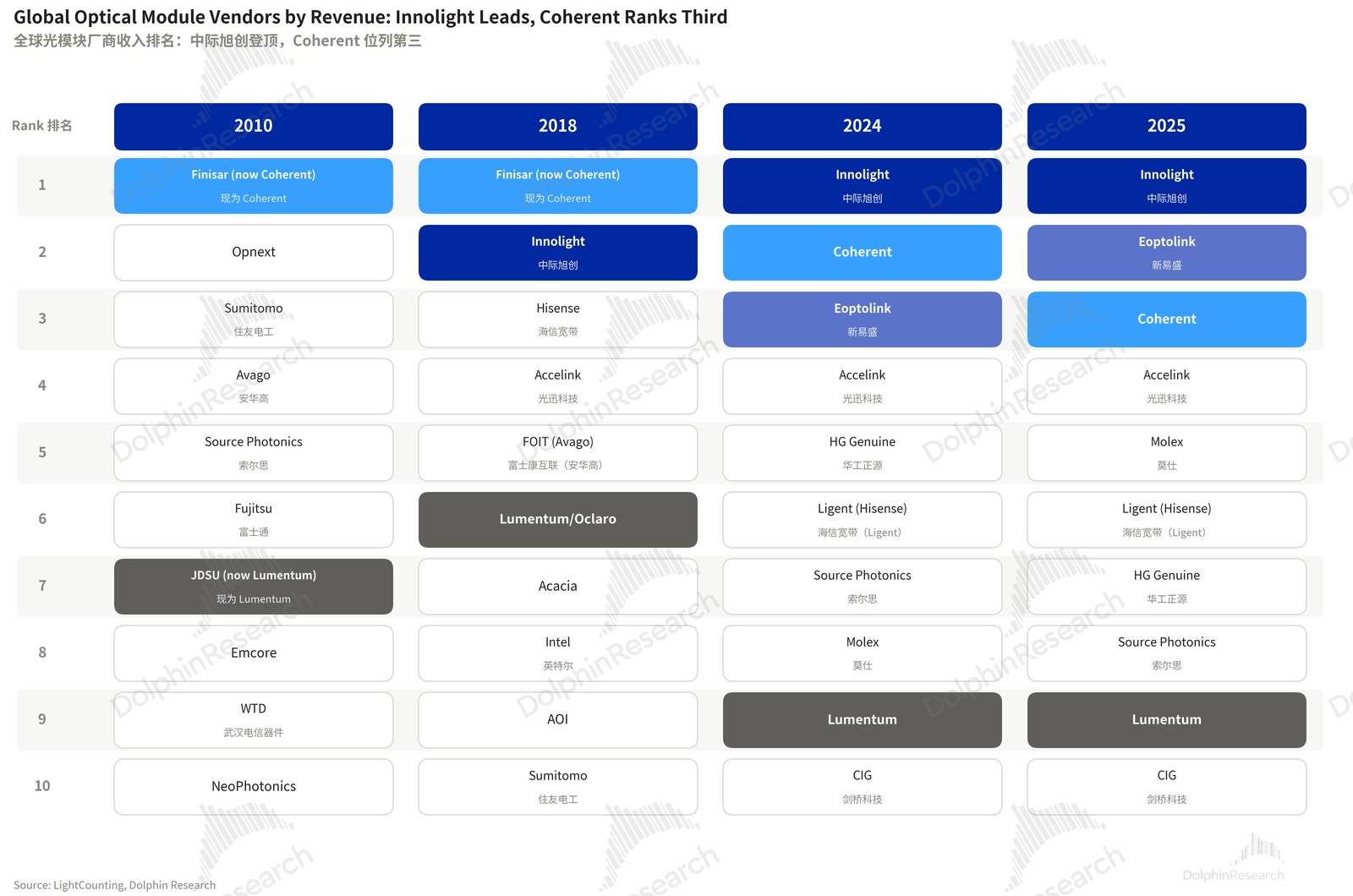
As a result, Coherent’s module revenue ranks top three globally, as shown below.
3. Downstream: customers lock capacity via equity
COHR enjoys deep customer tie-ins. Most notably, NVIDIA invested $2bn in Mar 2026, alongside multi-billion purchase commitments and future capacity rights.
Long-term contracts run through the decade, and FY2027 is largely booked.
4. Despite vertical integration, why is GPM still lagging?
Despite advantages in integration, tech and supply, these do not yet show in reported margins. Innolight and Eoptolink, which source laser chips externally, currently report higher GPM than Coherent.
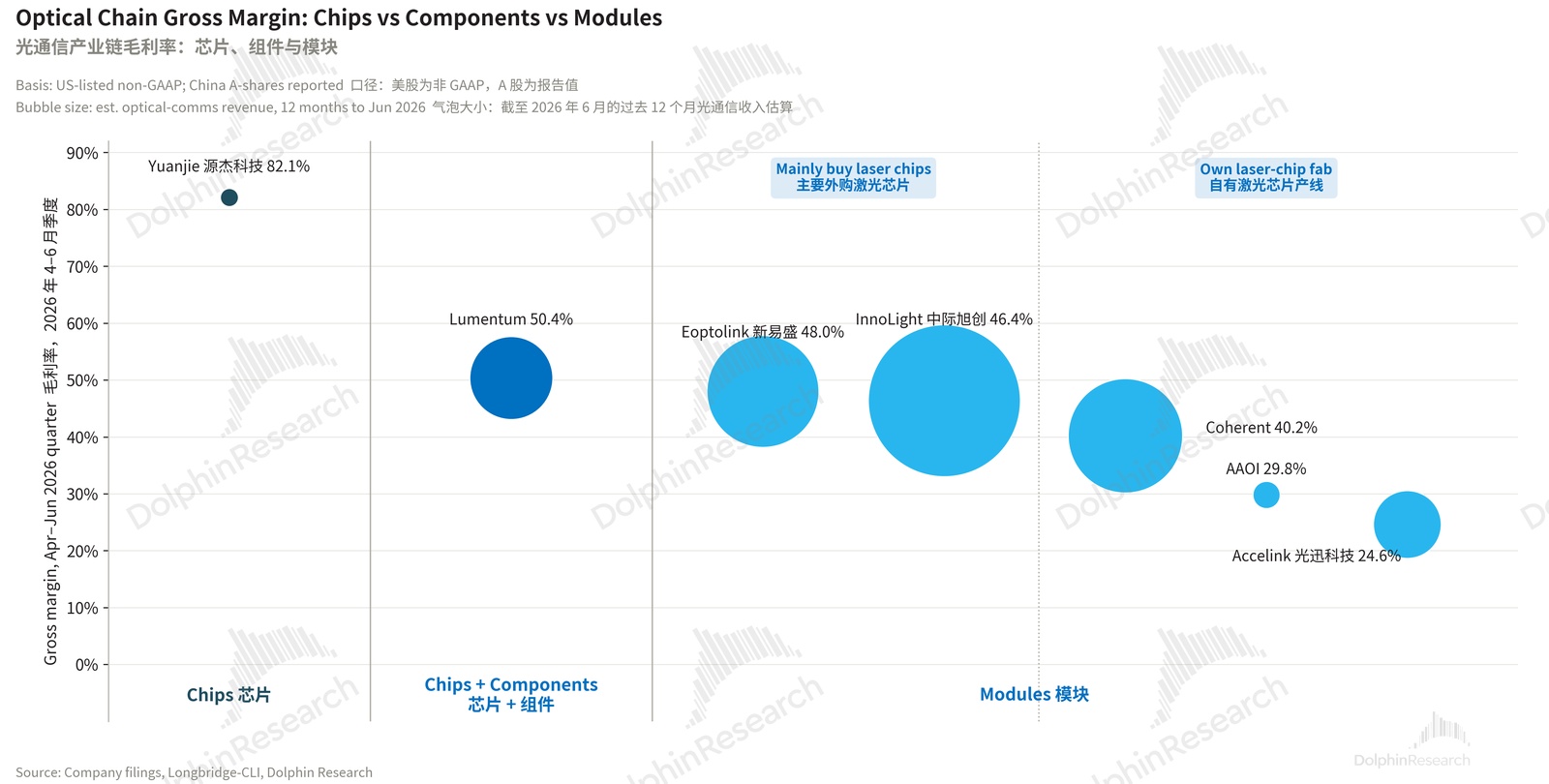
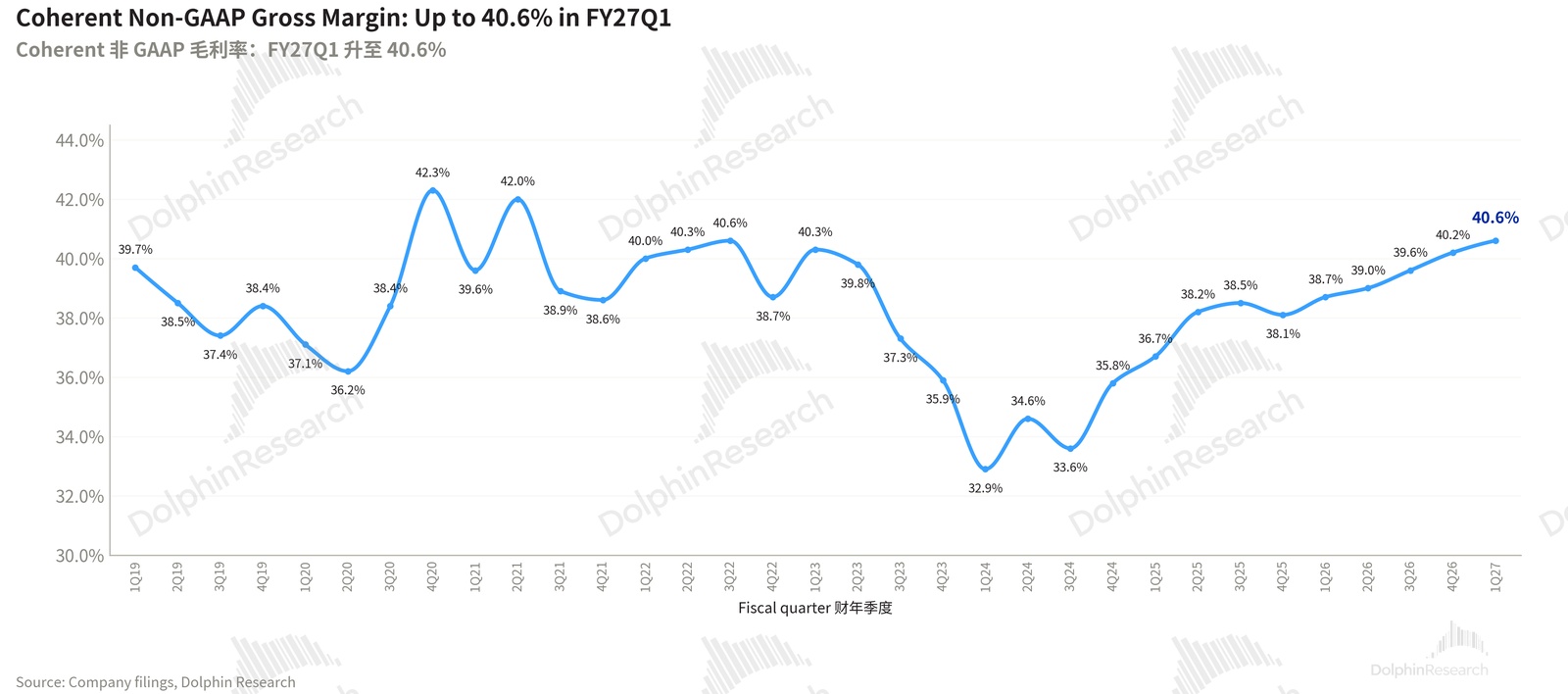
Since industrial carries higher GPM than the corporate average, Coherent’s Data Center & Comms GPM sits below the consolidated figure, widening the true gap vs. the two Chinese leaders.
Based on management commentary, we infer three main reasons: module yields and product costs still have room to improve; pricing optimization started late and only recently showed up as supply tightened, with full impact not yet in GPM; and legacy sites/low-margin lines from past M&A are still being rationalized, with 30+ sites sold or closed over six quarters.
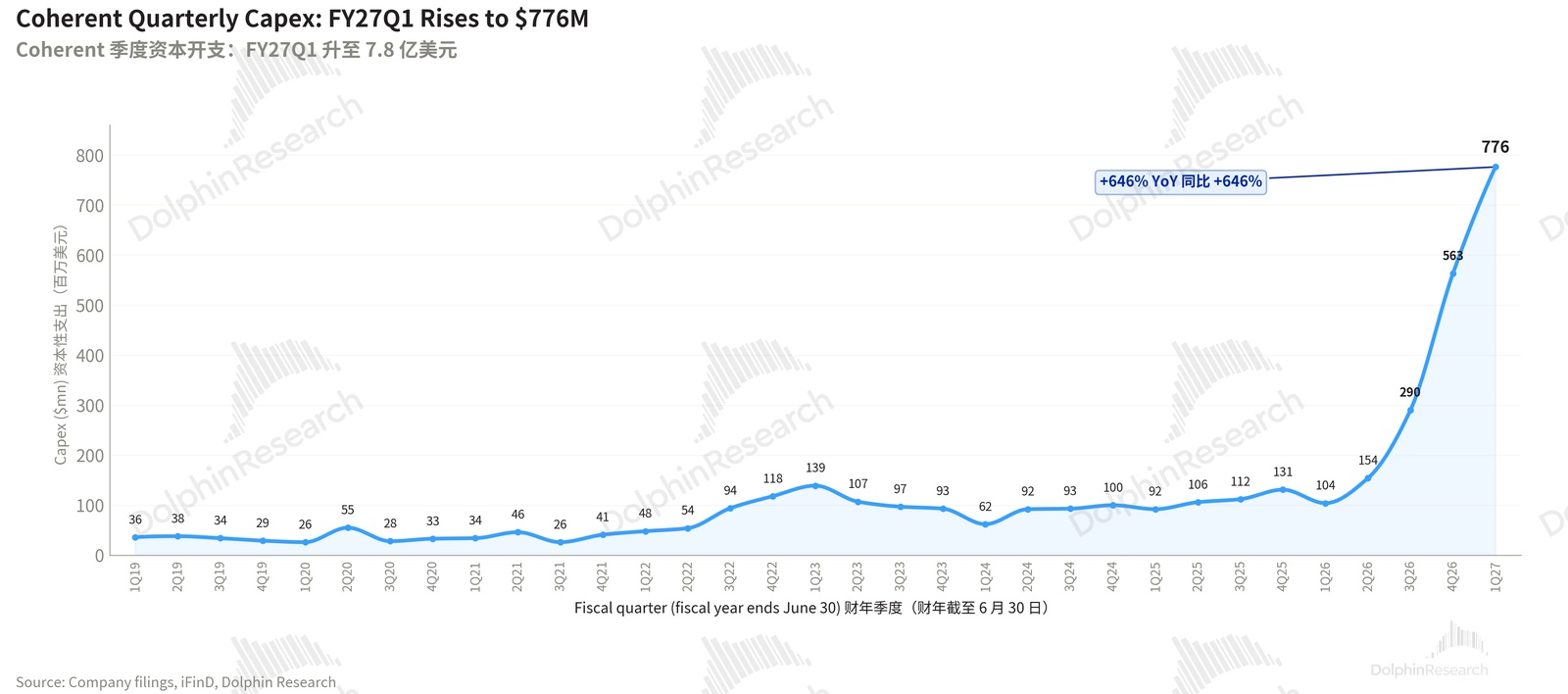
As industrial mix declines, consolidated GPM will converge toward comms’ underlying margin. We will track the 6-inch ramp’s contribution to comms GPM and capex cadence, as depreciation precedes revenue and weighs on margins during ramps.
Longer term, whether COHR can reach its 42%+ GPM target depends on translating vertical integration into structural cost advantages in comms.
In our next note, we will examine how route evolution impacts chip and module vendor value, and assess Coherent’s NPO/CPO outlook. Stay tuned.
Risk disclosure and statements: Dolphin Research Disclaimer and General Disclosure
Recommended Articles










Comments (0)
Click the $ button, enter the symbol, and select to link a stock, ETF, or other ticker.